
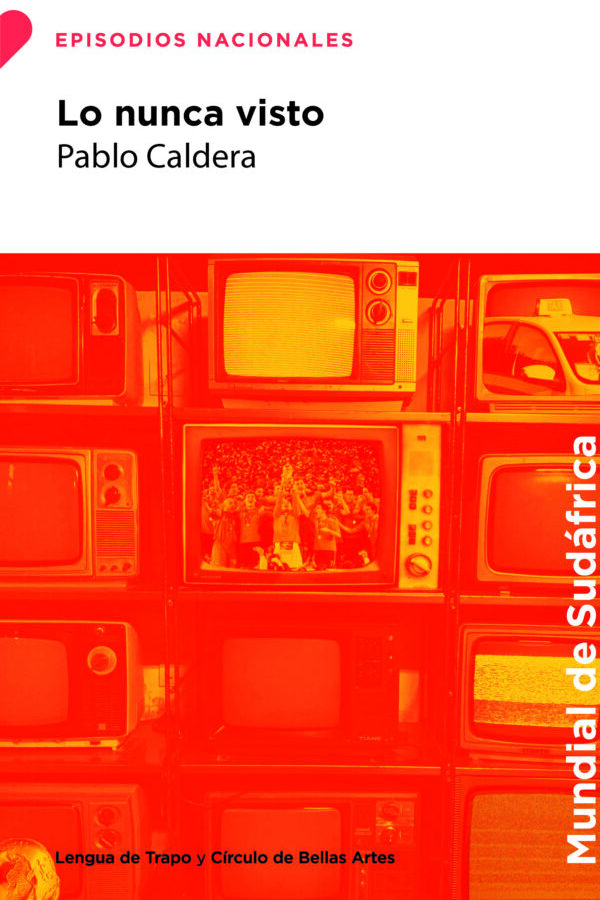
Not long ago the publisher Lengua de Trapo launched an appealing project that has continued in collaboration with the Madrid-based Círculo de Bellas Artes. The generic title of the collection, National Episodes, alludes to its stated aims: to carry forward in our days the Galdosian saga with the intention of presenting a “choral and plural portrait of what has happened to us in these last forty years.” They are tasked with fulfilling this undertaking, which has already reached about thirty titles, authors of very diverse styles and with different previous trajectories; in the case I am dealing with today, it represents a narrative debut, that of Pablo Caldera (1997) Lo nunca visto.
Dentro del espíritu de la colección, el joven ensayo
Within the spirit of the collection, the young Madrid-based essayist Pablo Caldera applies himself to observing the state of our country after the traumatic financial crisis of 2008 in two sporting events in which the Spanish national team triumphed: the 2010 FIFA World Cup and the 2012 European Championship. These resonance-heavy events function as pivots of the narrative structure. The first provides an anecdotal line. Two young brothers, Adrián and Beto, seize upon the national football frenzy to rob a villa and flee with the loot before the match ends. To do this they steal from their mother, Julia, the taxi with which she earns a living. The plan goes wrong for this pair of rather dim-witted youths and, following their failure, they vanish.
The other event, the European Championship, provides the linkage for the second axis of the novel, a series of scattered episodes that initially appear independent of the previous motive. In them we see Julia mentally scrutinizing her usual passengers with a diagnostic eye on social classes and the behaviors of certain human groups. We also observe her in curious circumstances: in one, she traverses the Retiro park with a gaze that is partly sentimental and partly sociological; in another, she indulges in the secret pleasure of being the taxi’s client herself, engaging in a refined dialogue with the driver that, among other effects, eases the great burden of loneliness that weighs on her since the disappearance of her children, from whom she seems to have completely detached herself.
These episodes adhere to a realist code, but another one of them shatters the provincial notes. A mysterious gentleman named Brando contacts Julia and tells her that he can inform her about how to locate her children. Brando makes a living in a peculiar way: he performs video-portraits, that is, he describes the content of images and “translates them into text.” In one of his tapes he keeps the bungled robbery of the children and intends to show it to the mother. Thus begins a friendly engagement between Julia and Brando, free of erotic lures, which gives rise to unusual situations: for instance, a visit to the palatial residence of a Brando friend where an unusual rite is celebrated, to celebrate a second New Year’s Eve at the end of July. The festive atmosphere becomes gilded with visionary types and gestures, and later Brando immerses Julia in a cybernetic experience in which she loses control of her rational faculties, slipping into a hallucinatory journey through time, and in that trance she is reunited with her children.
The confluence of realism, invention and visionary fantasy constitutes the authorial approach of Pablo Caldera in his pursuit of a creative document that illustrates a collective situation. Instead of adhering to a social testimony, he unleashes the arts of invention. Truth and fable coexist in the novel. In this way, he navigates around conventional realism and represents the world in a broader dimension. Against traditional verismo, he opts for an aesthetics loaded with expressiveness. To this end, he enjoys creating characters that are somewhat eccentric or enigmatic, without applying psychologizing criteria. He also favors situations that sometimes resemble a farce and at other times owe debt to an expressionist aesthetics.
These approaches, signaling a writing guided by a creative spirit, are accompanied by a variety of formal resources. Descriptive passages in the traditional manner are alternated with others that are entirely dialogued and somewhat theatrical, based on very short, brisk sentences. Moreover, Caldera infuses the novel with an experimental itch. The brief second chapter, which contains a report of anonymous authorship (it is later revealed to be Brando’s), resorts to crossing out words in the text as if it were a draft (“The subject of greater stature advances first. We cannot provide operational information about these images”).
Pablo Caldera has wanted to recreate with Lo único visto a state of collective mood during significant dates in our country’s recent past. The somewhat farcical plot of the novel serves to reflect a period of social disorientation, a time of material hardship and of discouragement and lack of expectations. Yet he has not fallen into the rut of critical testimony and has chosen to present that disheartening reality through a parable as sad as it is humorous. The author’s willingness to avoid worn literary paths invites us to trust that this peculiar fable will be the first milestone in the intriguing career of a writer who is not yet thirty years old.
———————
Author: Pablo Caldera. Title: Lo nunca visto. Publisher: Lengua de Trapo and Circulo de Bellas Artes. Sales: Todostuslibros.