
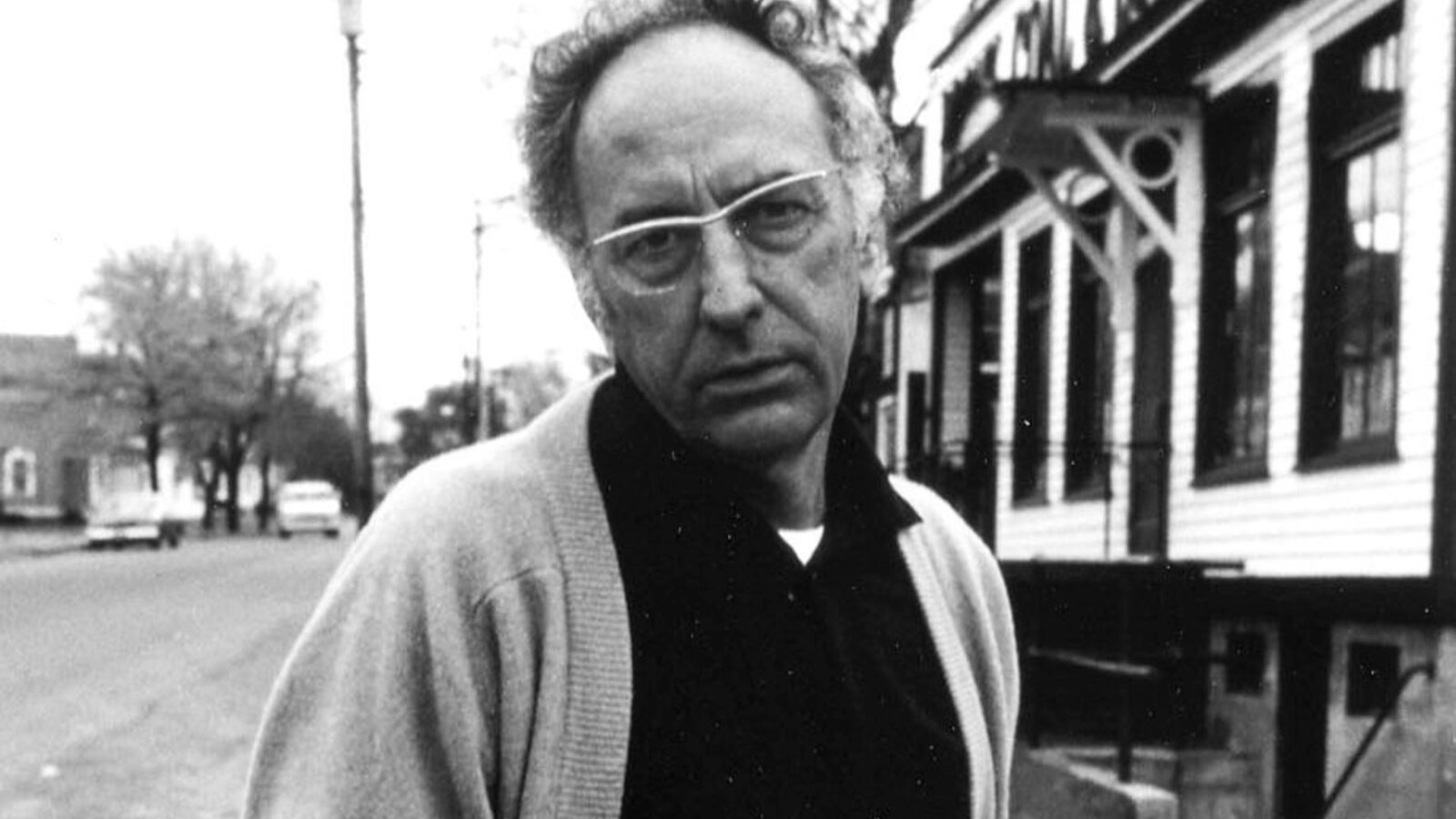
William Bronk was a poet born in Fort Edward, New York, in 1918. He studied at Harvard University and served in World War II. In many of his poems he questions human knowledge and its limits, while also playing with the distance established by humans toward the natural world, of which, it would seem to Bronk, he no longer forms part. All this written in a language, structure and style that appear simple. He also wrote Vectors and Smoothable Curves (1983), a book that gathers essays written over forty years. In 1982 he won the American Book Award for his book Life Supports. Other of his titles include Light and Dark (1956), That Beauty Still (1978), Death is the Place (1989), Some Words (1992), and The Mild Day (1993), from which the poems translated here have been taken. He died in 1999. We present a selection of poems with translations by Ramón Hondal, Silvia Camerotto and Ubaldo León Barreto.
*****
Little Walk
I wake at night, I walk in the house’s darkness.
Bare feet are quiet. The rooms remain unmoved.
What have the days and nights of others been like?
I think, now, that it is no more than this.
***
Safari
It is like moving to live in Africa
with animals around us, animals
independent of us and not us the life
of the place as in this universe,
even on earth, the forces are
that we do not see the way the animals
could be seen but they are around and are
independent of us who are not the life of the place.
Astonished, we defend our foreign terrain. We observe.
***
Alone
Alone, as it seems we are often,
we can determine parts of our lives and the lives
of those around us. More than that, we say
how the world may be, how it arose
and why. We utter the truth. So great we are.
Something that does not intend to contradict us,
something that does not even need to know that we are there,
in following its own procedures, it sweeps
everything away: whatever we have done or said.
It sweeps us away. We stand at the edge of the point.
No matter. Closed to the side. The seriousness
of desire is a voice that sings to us and,
in its song, shames any claim.
***
Good Story
Stories are not merely to help us sleep
but, more, to wake us easily:
stories of gods,
stories of science,
all because
it is not known.
***
Discretionary
What you looked at then and now may be
the same even if what you see is not. Asleep,
we can recognize people we know
and places from moments when we are awake. It is a different view.
We did not know it. It is not that we were wrong
in either case. It is that on other occasions
asleep, awake, we never see what is.
***
The Way It Works
The material world is a form — moreover
difficult, even impossible —
to speak of something that may be.
The material world makes it more real to us,
it is an emblem, a kind of metaphor, we can
put our hands on it and manipulate it.
We have the Big Bang to achieve it,
but everything is there before that.
It has to be. And aren’t we ourselves there too?
***
Bare Tables in the World
No more than we is the rest of the life
of the natural world. We love it as if we were it.
The deep earth and the sky even deeper
are backdrops that aren’t used on the stage of life.
The actors are not seen or heard.
Sitting as witnesses to the power of life. We attend.
***
The Smile on the Face of a Kouros
This boy, of course, was dead, and what that
signifies. And nobly dead. We should believe
that he died nobly. Perhaps he fell in battle,
and this carved stone recalls him
not as he perhaps was, but delineating perhaps
the naked virtue with which the stone clothes him.
A forward foot, the eyes alert, the arms
to the sides, the hands beneath the slender waist
hanging at the sides, with serene fullness, beside the solid flanks.
The boy was dead, and in his death the stone smiles
illuminating the lips satisfied with the pleasure of something achieved:
an ending. To reach an end. To reach death
as an end. And upon arriving, to carry there intact, the whole weight
of his strength and his virtue, the reward with which
his empty hands are filled. None of that lost,
safe at home, and the smile attained at the end.
Now death, of which still— or never — nothing is known,
leaves us alone to think of it as we will,
and accepts our choice, which shapes life toward death.
Do we desire an ending? That is what it gives us; and it takes what we give
and keeps it; and the end, in this way, has in life itself,
a kind of treasure-house with a beautiful form
reached and abandoned with death,
where it will remain, eternally beautiful and intact, as if
to desire excessively the perfect form, intact,
were the same as desiring death, as if choosing the other option
for death. There are other ways; we know how to choose
another option for death: reports or broken, not entirely full, perplexed,
we live in a formless world. Eternal, we expect no end.
I tell you death, do not expect a smile of pride
from me. I bring nothing for you in my empty hands.
***
Not My Solitude, But Ours
Most men are too much like me,
my external features perishable, like waste, hair, skin,
discarded clothing, useless to me and dead.
From unity, what should we say that we have not said
together before? Nothing to tell them,
nothing to tell. What they are to me, I must appear to them as. The human solitude
is the infinite unity of man. Man is one;
he stands alone in his world. We are that one,
even us, who now whisper together,
intimately, as if we were two, as children do,
knowing as much as we do and making ourselves believe,
as we believe, that there is another there.
***
In the Height of Summer
A world of green, a scene of deep green
With blue lights, the green deepened by the blue.
One thinks how in certain paintings the envied landscapes
Can be contemplated (perhaps through a window) far beyond
The serene face of the model, beyond its serene pose, as though
In some impossible mirror, set upside down, human serenity
Beholds a green world that watches its own face.
And now, look: here is that place, those greens
Are here, deepened by the blue. The air
We breathe is sweet, fresh, warm, imbued with the scent of berries.
We are here, we are here: the earth is more beautiful than any change.
***
Metonymy as an Approach to the Real World
Whether what we perceive of this world
Is the essence of this world alone or that of
Any of many possible worlds—what essence is that, after all?—
Something of what we feel could be true; it could be the world,
What is, what we feel.
As for the rest, a truce is possible, the travelers’ tolerance, devouring foreign food, attempting to pronounce words that tangle the tongue, feeling that time and place,
Not thinking that this is the real world.
Okay: all the clocks show local time;
Okay: “here” is any place we reach and in which
We occupy a space.
Okay: we construct a world:
Is there anything grasped there, contained there,
Something real, something we can feel?
Once, in a blocked and crowded city,
I saw light spill over the abyss of a street,
Tangible and blue, as if it had come from, say,
The sea, the purity of space.