
There is a poetry that is created with the eyes and another that is built with the hands.
The first one takes flight, speculates, turns, and brings back the precise contour, the drawn outline of things. It lives on rooftops and terraces and, in the best cases, nourishes the reader’s imagination with symbols.
The other is the result of the patient work that the poet carries out on his own heart and concerns. Because vision is not the same as observation. He who sees, believes he has seen or thinks he has seen, does not need anything else. When full, he often collapses onto the irregular furrows of life. By contrast, the one who observes questions, places the gaze upon things with humility and contemplation, practices attentive listening, that art increasingly difficult to find and that often ends in fertile learning, in a fruitful dialogue with everything that surrounds us.
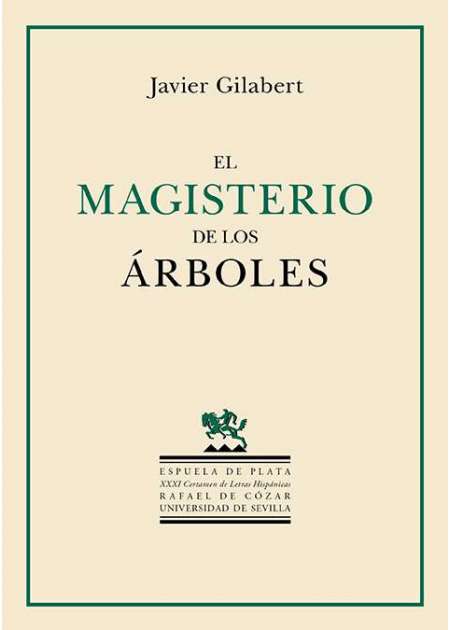
The poetics that Javier Gilabert (Granada, 1973) presents to us in The Mastery of the Trees (recent winner of the XXXI Rafael de Cózar Latin Letters Prize), and being more precise, the one he has been practicing since his first book, On the Shelves (2019), obeys the double vocation that threads his daily work and nourishes both shores of his biography: on the one hand, the practice as a preschool teacher in a Granada educational center, and on the other, the observer of the deep heartbeat of the world, resolved in an interrogative poetry, stripped of rhetoric, of existential cut and steeped in that convinced and despairing humanism that Ángel González spoke of.
According to what has been said so far, added to the poet’s fondness for horticulture, which he pursues when the other two vocations allow it, one can more easily understand the reason for this tremulous, beautiful, ethereal book whose title, by virtue of the open dialogue with things we mentioned at the outset, and because of the genitive it contains, can be interpreted as either lessons taught about or lessons administered to trees. Lessons to and from. Humility, recognition, learning.
The first part pays homage to the father figure and to the astonishment that, despite the passage of time, invades the poet as he contemplates the immense void left at the center of his emotional ecosystem by his disappearance. Resolved in absence, the painful feeling becomes a trembling memory: «There are trees that grow with us. / In memory their presence takes root / and they accompany us forever. // Who has never climbed / in search of a nest, nor turned the leaves / that blanket autumn into their toys? // Childhood is like a forest / that becomes depopulated with time».
The poet’s eyes turn, trying to anchor in the childlike detail a harbor, shelter, and consolation before the door shut and bolted, but he cannot find it: «It may seem easier / to always look under the shelter of doubt, / in case the truth were / at once the lighthouse and the shipwreck».
Perhaps then the old faithful hound, habit, can offer companionship: «Death hurts less / if it reaches habit, / if it twists time on its hinge doors / that let glimpses of a light be seen from both sides / that does not extinguish».
But the poet, after this orphanhood, this foggy void, this flesh in questioning turned to the clouds in the words of Cernuda, opens in the book’s second part to the luminous task of love and work, two categories that shape us and, despite everything, cast some meaning on the patient craft of living.
We earlier mentioned Gilabert’s role as a teacher of lives in that tender phase that welcomes the firm and wise hand of a mentor for optimal growth. A craft, by the way, that he inherited from his father, which adds semantic density to the whole of the book.
The poems that comprise this second part speak of trees and of the transmission of a legacy to coming generations (two poems dedicated to his children) and of the noble craft of educating, pruning, knowing how to listen, and accompanying.
Attention, concentration, care, a hand that wields the tool, an eye that listens to the signals deposited in the leaves and in the trunk. Thus the noble and millennial art of sculpting a bonsai or writing a poem: «To sculpt a bonsai is a mystery / that is always resolved through listening: / the original form of each tree / can only be defined by the tree itself. // Then it is up to the gardener / to seek it with patience, to translate the language / that can only be heard / through silence and scissors».
The immersion in that solitary labor does not prevent the poet from being dazzled by hunches arising from an interior rainfall never entirely eradicated: «Or perhaps we observe the trees / as a child stares at a mirror, / perhaps because of that amber silence of the sap, / or because of their resemblance to death».
Nor, among brief poems and distilled pearls of oriental wisdom, does he ignore the headstrong pupil, reluctant to the horticultural pedagogy of the author: «The pomegranate is wild, almost untamed. / It defies space with a thousand branches / that pierce the air like needles. // It tends to grow at will / and forces me to care for it more than the rest».
Junipers, orange trees, chestnuts, jasmines, ailantos, ficus trees form the peaceful army that accompanies the poet as he continues weaving and unweaving doubts, questions, miracles, and astonishment: «Exactly a year after you left, / today I become a child again / who looks toward the horizon. / Since then, time / seems not to move. / I look at myself and see my son / trying to understand / the why of things. // At least I remain here / and I can tell you / that, despite being his father, / I cannot even discern / the miracle of rain».
The author ends his book by the hearth, bearing witness, in the manner of Quevedo, to the ash that awaits us: «I don’t know, perhaps it is the light, / or the intimate whisper of the embers, / but there is something in the embers that seduces / and fills the observer with the strange sensation of being at peace. // The tree we are now / is nothing more than the ash we will be».
“I see men, but as walking trees,” answers the blind man of Bethsaida, in the Gospel of Mark, after being healed by Jesus.
Perhaps this is also, in the end, the beautiful mastery that Javier Gilabert offers us in this book.
———————
Author: Javier Gilabert. Title: The Mastery of the Trees. Publisher: Espuela de Plata. Sales: Todostuslibros.