
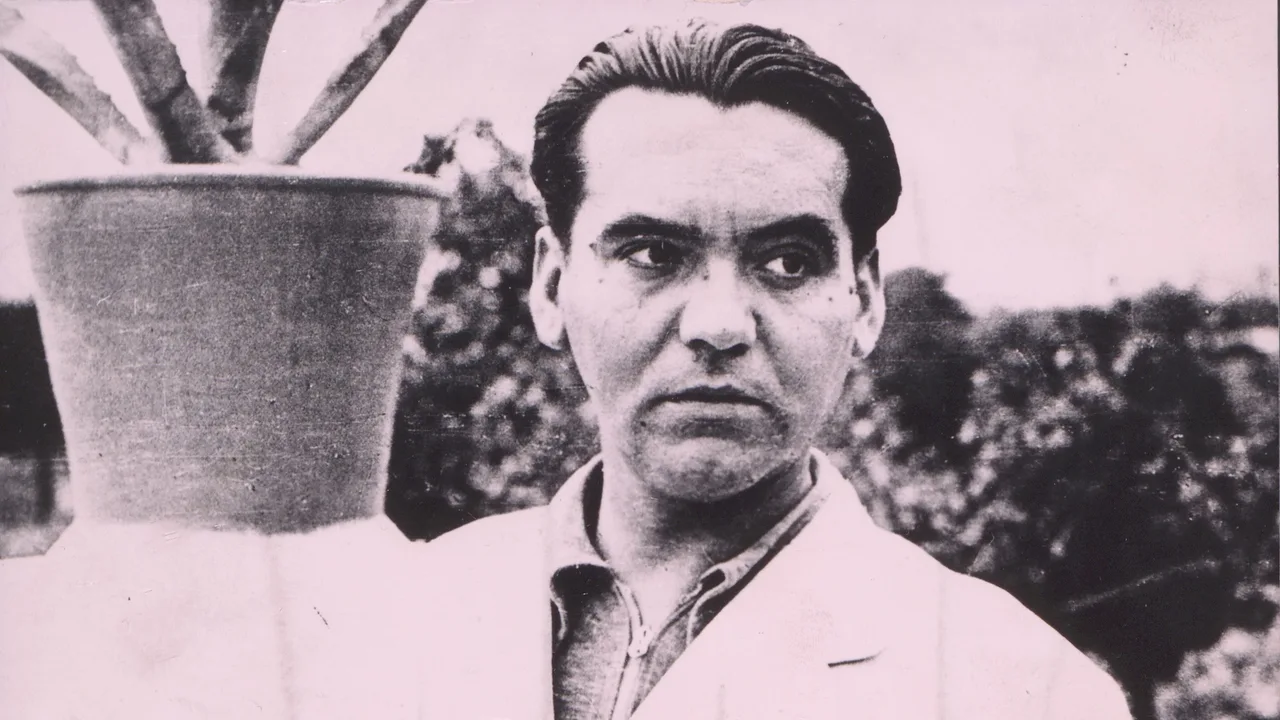
The August 18, 1936 Federico García Lorca was shot. The author of La casa de Bernarda Alba, one of the most universal poets in the Spanish language, was killed by the coup leaders during the early weeks of the Civil War near Víznar, Granada.
Below we reproduce this text about that event included in the book by Miguel Ángel Santamarina, The War That Changed Spain. Ephemerides of the Civil War (Ediciones B).
*****
On August 18, 1936, Federico García Lorca was shot. The author of La casa de Bernarda Alba, one of the most universal poets in the Spanish language, was killed by the rebels during the early weeks of the Civil War near Víznar, Granada. Much of the information about Lorca’s murder remains a mystery, even the day of his death, which most sources place on the 18th, though there are theories pointing to the 19th. What is known for certain is that, up to his execution, Lorca was imprisoned at La Colonia, a property rehabilitated two years earlier by the Republicans as a recreational site and which, with the outbreak of the Civil War, became a Francoist prison. From there, prisoners were transported to the Víznar ravine to be executed. One of the first victims was Granada’s socialist mayor, Manuel Fernández-Montesinos, husband of Lorca’s sister. The great writer from Granada, who had already suffered attacks from the Falangists in July, had hidden at the home of poet Luis Rosales. Rosales’s closeness to the rebels was not enough to prevent Lorca’s arrest by a group of guards and police led by the ex-CEDA deputy Ramón Ruiz Alonso. Lorca was accused of disseminating Marxism and of being a Russian spy, and he was taken away. At dawn, the author of Yerma was taken from La Colonia to be given the “walk.” The site where Lorca’s remains were thrown—likely in the vicinity of Fuente Grande, in an inaccessible ravine—remains a mystery to this day, due to the reluctance of the poet’s family to allow an exhumation. There are no official writings that can shed more light on his murder, only a 1965 police report in which the crime was acknowledged and Lorca was described as “socialist and Mason” and he was accused of practicing “homosexual acts.” Recent publications have pointed to the names of possible executioners of the writer. Juan Luis Trescastro, a lawyer and conservative politician who denounced numerous neighbors for their political ideology, circulated through Granada the legend that he had been the one to administer the fatal shot to Federico.
For a long time, in Spain it was said that “a story isn’t a story until it appears in ABC.” The news existed and everyone had read it in the Republican ABC, but in official Spain the silence lasted forty years, until it was published in El Nacional. For Ian Gibson, discovering Federico García Lorca was “a miracle”; the impulse that led him to become a Hispanist and biographer of the author of Romancero Gitano as well as of other writers such as Antonio Machado. Through Lorca’s verses, Gibson uncovered the cruelty of the Civil War and the repression, and decided to tell it to the world. One cannot understand Federico without knowing his terrible death: a body in an anonymous grave, an immortal memory in the hearts of those who love poetry and freedom. Much has been written about this murder; I’ll leave you with this from Miguel Barrero: “Life goes on, but there are those who resist making the future synonymous with oblivion. A few years ago, a graffiti appeared on a wall in La Cuesta: ‘Fascists killed Lorca.’ A truth as stark and as bitter as a moonless night.”
—————————————
Author: Miguel Ángel Santamarina. Title: The War That Changed Spain. Publisher: Ediciones B. Sale: Amazon.