
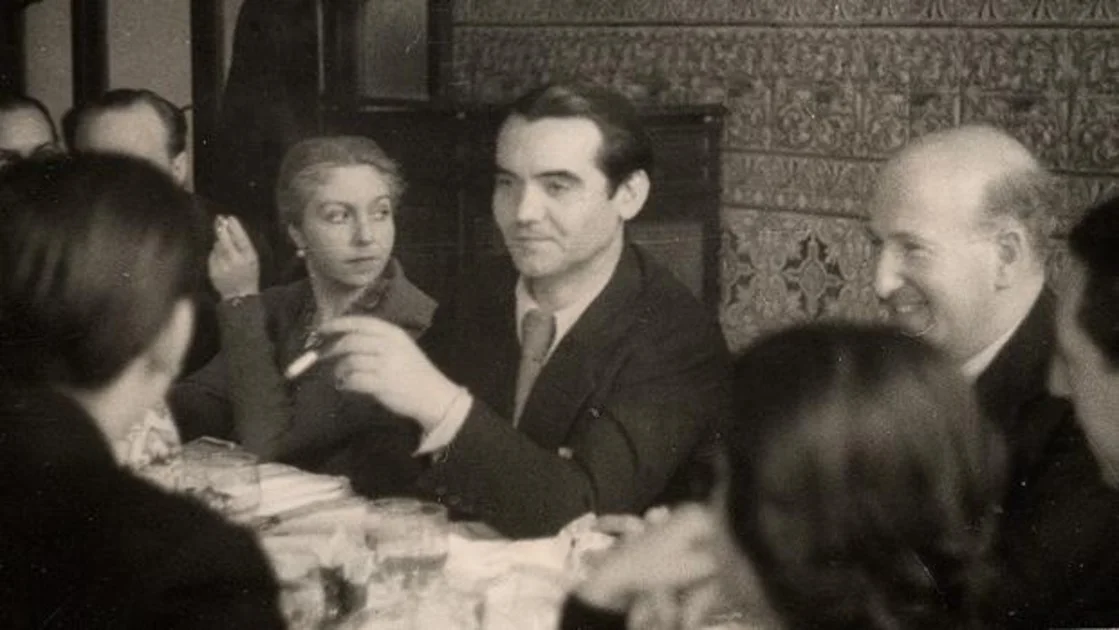
To commemorate the 90th anniversary of the Civil War, José Ángel Mañas recreates in Zenda, day by day in this section, what happened in 1936, perhaps the most pivotal year in all of Spain’s recent history.
Sunday, August 16, 1936: Federico García Lorca is Detained
I tell him that Federico cannot go out. He will not do so until my children arrive.
—Then please call your children, madam. Call them, for I am also going to send some of these youths to fetch them…
It was four in the afternoon. The conversation took place in front of the Rosales house, not far from the Civil Government of Granada. Federico García Lorca heard it from the living room with its barred window facing the street. The father Rosales ran a hardware shop on the Bibarrambla square. He was a respected merchant, a friend of Lorca’s father, with whom he shared a place at the club and with whom he, in a way, competed for the literary inclinations of their sons. Excluding the youngest, who dabbled in painting, the others were three well-born Andalusian gentlemen who enjoyed good wine and women, and, of course, were anti-Republican. All three had joined the Falange. That is why Lorca took refuge in his house.
, after the scare at the Vega house, Lorca began to settle down. He devoted himself to captivating the women with anecdotes of his travels to New York, Buenos Aires, and Cuba. He played popular songs on the piano that had been installed in his room on the second floor, next to Aunt Luisa‘s. Mrs. Rosales, her daughter Esperanza, and Aunt Luisa all adored Federico. They found amusing that, whenever an airplane swept overhead, he would rush under the bed and, after that, ask for a cup of lime tea to recover. When they dined together as a family, if one of the brothers appeared with a rifle or pistol, he would beg them to leave the weapon outside. The Rosales did not bother hiding the guest’s presence and treated him like any ordinary visitor. But, of course, he was not.
That day, the street filled with soldiers and Assault Guards. Some climbed onto the rooftops in case he might try to escape. But Lorca, terrified, did not move at all while the lady phoned her children. The only one he managed to locate was Miguel, the most timid of the Rosales. Miguel immediately returned from the Falange headquarters and was struck by the sight of so many armed men at the doorway. Inside a convertible Oakland, seized by the Civil Government, he recognized one of Granada’s prominent figures in the CEDA and former deputy, Ruiz Alonso, with whom he confronted him.
—Where is the arrest warrant, and what charges are there against Federico?
—Here is the warrant —said Ruiz Alonso—. We all know that García Lorca is an agent of Russia and has done more harm with his pen than others with a pistol.
While he read the document, Miguel glanced at the soldiers and lacked the courage to confront them: they posed a threat to his own family. In the end he helped Lorca prepare himself while the squad leader sipped tea in the courtyard, among pots and columns.
—Oh, how sorry I am, Federico! —exclaimed Mrs. Rosales, stifling tears.
The poet embraced her. Without protest but trembling, he accompanied Miguel and Ruiz Alonso to the car. “I’m coming with you, Federico. You’ll see how we’ll sort this out at the Civil Government,” said Miguel, also getting into the Oakland. But there was little conviction in his voice, and he avoided meeting Lorca’s gaze.
Todas las entradas de 1936 día a día
Entrevista con José Ángel Mañas sobre 1936 día a día