
To commemorate the 90th anniversary of the Civil War, José Ángel Mañas recreates in Zenda, day by day in this section, what happened in 1936, perhaps the most pivotal year in all of Spain’s recent history.
Monday, August 24, 1936: Interview with Francisco Franco
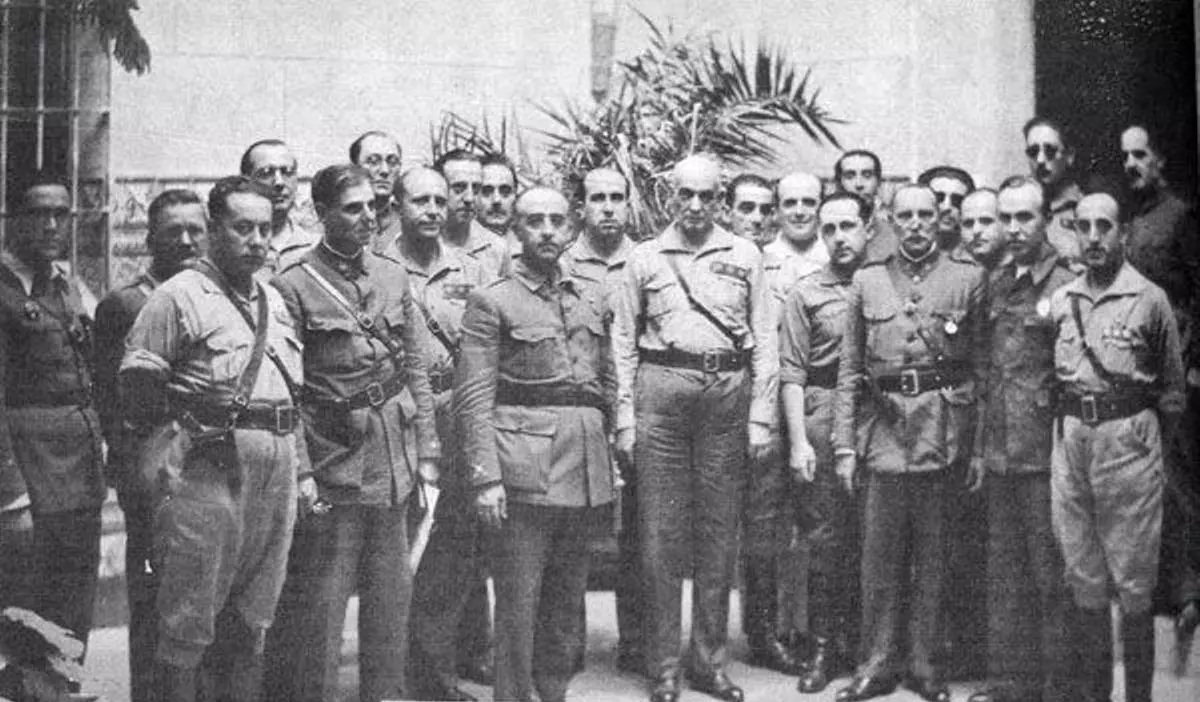
That Monday appeared in the newspaper Extremadura the interview with Francisco Franco, the rising general, conducted by the Diário de Lisboa. In Cáceres, at the Palace of Golfines, where his headquarters were located, Franco continued to command the Army of the South, made up of legionaries and regulars who, after crossing the Strait had advanced up from Seville and were now stopping to carry out reprisals and restore order in Extremadura.
In the interview, Franco complained about the treatment by the Republican press: “Imagine that the Government permitted Mundo Obrero to publish my portrait on a full page with the caption, inciting crime: Ave César, those who are about to die salute you.” He also asserted that the Uprising had no ties to politicians. For him, the main cause was the denationalization and dismemberment of Spain that had been taking place since 1931, along with the mistreatment of the Army, as the origin of a revolutionary action. “With the authority and complicity of the Government, the destructive and bloody social revolution was prepared for this August,” he declared.
He highlighted the distinction between the behavior of soldiers such as the legionaries, whom he said idolized their officers for their work ethic and heart, and the Republican sailors who betrayed their own, handing them over to the Government as soon as the uprising began, or even killed them themselves. It was evident that the Navy had been the great disappointment of the Uprising and one of the Government’s principal assets: it had been entrusted with confining the Army of Africa to Maghreb territory, the most professional of all the units. That plan, however, had failed.
Franco stated that the movement he led would pave the way for a military dictatorship that would hand the administration of the State to technicians, never to politicians. And he stressed that his organization would be similar to those in Portugal, Italy and Germany, as the journalist had suggested: “… but without copying them. In Spain the problems are different. There is no racial issue, as in Germany, nor are there the other issues that exist in Italy, etc. Our movement did not arise from within outward, but from outward inward.”
Perhaps what angered Franco the most, without bothering to hide it, was the Republican accusation that the African troops were not Spanish. Both the Tercio and the Regulares were forces of the Spanish State, like any other: “This is what Azaña thought when, to fight the August movement, in 1932, led by the illustrious and unforgettable General Sanjurjo, he ordered the regulars and legionaries to Seville.” The tone in which he referred to the man who was supposed to lead the rising was laudatory. Pictures of Sanjurjo’s funeral circulated in the rebel zones.
He emphasized, finally, something important for the course of the war: he would direct the movement of the troops from his headquarters in the Cáceres palace of the Golfines. He explained an aspect of his tactics that would soon be proven false: “Since this is a struggle between Spaniards, large-scale clashes should be avoided, as should the bombing of the capital, where hundreds of thousands of people are with spirit and heart behind our movement.”
To conclude, he acknowledged that in the territory controlled by the insurgents, the two‑color flag flew across the north, and only exceptionally in the south. In his conversations with General Mola and other rebel leaders, it was agreed that the movement would not go against the Republican regime, but would aim only to “nationalize it,” “to achieve a strong, progressive, and orderly nation.” With more important problems to solve, the issue of the flag would be left for later.
—Everyone uses the flag they want. As long as it does not have an anti-Spanish meaning, of course.
Todas las entradas de 1936 día a día
Entrevista con José Ángel Mañas sobre 1936 día a día