
The Otsindundua bridge, a stone arch spanning the Belagua River, is a plain but effective piece of architecture. A plaque honors the memory of the masons Joanes Beltrán and Pedro Pérez, because in 1568 they did not build a monument but a sturdy work, indispensable for the lives of thousands.
Why did they open this road, if it goes straight toward the Pyrenees’ wall, into a cirque ringed by two-thousand-meter peaks? Because these mountains were never as great a border as people think. Shepherds, mule drivers, and cattle traders crossed the range step by step. Between 1880 and 1935, hundreds of young women from Roncal, Ansó, and Hecho crossed the mountains on foot in autumn to descend to France and work in the espadrille factories of Mauleón. They returned wearing black in spring — hence the name “swallows” — exposed to fog, storms, and ravines, laden with dishes, coffee pots, fabrics, and shoes they had bought with their wages, fearful of the customs officers.
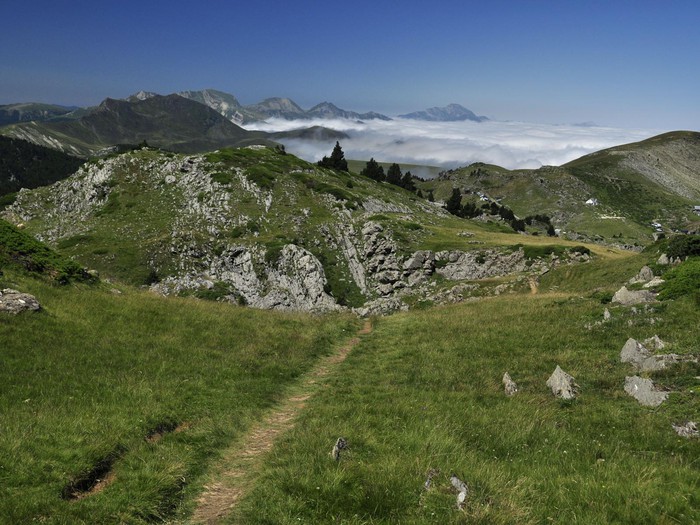
From the Eraize pass extends the imposing labyrinth of chalky limestone rocks of Larra. In 1973 dynamite was used to widen the asphalt road up to the Piedra de San Martín pass. The destruction of part of that landscape unsettles the sensibilities of our era, but I would not dare tell those swallows from a century ago what a pity of a project it was, what a wreck in the Pyrenees. Time, with its social transformations, builds barriers between people that are far greater than any mountain range.