
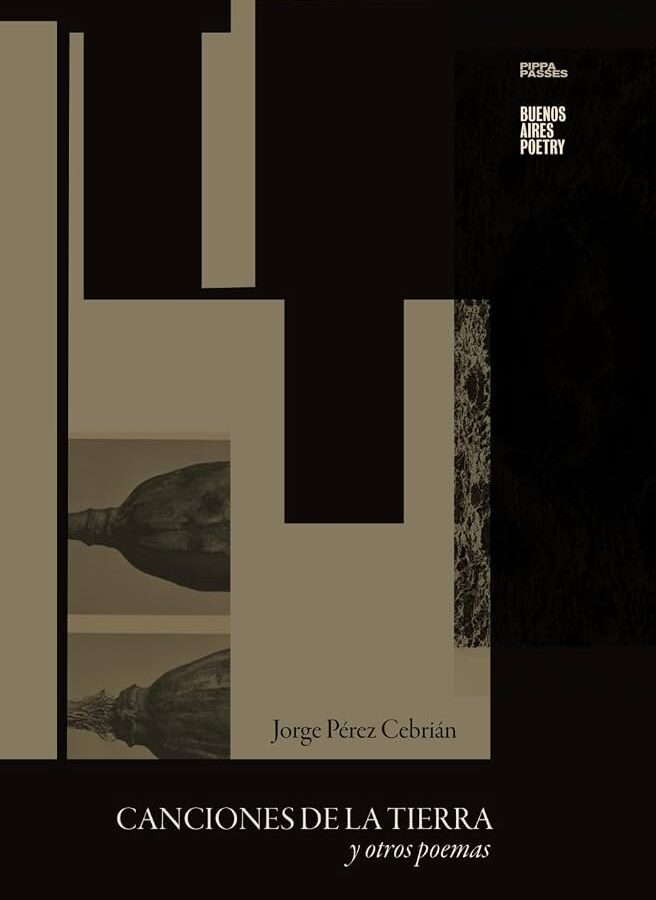
The poetry in this book links to history, aesthetics, and politics… because all of it shapes a reality. Jorge Pérez urges us not to betray the reality of pain by beautifying it with poetic language; he calls on the poet to safeguard a poetry that bears witness to tragedy (of history), as Sophocles did. Poetry must serve to pierce reality and lay it bare, in order to bear witness to the world’s darkness. He, the poet, facing the abandonment of the gods, amid the ruin and rubble of a wounded world, must guard with his rituals in the face of the final disaster. The dialectic of pain stands at the epicenter.
From that center the collection unfolds a questioning of existence that ranges from a genesis to an end, from individual experience to the violence of history. The “I” is built against a “you”, which is also the form of all its voids, while the body is subjected to the commands of a world that orders, classifies and disciplines: to produce, to consume, not to fall ill, to obey. In front of this machinery of norm, poetry summons a community of dispossessed – prostitutes, the mad, soldiers, the disappeared – a ‘legion’ that gathers those who have been left out of the triumphant narrative of history:
«Legion is my name, because we are many.
Come, through me one enters the afflicted city,
and leave, here at the doors, your word.»
Although there remains an echo of his previous and award-winning books, De cuánta noche cabe en un espejo (Pre-textos, 2022) and Pero nunca los huesos de las aves (Pre-textos, 2024), this book distances itself from those and surprises us with the introduction of elements closer to the vanguards such as the absence of punctuation, plays with capital letters and lowercase, and with spatial syntax — longer pauses and breaths — resources drawn from orality, experimentation in layout, or a rupture of the usual rhythm, which identifies his poetic voice. The linguistic tension does not derail completely; it finds its balance in the pretension, achieved, of linking form and content, where the poet becomes a shaman or medium: «And a poet can make a fountain spring in the middle / can strike his drum to the marching of the devil / afterward all the dead». A arcane, sacred atmosphere resonates in Songs of the Earth and Other Poems . The predominance of a language with magical and primitive value seeks to strip the word of its impostures and return it to an original stage, but not to ingenuously recover a lost sacredness, but to test its remains and explore, from the crack, what language can no longer contain. Ritual, invocation and prayer tension between the need to believe in the power of the word and the awareness of its failure, as in “On the impossible transubstantiation of the flesh”:
«But then we knew
that the embrace, like language or
the caress
is another form
of failure.»
There persists among these verses a deep reflection on human existence, weaving the poetic word with mystical and ancient references and skirting the notion of the end, the building of one’s own identity in relation to the ‘other’ and the relationship with the sacred. The combination of Sumerian mythology, legal codes, and observations of child psychology to question the origin of language and social order, as well as biblical references from the Old Testament, the Quran, and the Torah, configure a mosaic where classical tradition and contemporary reality converge in the fragility of the body and the longing to belong. Songs of the Earth and Other Poems uses the symbolism of sacrifice and ritual to represent the constant search for meaning in a world marked by emptiness:
«Let fall bed, honey, wine, pure water
and sprinkle on top white flour.
(…)
To you belong these rites.
And you, the one with many names, bull-headed offspring of thunder,
swords of blood and sacred fury that bewitch,
you who revel in the ether, deep God, enthusiastic inspirer
who wields the thyrsus, make yourself present with your torn limbs.
Bless these ceremonies, attend this prayer,
be favorable and open the earth beneath us like a bolt of lightning.»
The title gathers the two parts that articulate it: “Songs of the Earth,” formed by seven extensive poems — a cosmological number that appears in various places in the book — and “Other Poems.” In “Songs of the Earth,” we witness a birth in the word: «to call:invoke:to name them», which will occur after the ending with which the book opens:
«the END
the END is what is always closest
surrounds my name my hands my
eyes
surrounds my mouth and»
And it ends with a lament of history. Imagined as an epic and evoking Hesiod and his Theogony, “Songs of the Earth” confronts the individual with power, war, and sacred origin. In the face of a dehumanized world, the poet also assumes the guilt of the one who regards suffering with “odiously clean” hands, and the voice ends up recognizing itself in a community of marginalized, suffering beings whose hope is born, paradoxically, from pain and from the “cry of life that begins.”
In “Other Poems,” we find ten poems and the epilogue poem, in which the wound of existence and the poetics of waiting answer each other. It delves into the fragmentation between being, language, and the sacred, and into the need for poetry that does not anesthetize pain with beauty. To name also implies separation: language, by classifying the world, distances us from what it still cannot contain, the “Other.” In light of that impossibility, the poet seeks a broken, violent, and vigilant voice, capable of bearing tragedy and resisting oblivion:
«We never knew its name. It was a long time ago.
But the earth keeps turning, so one can imagine
that it keeps looking at the sun
on the table somewhere,
the blood and the stone of history,
the silent priest of days.»
The poetry reveals itself as a vigil-like exercise before the end, a way to sustain the bond with the other even when there are no longer certainties or universals. A wounded language that does not seek to console, but to point out the wound and sustain time.
Beyond this book, the word transcends as a vehicle of communication. Naming corporealizes the sacred, but also distances it: in that act of giving a name lies both the foundation of primordial sacrality and its loss: “you were a child, because the youth of the world is to be immense,” says it in ‘Intruder,’ and when “everything had a name” finally “the universe was old.” For this reason, in the act of naming we do not approach the world, but we move away from its anatomical essence; though to name is a “crystal goldsmithing” that, though beautiful, delimit, it is the paradoxical possibility that the poetic gives birth to a miracle: learning to name returns things to themselves, a return only possible if they are freed from their cadaverous wrappings: “return, I free you from your name”. This is how the ungraspable is calmed. This idea reappears in the poem “Lucio Fontana or Jesus Christ,” where the name appears as that which hides beauty and domesticates what is “unbearably violent” about existence. For in the sublime and the poetic there is also violence: “I always desired violence / the flower that tears the belly of an empire / the unbearable violence of being alive.” Beauty must not be complacent. The tension between the name and what is named weaves a shroud in which the poet tries to know himself, that identity that hides a proper name:
«i learned the voices the precise sounds yes I think I learned to name things but what a shame to confess it sir but I don’t know my name yet you know I suppose it’s something you learn perhaps when one dies perhaps because one is not that thing that continues and sir no thanks we’ll get by and see you soon if God wills if God wills soon if God wills God wills»
It suggests that true knowledge of one’s own name is perhaps something that is only attained with death. To name is the act that marks the end of the sacred and the immense to make way for the known and the distant; it is a tool of human control that the poet seeks to transcend in order to recover the closeness of things:
«Come -he said to me- / the god of what ends has called you / by your name (…) MY mouth where my voice vibrates and drinks /(The holy house, the house of the gods, in a sacred place had not yet been made)».
It is difficult to confine Jorge Pérez Cebrián’s poetic style to any of the current trends in Spanish poetry; perhaps that is why he remains outside anthologies or certain poetic circles. His poetry does not bend to the more experimental vanguards, though much of that is present in this book, and his affiliation with figurative poetry is insufficient for a poet who plays with a powerful symbolism and poetic references seldom seen in these times. The poetry of Ezra Pound reverberates through this book, though Jorge Pérez Cebrián internalizes and transforms it, the choruses of Sophocles’ Antigone, perhaps the most beautiful in literature, in which the essence of humanity is reflected, with that Baroque, culturally infused, aesthetic imprint that only this poet is capable of chiseling into verse. Songs of the Earth and Other Poems is an invocation before the failure of naming, where poetry must guard the remnants of the sacred and the human testifies to the painful darkness of the world, its violence, its pain, and the insufficiency of its own words.
———————
Author: Jorge Pérez Cebrián. Title: Songs of the Earth and Other Poems. Publisher: Buenos Aires Poetry.