
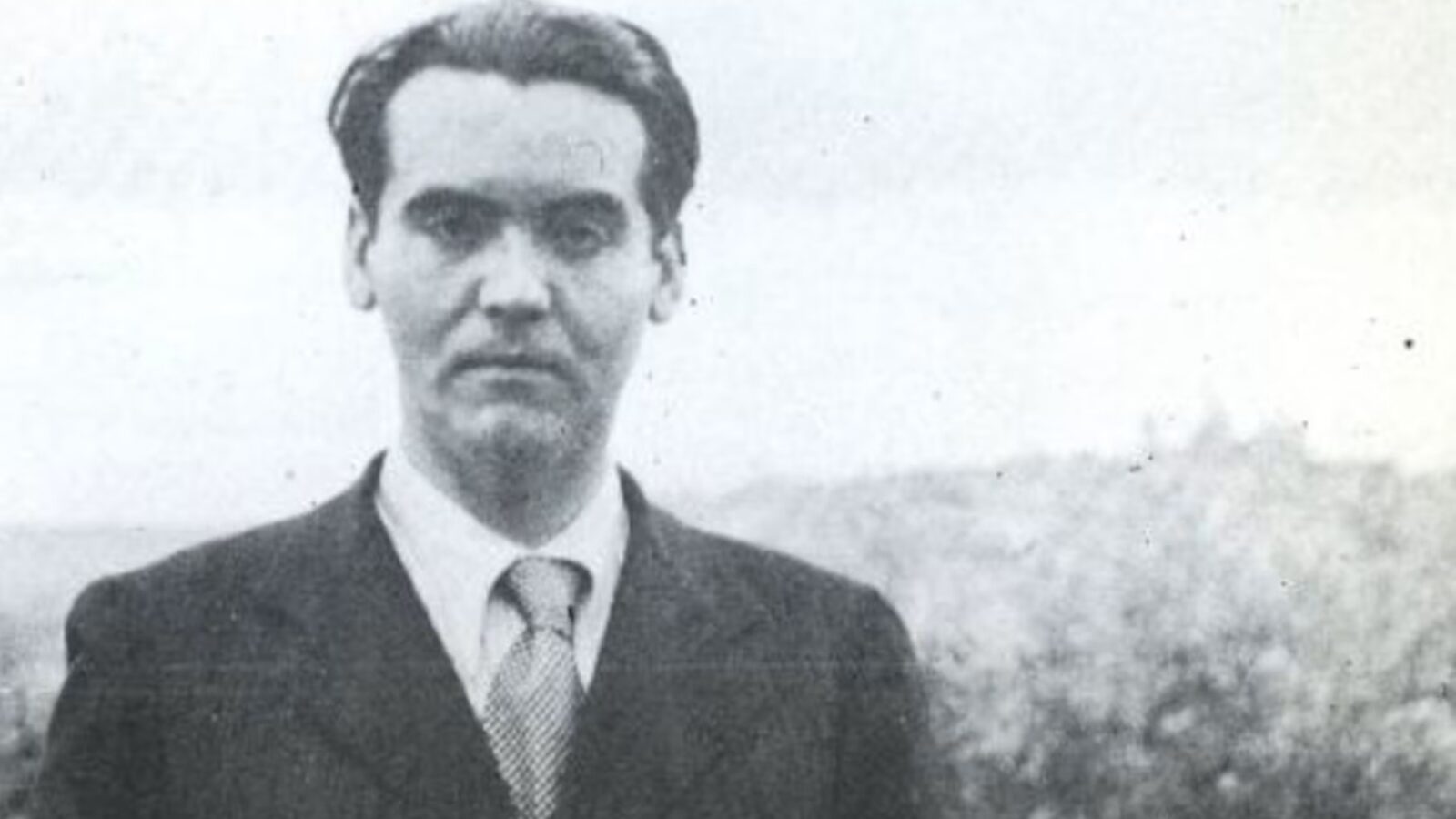
How furious it still makes Spain, and how furious it will keep making history, the death of Federico García Lorca. The greatest symbol of a country born for tragedy, but also for poetry, and which found, in 1936, the ultimate explanation of evil: the murder of a poet.
Many died, many are still in the ditches, and they are in memory; the memory of the murdered never dies. The dictatorship that followed that disaster muffled the voice of all Spain, and even today there are clear corners of reality that harbor the ruinous fantasy that the sound of what the Spanish Civil War was might return.
I write as night settles in at my home in the south of Tenerife, on the night when the 90th anniversary of Lorca’s death was observed. The poet Federico García Lorca. Still young at 38, a friend to everyone, writer, musician, wanderer, generous, a traveler in himself, the merriest of the Generation of ’27. And they detained him one night at his house in Granada, his Granada, to turn him into a martyr whose human future ended abruptly as if he had never existed. And then he has never ceased to exist.
The poet whom so many loved, treacherously murdered as Spain began the war against the Republic. And the symbol was Lorca, his death, his disappearance, his memory.
For some, that war has not yet ended, because Franco, the one who started it, still rules in the hearts of those who believe that the man, the dictator, has not finished with the shrill sound of his evil.
Federico García Lorca, the cheerful poet, the happy musician, the traveler who went to New York to glimpse the future’s face, the irredeemable symbol of a rebellion born to break the Republic and to make Spain a worse country and, by history, compelled to be, also, part of Hitler’s war.
Ever since, Spain has lived with that memory, and there are still sad echoes of that dark history—a dictatorship forged in lies. I was born in 1948. My parents did not dare to speak in their home of anything other than domestic life, and thus from the evidence of misery. They killed Federico so that people would know that death was a common and terrible harm that Franco had established so that people would know not to open their mouths.
The murder of Federico was a flagrant treachery, meant to show the undecided that the matter was serious and that even the joy of poets would not be spared.
Federico García Lorca… His figure is the largest part, the most symbolic of that sad story that will never truly end. Because figures like Lorca, and so many others, can never be brought back to life, though they will be the best way to remember them. He exists without existing, as if in the air of a story where his figure, the reality of his past, his voice, are missing. He is everywhere and nobody sees him, not even in the ditches. The poet is here, his verses have never left, neither is his voice (never found) nor the exact place where any of his traces could be found. That is his universal song: he is not here and he is everywhere. He is the symbol that embraces his history.
Franco ordered his killing. History says that the leader of that catastrophe did not know of the poet’s death. But the truth is that, in that war, Franco and his men gave the order to kill him. In the postwar era and in the time that followed, and even now, there lingered the constant pretense of malice. And now that iron core of this country quietly demands the dictator’s resurrection.
Ninety years later, that murder is more than a symbol. It was a misfortune that swept away the hope of a future, forever leaving a living history: Federico García Lorca, the poet. He left written, in one of his verses, this embrace: “A esta hora de la tarde qué raro que me llame Federico”. His figure is the name itself in a country that has not been able to ease the cry it bore away and which, with him, has continued living. Federico has not died; he is a greater symbol, and he is alive.
Time has passed and, in some way, Spain—the republican and also the frightened, as well as the fractured Spain—has never ceased to call itself Federico.
Since it became known that the poet had become poetry’s impossible goodbye, Spain has lived in its search for him, as if he were in the world’s air and as if the purpose of those who sought him were not true: he is no longer here, but he lives in poetry. Those who searched for him never found him: relatives, scholars, youths… Those who wished to know about him have had to seek him in songs and in verses, in theater and in memories held by others who have already died.
And even today there are hesitations about seeking him, as if exhuming him were a way to draw him into a light that is unnecessary. When the desire to bring him into the present and into history grew stronger in Spain, a Irishman appeared in Madrid, Ian Gibson, a writer, in love with Federico’s history.
Gibson left at a friend’s house some belongings and set out in search of Lorca. To Granada. To his Granada. More than fifty years ago, and Gibson has not ceased in that search, which seeks not merely restitution but the obligation this country and the world owe: to know where Lorca is, where Federico was killed, in exactly what spot in Granada his killers ended his life.
I was a boy when schools began to utter Lorca’s name, drawn from history because those who dared to say his name, his surname, his existence, could not bring him back to life. The given name Federico ceased to be merely a page in an encyclopedia and became the country’s very essence, whose resurrection is like a shout with its own name. Federico.
Books brought him into homes and schools. Little by little his presence returned, as if he himself were a pupil arriving from another corner of the world to spell out his poetry. We read Lorca as if he were speaking to us. He lay in a secret tomb, or perhaps in some unknown tomb, but suddenly, in that Spain waking to freedom, Federico García Lorca was the one who never died. Poetry is his symbol, and it does not cease.
That death was the imprint that cannot be erased, the symbol with Lorca as its standard. He saw a hope broken (that there would be no pain, that there would be no war). And afterward the certainty entered our republican country that evil would keep destroying the future and hope.
I asked Ian Gibson now, still the most Lorcan of all who love his history and his poetry, what it means that so many still love and seek him. He told me: “It is earthy… He was the poet of the earth… Everything that comes from the earth is earthy, like his poetry. He is the greatest of poets, he comes from the earth of the moon, he is empathetic, he was the symbol of all who suffer, of that mestizo Spain that the right did not approve. Just as now.”
From all over the world. The poet of the world. “Among the reeds and the late afternoon, how strange that they call me Federico!”
—————————