
Develop this course to acquire the essential skills for writing short stories with personality, working through each stage of the narrative process, and discover your own perspective as a writer. The exclusive channel of Penguin Random House is a pathway created specifically for students enrolled in some Cursiva writing courses. Upon completing the course, students can submit their editorial proposal and/or manuscript to this space.
Writing a good short story requires much more than inspiration. It requires learning to observe, select, construct, and refine every element of the narrative until every word counts.
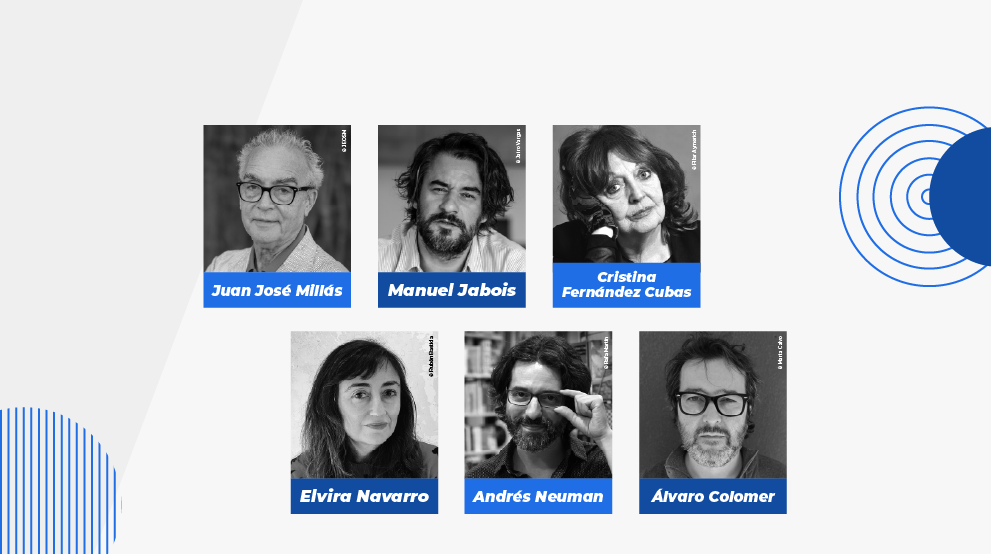
From the initial idea to the final revision, you will learn to work on voice, atmosphere, structure, characters, and conflict, while you develop your own story through progressive exercises. Furthermore, along this journey you will be guided by authors of stature such as Juan José Millás, Manuel Jabois, Cristina Fernández Cubas, Elvira Navarro, Andrés Neuman and Álvaro Colomer, with whom you will refine your writing and cultivate your own literary sensibility.
 100% online with live classes
With tutor: Personalized tracking
Course start: 12/10/2026
Price: €450
👉🏻ENROLLMENTS
COURSE OBJECTIVES
- Learn to identify the narrative potential of everyday situations, characters, and experiences to transform them into short stories with significance and the power to move readers.
- Understand the essential elements of the contemporary short story and how voice, tone, atmosphere, rhythm, and point of view interact in constructing a narrative.
- Develop your own literary voice through deliberate reflection on language, style, and narrative decisions that shape a writer’s identity.
- Build stories with a solid, coherent structure, learning how to organize information and generate narrative tension from the opening lines.
- Learn to revise and edit texts effectively, spotting opportunities for improvement in both structure and narrative expression.
MEET THE TEACHERS AND THE TUTOR
In this course you will uncover the techniques used by master storytellers to craft brief, emotionally resonant, memorable narratives, and you will do so alongside some of the finest writers in the Spanish-speaking world.
JUAN JOSÉ MILLÁS

MANUEL JABOIS
CRISTINA FERNÁNDEZ CUBAS
ELVIRA NAVARRO
ANDRÉS NEUMAN

Andrés Neuman (Buenos Aires, 1977) is a Spanish-Argentine writer and poet who spent his childhood in Argentina and grew up in Granada, where he studied Philology, taught at the university, and currently resides. Born to Argentine musicians in exile, he began to stand out at a young age with Bariloche, a novel that was a finalist for the Herralde Prize. Since then, he has built a broad literary career spanning novels, short stories, poetry, essays, and travel diaries, with works such as The Traveller of the Century, Fractura, or Until It Begins to Shine. Throughout his career he has received important awards, including the Alfaguara Prize and the Critics’ Prize, and has been recognized by Granta magazine as one of the best Spanish-language storytellers of his generation. His books have been translated into twenty-five languages, consolidating him as one of the most prominent voices in contemporary Spanish-language literature.
ÁLVARO COLOMER

Álvaro Colomer (Barcelona, 1973) is a writer and journalist. He is the author of a trilogy about the death of the city and of the novel Although They Walk Through the Valley of Death. He has also explored non-fiction with works such as Guardians of Memory, which earned him the International Award for Excellence in Journalism. He has written children’s and young adult books and collaborates with La Vanguardia and Cadena Ser. Currently, he is the editorial coordinator of the magazine Zenda and a lecturer in the UPF-School of Management’s Master in Editing. In this regard, his book Learn to Write stands out, a writing manual with the “creative tricks” of the great masters of Spanish-language literature.