
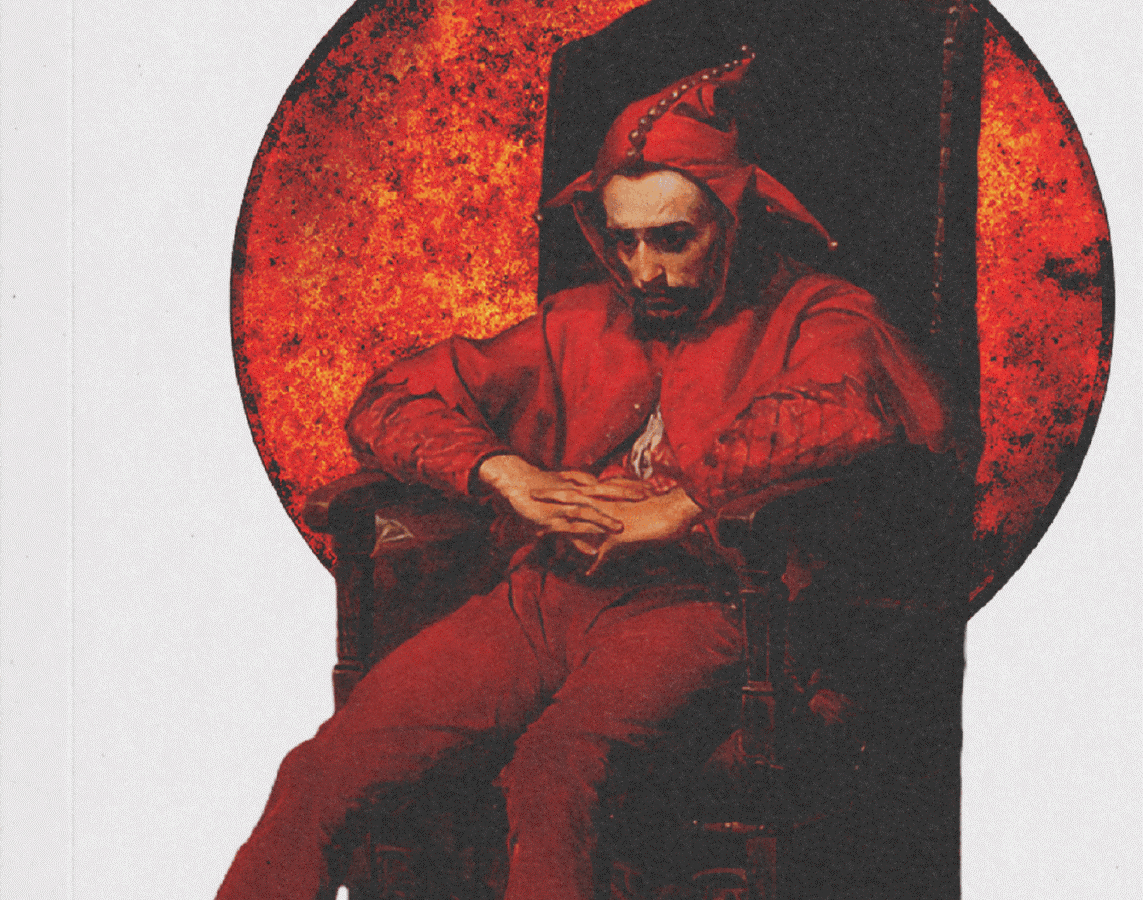
Economic family troubles prevented his graduation. Nevertheless, he spent much of his life as a civil servant in the administration of his country. In 1922-23 he was sent to Munich as part of his duties as librarian for the Ministry of Finance and the National Assembly. There he came into contact with European vanguards, primarily with Expressionism, an influence that would mark part of his work, specifically the stories contained in this anthology.
Earlier he had undertaken war journalism during the Balkan Wars (1912-13) and the Great War. This journey to Germany has been described as “transformative,” but, as readers of these stories will sense, the wartime period was probably as significant as the readings of Poe and Hoffmann, which clearly leave their mark. And those who expect to find in this volume an anthology of fantastic tales will find themselves somewhat disoriented. “The Stranger”, one of the most accomplished pieces, with which the anthology closes, where one of the characters reads a book by Maupassant, would fit perfectly within the conventions of the genre. The same would apply to the preceding tale, “Carnival”, organized around very powerful dreamlike images with a distinctly cinematic texture. Yet in “Sin”, the longest tale, overflowing with images of sordidness and violence inserted into a rural melodrama, the lethal, the diabolical—not the diabolic—dissolves into the irrationality and murkiness of human passions that Dostoevsky, precisely because of spiritual beliefs absent in Raichev, knew how to modulate.
The problematization of moral choices, the matter of “crime and punishment”, is present in most of these fantasies, some of them indebted to the influence of Sigmund Freud on the author. A very clear example of this occurs in the tales “Fear and Madness” or in the highly expressionist and fragmentary, caligaresque, “Images of Dreams”, otherwise one of the most accomplished and unsettling, due to the disorientation that the narrative mechanism imparts to the events. The author’s transition from Symbolist modernism, with its positive mythologizing of childhood, as occurred in Lovecraft, to a form of “diabolical realism,” a concept that is disfavored in scholarly circles, is the basic concern of critics whom we can safely disregard.
This shift results from focusing a hopeless and intense inward gaze, without the safeguard of belief or any spiritual symbolism. There is something sinister, at least, about Raichev’s photograph that circulates on the Internet. The transformation of the human being into irrationality through fear, sin, jealousy, or war is the engine behind nearly all of these stories. Noteworthy among them is the multifaceted yet cunningly realized presence of female characters. The eternal feminine is subjected to the cruellest papyroflexical determinations in a world in crisis, where not only does the communal protective framework of rural society fade, but all those demons Dostoevsky identified as belonging to a demonically nihilistic disorder come to light, provoked by a stark disturbance of conscience. The historical moment in this region of the world could hardly be more turbulent. A significant example is Lina, a love story that traverses passion, the search for harmony, and deviation, ultimately, by virtue of the blindness and superficiality of its characters, including one labeled “the artist,” culminating in crime.
“Locura,” however, the tale that gives the collection its title, traces the characters’ hallucinatory drift to the authentic determinative influence on the author: the war, which he experienced as a correspondent and which undoubtedly exerted a great influence not only on the images but also on the style. The Bulgarian Academy, through one of its specialists, Elka Constantinova, who would later hold the post of Minister of Culture from 1991 to 1992, asserts that “Locura” is not a fantastic tale but inaugurates a new narrative mode: the “analytical psychology of trauma.”
It is worth noting that Bulgaria is a nation with particular characteristics. Freed at the end of the 19th century from Ottoman rule, it endured very bitter moments and significant vicissitudes, and in some sense ahead of its time. The Great War was preceded by the Balkan Wars, and in both cases Bulgaria played a decisive role. After World War II, it sank into the gray dystopian Stalinist nightmare, something that Raichev did not enjoy much, as he died in 1947. His work began to face problems for not conforming to the limits proposed by socialist realism.
An interesting anthology that brings us into contact with a European literature that is exotic to us. The exploration of the dark aspects of the psyche is fully compatible, in Raichev’s fiction, with the presence of convincing characters endowed with remarkable intensity. He also wrote children’s tales that achieved wide diffusion.
The devil is the Unconscious unleashed…
————
Author: Gueorgui Raichev. Title: Madness. Translation: Marco Vidal González. Publisher: Caleidoscopio. Sales: Todostuslibros.