
*****
We are already the forgetfulness we will become.
The elemental dust that eludes us
and which was the red Adam and which is now
and it is all men and that we shall not see.
We are already in the tomb the two dates
of the beginning and the end, the box,
the obscene corruption and the shroud,
the rites of death and the dirges.
I am not the fool who clings
to the magical sound of his name;
I think with hope of that man
who will not know that I was here on earth.
Under the indifferent blue of the sky
this meditation is a consolation.
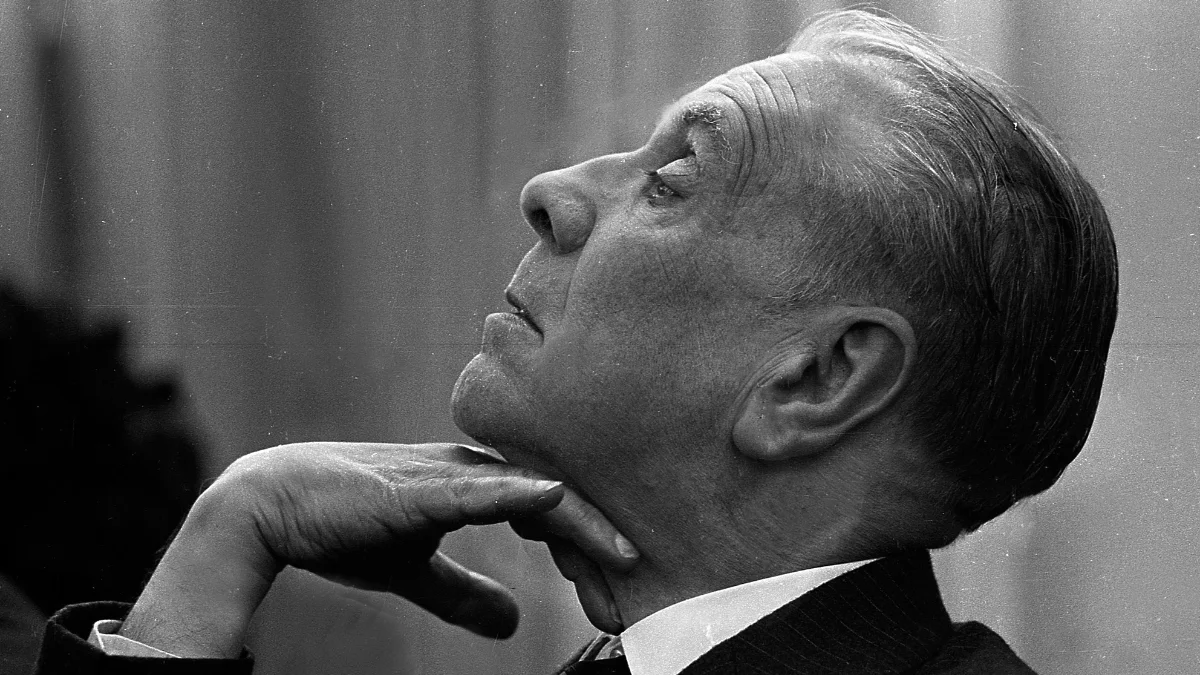
Borges could not have imagined that the sonnet he had let slip would appear in the pocket of a man murdered in Medellín. Héctor Abad Gómez was a renowned physician and human rights advocate, dean of the Faculty of Medicine. After the paramilitary hitmen shot him to death on August 25, 1987, when his son reached the place where the body lay on Argentina Street, two papers were retrieved from the pocket of his shirt. One was the page bearing the death sentence of twenty people, of whom seventeen were executed. But he also found that sonnet signed at the bottom “J.L.B.”. Then, not only did he write a news article reproducing the poem, but he had it engraved on the tombstone with Borges’s signature.
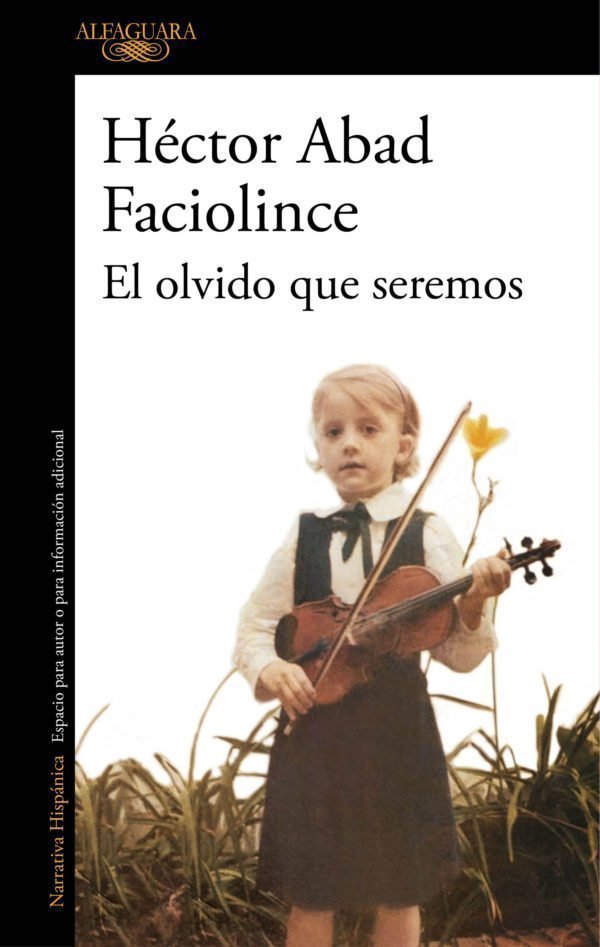
Casi veinte años después, en 2006, Héctor Abad Faciolince publicó un libro extraordinario sobre su padre titulado El olvido que seremos. Rápidamente se transformó en un suceso de lectores en Colombia y las ediciones se sucedieron. Inesperadamente, en 2007 apareció el estrambótico poeta Harold Alvarado Tenorio y le aseguró a Héctor que el poema no era de Borges, que lo había escrito él. Herido por la posibilidad de haber caído en una trampa, inició una pesquisa desesperada. Pero no tardó en encontrar inconsistencias en la versión del extravagante personaje. Al final Alvarado Tenorio, acorralado, le confesó: “Es cierto, yo no escribí el poema, lo escribió un tal Jaime Correas que vive en Mendoza, pero no quiere oír hablar del tema”. Fue así que Héctor me llamó por teléfono desde Berlín la tarde del 12 de agosto de 2007. Empezó diciendo: “No quiero que usted piense que yo estoy loco”. Y luego a borbotones desarrolló una historia increíble, cuyo origen remoto yo reconocí de inmediato hundido en mi memoria de estudiante de la Facultad de Filosofía y Letras de la Universidad Nacional de Cuyo a fines de los 80. En medio de la agitación de su detallado y perturbador monólogo, lleno de violencia y engaños, se detuvo y me preguntó inquisitivo: “¿Usted escribió el soneto?” Lo alivié parcialmente: “No, el soneto es de Borges y lo publicamos junto a un grupo de compañeros de estudios con otros cuatro más, todos inéditos”. Casi sin dejarme terminar volvió a la carga: “¿Me lo asegura? Después de lo que está pasando ya no creo en nada, ni en nadie y para mí es muy importante conocer la verdad”. “Sí, créame, han pasado veinte años, pero recogní el verso que me citó: ya somos el olvido que seremos”. “¿Me ayudaría a demostrarlo?”, contraatacó. “Por supuesto”, respondí seco casi sin pensarlo.
I remember those fifteen days after the call as the most exciting in my intellectual life. Mails came and went with details, updates, suppositions, red herrings and some truths, incredible characters who accessed the classified files of American intelligence or traced the most unbelievable data, poets of every stripe, victims and disenchanted people. My existence began to revolve around the obsession of that man who emerged from the shadows and I could not escape.
The story of Héctor Abad Faciolince and me seemed contrived by a mind that generates fiction. Like that of Borges. Yet all the details of what looked like a novel were entirely real.
Those five unpublished sonnets had reached us through a mutual friend who had received them from his friend Franca Beer, who was married to the painter Guillermo Roux. Borges had entrusted the texts to her. He had promised them to a French poet to accompany an interview he had given in his Maipú Street apartment while Roux drew him. Borges’s prank sparked a long Ariadne thread that brought him back to Mendoza in an unprecedented way.
Encounter with Borges and the honorary doctorate
In 1983 I had spoken with him one Saturday morning at the Gallery of the East in Buenos Aires, just a few meters from the apartment from which the sonnets had emerged. He would go to the City Library to sit and chat with any passerby. An uncle of mine asked the staff to introduce us, and that is how I sat opposite Borges. Since they had told him I came from Mendoza, he asked how the irrigation channels were. And suddenly personal memories of interest to us surfaced: “Imagine, I, a man so unjustly rewarded, still rank the doctorate I was given in that nearly secret Universidad de Cuyo as my first preference. It was the first one.” He soon almost dismissed me to weave his own perplexities about China and elephants, until I interrupted him almost accidentally to ask about the taste of wormwood. Unmoved, he told me: “It has a hint of mint, of fennel. But why do you ask me that?” I told him I was reading Under the Volcano, Malcolm Lowry’s novel, and that the protagonist goes from party to party, taking wormwood. “I’ve heard of that book. What do you think of it?” That was his first request for an opinion and, almost interrupting me, he answered that he liked it quite a bit, though it bored him a little. Borges grew restless and, with a friendly annoyance, as if offended, admonished me: “You are very mistaken; that cannot be; the only inexcusable duty of a novel is to entertain the reader.” That ended our conversation. With courtesy he suggested it was time to go to lunch. He asked that I accompany him and he left. I never finished Under the Volcano, but I learned the best lesson of my life as a reader: a novel must above all entertain the reader.
With that precedent, when we received the unpublished poems, we imagined contacting him and asking for authorization to publish them with an introduction by him. We were compiling anthologies of anonymous poetry with our own poems. We envisioned, with youthful enthusiasm, that our imprint Ediciones Anónimos might appeal to him. But events accelerated and Borges died in Switzerland.
Publication in Mendoza of Borges’s unpublished poems
We took two actions in his honor. The first was to begin the release of Poesía Anónima 4 with the dedication “To Jorge Luis Borges, in memoriam,” beneath an interview excerpt he had given at Indiana University. There you can read another of his unforgettable lessons: “I do not prefer one thing over another. I love all the countries and all the writers I have read (and there are many I have never read who have nonetheless influenced me). I am a disciple of the past, of all the past. I do not believe in schools. I do not believe in chronologies. I do not believe in the need to date writings. I think poetry should be anonymous. For example, if I could choose, I would wish that some of my poems, some of my stories, be rewritten and improved by another so that they endure and my name is forgotten, as it will be with time. That is the destiny of all writers.” That statement seemed tailor-made for our poetic venture.
The second form of homage was publishing his unpublished pieces in our little books. For that edition, with no commercial value, I wrote a brief introduction dated in Mendoza on November 13, 1986. It opens with a quote from T. S. Eliot, also foreseeing: “And all is always now.” A line that surely pleased him. There I wrote: “When this collection of poems came into our hands, it was not impossible to imagine the poet’s immortality. In early 1986 these verses appeared magically with the novelty of being unpublished (at least in book form). The initial idea was to contact Borges and ask for his authorization to publish them in an edition like the present, a few copies and a distribution almost hand to hand.
“The first months of 1986 passed quickly; Borges’s settling in Geneva and then his passing made the project impossible.
“The news, received by telephone, was a quiet sadness: ‘we must enter into death as one enters a party,’ he had written in one of the poems of Los conjurados, his last book. His dates were fixed: 1899-1986.
“What happened confirmed that a living poet is not the same as a dead one. Always, before poetry, there is the affirmation of a living man. A strange being who somewhere is dreaming.
“Borges gave us the pleasure of reading. Now he is already an absence, a shadow in time, a name, a few dates and a few texts, also a few nights, love and such wonder. What remains is a shared morning, a friendly conversation, and the strange sense that there is no forgetting.”
The key to the diffusion of the sonnet that reached the man murdered in Medellín lay in sending that publication to several important poets for whom we had postal addresses: Octavio Paz, Roberto Juarroz, and José Emilio Pacheco, among others. The poems appeared in the most prestigious Mexican and Spanish newspapers. The echoes of those publications reached the Colombian magazine Semana, and Héctor’s father read them as a kind of poetic testament.
From all that experience resulted not only the wonderful book El olvido que seremos by Héctor Abad Faciolince, which Mario Vargas Llosa in 2010 called “the most exciting reading experience of my recent years,” but his long essay Un poema en el bolsillo, where he recounts with loving detail, photos and maps our joint adventure. It is part of his 2009 book Traiciones de la memoria. And, also, my novel Los falsificadores de Borges of 2011.
More relations of Borges with Mendoza
Perhaps what I have just told is one of the last resonant echoes of Borges’s relationship with Mendoza until these magnificent days we are living, in which our poet reasserts himself with his presence.
It is worth reviewing some of his other visits. Borges began his contact with the National University of Cuyo in 1940. Edmundo Correas, the founding rector a year earlier, recalled that he was recommended to him when he was organizing. He met the prospective candidate at the City Hotel in Buenos Aires and offered him $300 to take charge of the Chair of Spanish Literature. The response was: “That is a lot, because here I earn only $180 at a municipal library, but I cannot accept; I am not a professor, I don’t know how to speak, I only write some insignificant things.” Correas persisted, even adding the offer of the Chair of Hispanic American Literature to make the proposition more tempting, but Borges stood firm and replied that, surely, the students would hiss. Correas did not give up and offered to arrange a trip to Mendoza for him to deliver a talk on a topic of his choosing. Borges confessed that he did not know the province, and when offered air or rail travel, the latter suggested by the rector, he replied with his unmistakable charm: “I think — he smiled — the landscape isn’t very varied: sometimes you see four cows and a horse, and other times, four horses and a cow.”
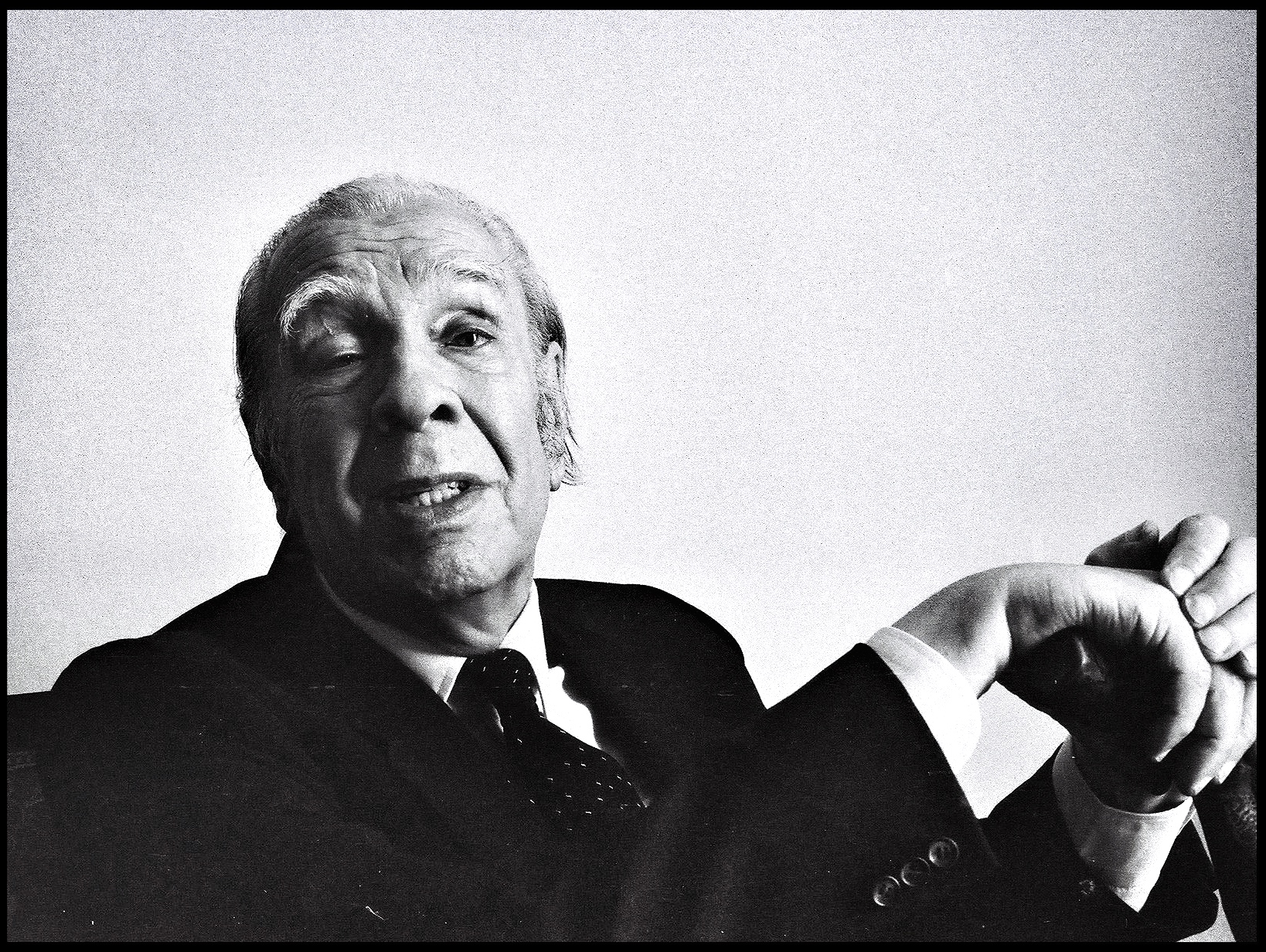
Sixteen years later, now a notable speaker, he traveled to Mendoza accompanied by his mother, Doña Leonor Acevedo. He came to receive the much-discussed honorary doctorate.
Years ago my teacher Emilia de Zuleta, upon my interest in learning about that event that appeared on the green cover of Emecé’s Complete Works, gave me a handwritten note with her signature. She assured me that one day it would become history and that she wanted to leave it for me to pass along: “It was Félix ‘Grillo’ della Paolera who suggested the idea of granting Borges the honorary doctorate. A friend since his youth in Adrogué, he was also the man who introduced him to a talented Bolivian, Marcial Tamayo, and to Adolfo Ruiz Díaz, who together would write Borges, enigma y clave.”
“Borges always remembered that first Doctorate and left friends in Mendoza where he returned on several occasions accompanied by his mother Doña Leonor Acevedo and later by his first wife Elsa Astete Millán.
“The act of awarding this Doctorate, to be understood in its full significance, must be placed in its context; it was a reivindication of the writer persecuted by Perón in the cycle opened by the Reign of Liberty.”
The late Della Paolera, in 1999 in the newspaper La Nación, provided a pivotal political explanation: “In 1956, a leftist group, arguing that Borges did not have a university degree, attempted to remove him from the English literature chair. I knew the dean of the Faculty of Philosophy, and I told him the case. They named him doctor honoris causa of the University, and he was then authorized to teach wherever he wished.”
Anecdotes of Borges in Mendoza
Another important point is that it was “Grillo” who introduced Borges to Marcial Tamayo and Adolfo Ruiz Díaz, coauthors of Borges, enigma y clave. The book appeared on March 11, 1955, when Perón’s future was uncertain and publishing a book about Borges was not particularly promising for an intellectual. It remains one of the best books on certain Borges texts. It can be read with admiration for its prose and the solidity of its analyses, which have not aged. Rodolfo Modern has written that Tamayo’s involvement was “more than anything symbolic.”
The figure of Ruiz Díaz, unjustly forgotten, takes flight in his relation to Borges. Adolfo was a key teacher for many of us who passed through his chairs. I was fortunate to take Introduction to Literature and Aesthetics with him, as well as the undergraduate seminar. He displayed with his students the incomparable charm of his intelligent, seductive, and cooperative personality. Our debt to him is immense. Not only for his classes and his extraordinary book, but also for his numerous articles, several of which I still have with dedications. They stand as the testimony of those long conversations in the faculty or in his study on the alley Delgado.
Amalia Ugo, Ruiz Díaz’s wife, was a privileged witness to several chapters of that long friendship and recounted: “Borges arrived in Mendoza by train, accompanied by his mother, Leonor Acevedo. That morning we were waiting for him, along with several local writers, at the San Martín station.”
“Master!” they exclaimed. And after the greetings they asked what he was writing.
“On the train it was difficult to dictate to my mother,” he said; “but I’ve thought of some couplets, those that seem to belong to everyone and should already be written.”
They asked him to recite one, and Borges first gently separated from his mother and said: “Go to the other side, mother, please.” Then he began:
‘There in the middle of the square
of the town of Pehuajó
there is a sign that says
the whore who bore you.’
Laughter eased the tensions and the cordial closeness that remained with Borges began to reappear, due to his highly respected and feared intellect. From there — continues Amalia — we went to the Instituto de Lenguas y Literaturas Modernas on 9 de Julio street. Two female students were looking for something in the files and, turning around, they saw Borges. “Professor Borges!” they exclaimed with enthusiasm and emotion. At sunset, the academic ceremony took place in the Dean’s office of the Faculty of Philosophy and Letters. After the ceremonial portion, Borges thanked: “This morning, some colleagues who had come to meet me at the station said, ‘Master!’ And I am not a master. Then, at Ruiz Díaz’s Institute, some students told me, ‘Professor!’ And I am not a professor. And now they grant me a university distinction. What a rapid career I have made! I will tell my friends not to waste time in Buenos Aires and to come to Mendoza without delay.”
Los Andes coverage of Borges’s visit to Mendoza
Following the Los Andes newspaper’s coverage of those days reveals a key element of a long-lasting relationship. On Saturday, April 28, there ran a lengthy interview conducted by Antonio Di Benedetto. Months later he would publish his major work, the novel Zama. He was a 34-year-old who, after that meeting, was invited by Borges in 1958 to the National Library to discuss literature—specifically, the realm of fantastic literature.
Also of interest and well covered in Los Andes is the July 1969 visit. Borges gave two lectures: “Painting and Letters” and “The Compadrito.” He was accompanied by Elsa Astete Millán, whom he would separate from the following year.
A meticulous inquiry into Borges’s trips to San Rafael, to the Los Álamos estate, where his friend Susana Bombal received him, remains to be done. She, the aunt of our beloved Camilo—maker of the labyrinth and of his brothers, our friends Caro and Nacho—two giants in the preservation and diffusion of that legacy, who through her, as Borges noted, are always where there is music, in the blue, in the hexameter of Greek poetry, in our own solitude that seeks it, in the water’s reflection of the fountain, in the marble of time, in a sword, in the serenity of a terrace that overlooks the west and its gardens. Seeing the image, I felt the happiness of confirming Borges’s love for that nearly secret university, to which so many owe so much, a love he would keep as one of his most precious memories, as he confessed to me. While finishing these words I searched for it again because, as often, I had mislaid it. I found it, luckily. Seeing the image, I felt the happiness of confirming that Borges’s love for that nearly secret university was not a false memory but an indisputable reality.
(*) The author is a writer, journalist, and member of the Argentinian Academy of Letters. This text is the adaptation of a lecture given in 2025.