
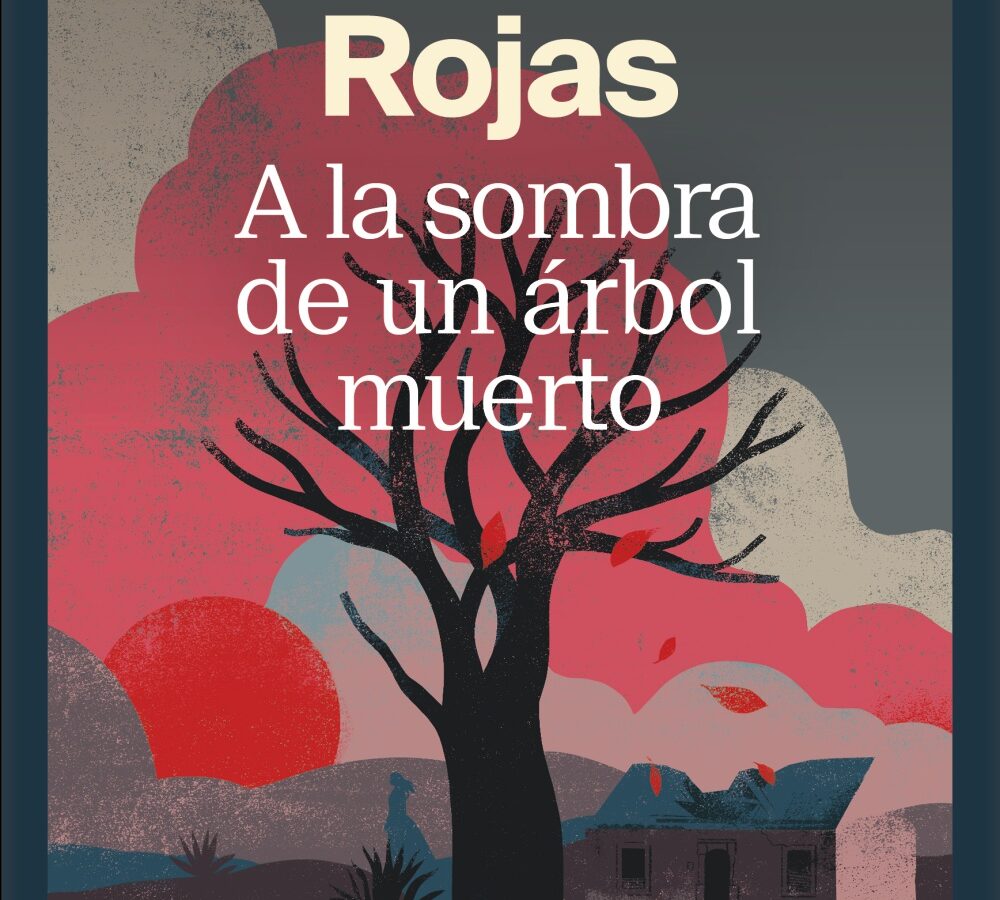
1873: a childless couple decides to leave Spain to settle in Jalisco (Mexico). A novel, then, about migration, the revolutionary upheaval, the subjugation of women, and the resistance of the oppressed. A story about those who face their destiny from the place they occupy long before they are born.
In this making of Mónica Rojas explains how she wrote A la sombra de un árbol muerto (AdN).
*****
My maternal grandmother had one brown eye and one gray one from cataracts. She explained to me, quite convinced, that she had the “dead eye” because she no longer felt like continuing to see the dead, the spirits, and the witches. She said she carried “shadow”. It had been inherited from her mother.
When I was a child I longed to have her. I wanted to see what she saw. I wanted to speak with my departed grandfather, to see the dead approach the offering food, to see the witches shed their legs to fly out the windows, but none of that happened then. Many years had to pass before that shadow manifested. By then I was already a writer.
A la sombra de un árbol muerto is a multi-generational story that interweaves memory, forgetting, and trauma. It begins with a couple in Santander, Spain, in 1873. Magdalena is a newly married fifteenth-year-old who bears an unchosen biological condition: she cannot have children. A terrible misfortune for her and for Juan, her husband. The infertility of her body dooms their land to infertility, for in those years those who did not have offspring had no labor. “A woman without a womb is not a woman.”
In search of a land to begin a new life, the marriage migrates to Mexico, where a relative welcomes them. There, in the region of Los Altos de Jalisco, fate—perhaps condemning them—drives Juan and Magdalena to resist their own condition as foreigners in a town where the master is the outsider. There is obedience and there is also resentment.
Because no one chooses the body they occupy, nor the land in which they are born, nor the language they speak…
And before that, there is nothing we can do. Not even migrate.
That primal story threads through almost a century of history. It passes through the Mexican Revolution, the Cristero War, and finds its end during the Tlatelolco massacre, in the late sixties—episodes I learned from my grandmother’s voice long before I ever walked into a classroom.
Where is the common folk who sang rondas and corridos?
Where are the tempos?
Where are the women?
Where are the children?
I close my eyes and remember, as a girl, asking myself all of that while the teacher filled the chalkboard with names and dates. Always masculine names. Always dates used to commemorate the heroic acts of men.
I close my eyes again.
Now I see myself at the keyboard, eager to remember all of that and to discover what the cataracts in my grandmother’s eyes provoked in her, so as to tell the story from subalternity. From those who were women because that is how it was for them, those who rose up, those who had no choice but to claim souls, and also those who resigned themselves. That was the greatest challenge: to make all of them visible; all of us, to be precise. But also to the men. Because social dictates are prisons for men too. A man who maternated was not man enough. One who gripped the violin in times of revolt wasn’t either. Another who could not “get his wife pregnant” either.
And so they leave the land, sowing the seed of their traumas.
From the departed remain their echoes and we remain as long as we live.
Now that I think about it, perhaps, perhaps, tightening this bond was the true reason for my writing, which is really a pact: so that the living do not forget that we are going to die and so that the dead do not forget that they were once alive.
Let the echoes stay…
——————
Author: Mónica Rojas. Title: A la sombra de un árbol muerto. Publishers: AdN. Available at: Todostuslibros.