
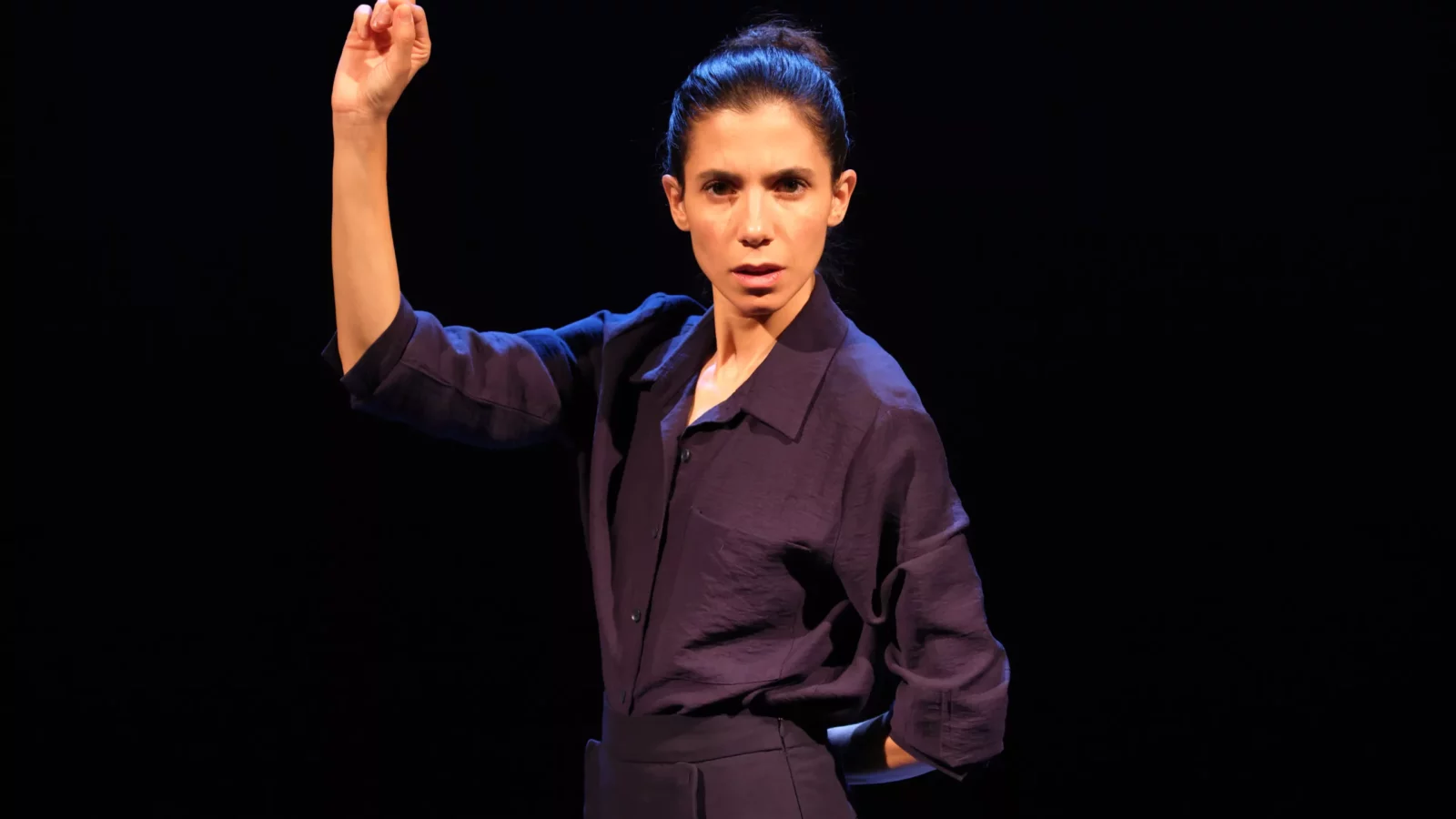
Cover photo: Teatro de la Abadía. Susana Martín
Painter, sculptor and writer, Leonora Carrington was one of the great creators of the 20th century. Marked by dark and painful episodes, she transformed those experiences into artistic material, which now director and playwright Alberto Conejero gathers in Leonora, an invocation of her “indomitable spirit,” performed by Natalia Huarte.
Leonora was “survivor of many shipwrecks”, Conejero explains in an interview with Efe, who, far from creating a “biodrama,” has built, from the autobiographical account Memories from Below by Carrington herself, a work about her early artistic vocation, psychiatric violence, her passage through postwar Spain and her “need to imagine.” Premiered in September 2025 at Contemporánea Condeduque, Leonora now opens the 2026-2027 season of the Theatre of the Abadía in Madrid, where it can be seen from September 3 to 13 in a co-production between Teatro del Acantilado, Come y Calla and Condeduque. Conejero presents this play coinciding with the autumn release of the film La bola negra, by Javier Calvo and Javier Ambrossi, in which he also participates as screenwriter.
Norn in 1917 in the United Kingdom, Carrington was a woman “who fought and struggled to become a creator”, a woman who “rose to her vocation to survive”, in Conejero’s words. “We witness the forge of a creator, how a woman becomes an artist,” explains the director, who discovered the artist on a trip to Mexico: “I saw one of her sculptures and I was fascinated. I was drawn to her biography and to discover that some fundamental episodes of her life took place in Spain.”
Moreover, the director intends to “invoke her spirit” and provoke in the audience the same sensation he felt when meeting Carrington, so that they want to discover her work, without seeking to “usurp her voice or occupy her place.” “My friends tell me to close my eyes, but I want to look at the horror of the world,” Carrington says, via Natalia Huarte, who travels to the painter’s childhood in the United Kingdom, passes through her youth in a Europe at war, and arrives at her exile in Mexico, the country that welcomed her until her death in 2011.
Huarte interprets the artist on an empty stage, a “blank canvas” with “infinite possibilities”, explains Conejero. “It is only me; then it becomes a playground, of painting and of discovering wild animals with my body,” says Huarte, who seeks to convey ideas of freedom, nudity and vulnerability through her interpretation and to make the text and the movement the protagonists of the show. “Leonora was a wild woman, irreverent, indomitable, vital, very free for her time, daring, and with a vocation and a desire closely connected to her actions,” notes Huarte, who says she connected with the artist by “calling her directly.”
Conejero and Huarte hope that the audience connects with the game of imagination, that they “switch off the screens” and understand the work as a blank canvas with infinite possibilities.