
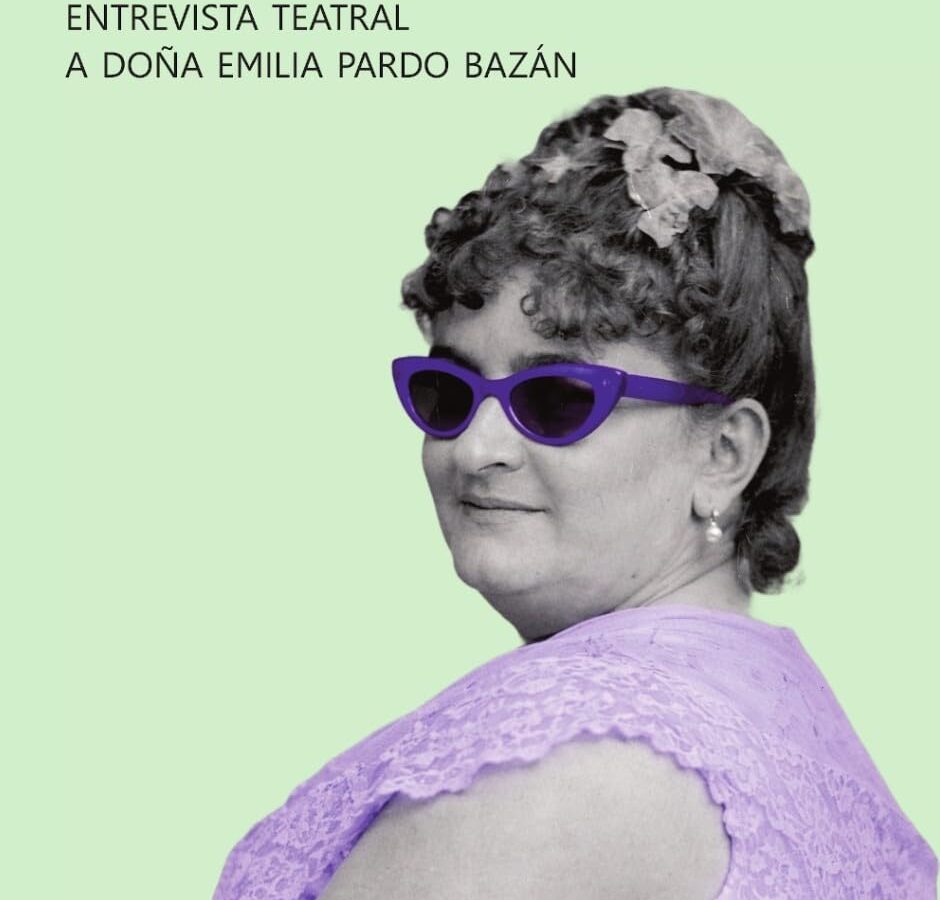
With extensive academic and intellectual training, paired with a pedagogical concern, Dr. Concha Fernández Soto offers us a conversation with the first woman to reach the rank of full professor at a Spanish university, Doña Emilia Pardo Bazán, who always remained in control of her own destiny. It is not the first time that Fernández Soto approaches exceptional women such as Carmen de Burgos, María Teresa León, or María Moliner with depth.
It remains paradoxical, or at least curious, that this illustrious Galician woman triumphed in several literary genres, yet not in theatre, and that she now steps onto the stage as the sole protagonist, revealing to us her literary career and her journalistic facet — not forgetting her work as a literary critic.
Fernández Soto delves into Doña Emilia’s life through an interview for the newspaper El Liberal, founded in 1879 and oriented toward liberal republicanism, widely read by the public and characterized by its clear language, its concern for the problems of the people, and its rigorous reporting, albeit with a certain sensationalism.
As an introduction, the text begins with the presentation of generic characters: actor, actress… It consists of eight scenes numbered and titled, in addition to two epilogues. The spaces could be narrowed to two: the one where Doña Emilia and the journalist meet, and the one occupied by the editor and the editor-in-chief. Characters such as the actor, the actress, supporting actors, the author, the editor, the father, etc. are portrayed. Of vital importance are the brief stage directions and footnotes, which could serve as a reading guide and content expansion that enriches the reading experience.
With deft questions and answers, the author from Extremadura, based in Almería, displays several skills: breaking the fourth wall (p. 56); guiding us to understand the situation of women in the era (p. 51) and Emilia’s own situation as a woman (p. 53); the contemptuous and almost insulting treatment she received from the press (p. 55); or the relationships with close people. On page 56 the father appears, and in the following pages her mother and husband. Her life is recounted with irony and even sarcasm: the audacity of writing as a woman in the era without her husband’s permission (p. 61), Emilia as a mother and her first child (p. 63), her craft as a writer, the positions she held (p. 66), the insults she endured (p. 67), her friends Galdós (pp. 68 and 71) and Lázaro Galdiano (p. 70), her novels (p. 72), theatre (p. 79), the RAE… Thus, the succession of biographical episodes is not merely documentary in intent, but contributes to reconstructing on stage an intellectual personality confronted with the limits imposed on women of her time.
And all this is viewed through the lens of a sensationalist editor (p. 62), since the dramaturgy begins from a fictional situation in which Doña Emilia, now elderly, is interviewed by a journalist who must follow the instructions of an editor whose aim is to obtain morbid content. Yet both confront the intelligence of this woman.
The volume opens with a few words, in the manner of justification, from Concha Fernández Soto, who shares with us her approach of a “restorative” reading of the famous Galician figure. This is followed by “Prologue Words,” written by five specialists in the life and work of Emilia Pardo Bazán: María Pilar Panero García, Cristina Patiño Eirín, José Luis González Subías, M. S. Suárez Lafuente, and Elena Freire Paz. The pedagogical character of the volume is thus evident. Before the dramatic text, we may also read brief notes on Fernández Soto’s career.
Now it is the readers’ or spectators’ turn. This is the moment to discover this metatheatrical game, to understand the title’s significance and why it appears in the last scene; the reason each scene bears a title that recalls the traditional way of dividing narratives. Why do Galdós, Gregorio Martínez Sierra, María Lejárraga, Gómez de Avellaneda, Concepción Arenal, Lázaro Galdiano, Balbina Valverde, Loreto Prado, Pastora Imperio and two newspapers of the time, El Imparcial and El Liberal, appear? It is, in short, the moment to meet this persevering woman and to value her for herself. The carefully crafted structure of the work allows the reader to delve into her trajectory without losing track of chronology or the numerous topics addressed.
The pedagogical concern, her love of theatre, and her will to give visibility to female authors do not end with this newly edited volume, but very soon her next book will see the light, whose title is Inspiradas, a theatrical collective edition in the line in which she has been publishing: women teetering on the brink of madness.
—————————————
Author: Concha Fernández Soto. Title: The Salamander in the Helmet: A Theatrical Interview with Doña Emilia Pardo Bazán. Publisher: Antígona. Availability: All Your Books.