
To commemorate the 90th anniversary of the Civil War, José Ángel Mañas recreates in Zenda, day by day in this section, what happened in 1936, perhaps the most pivotal year in all of Spain’s recent history.
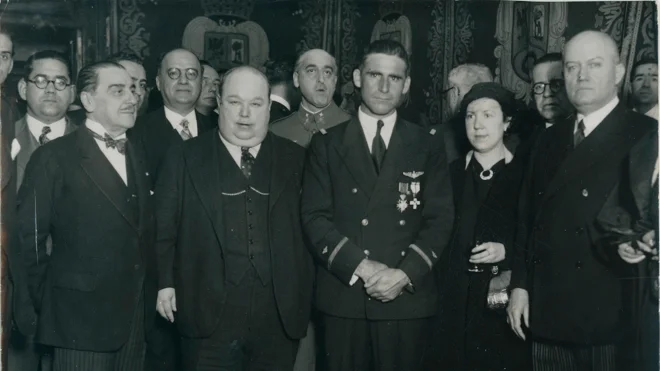
Wednesday, September 2, 1936: Don Pedro Rico, mayor of Madrid
What are those voices?
—One from the CNT of Carabanchel. A secretary of Supplies who insists on seeing him.
—Tell him that, although I sleep here now, I do not receive anyone until after breakfast.
The secretary left the office where Pedro Rico was having a coffee with milk and his plate of porras. On the table he had the ABC opened to the page that spoke about summary trials in La Modelo; the Socialista; the CNT, the Heraldo. The international edition in French of the Pravda stood out. The mayor read it since the correspondent Mijail Koltsov was in Madrid. They already knew each other, and Pedro Rico had a certain affection for him, he thought as he dipped the last porra in the coffee and swallowed.
For weeks he had not left the City Hall, in the Plaza de la Villa. There he slept in a room adjacent to his office. He hardly went out into the streets. Not at night, and by day only accompanied by his escort. Even if for security, he was also working as never before during a month of August in which, under other circumstances, he would have been on vacation. One had to guarantee the city’s supply.
—Things look bad —he pushed the ABC aside and picked up El Socialista.
He was not in favor of creating people’s tribunals, but, like many Republicans, he thought the circumstances forced it. Always better to have a semblance of legality than chaos. Anyway, his main duty was provisioning. He never thought that this second term of his would be so complicated. During his first term as mayor in ’31, Rico became famous not only for the 130 kilograms of weight that made him the most recognizable municipal authority, but for popular decisions such as opening the Casa de Campo to the public, taken in collaboration with Prieto.
He had just swallowed the last bite of his porra, a drop of coffee staining the cover of El Socialista, when the door opened and a furious man burst in, his secretary trying to hold him back in vain.
—Sorry, Mr. Rico, I couldn’t hold him back….
—Don’t worry, I was almost finished. Leave us alone —the mayor closed the newspaper and looked at the militiaman, who stood on the other side of the table—. I was reading the press and planned to receive you right now. Sit down.
—I don’t have time. I am Ángel Navarrete, secretary of the Carabanchel section of supplies.
Pedro Rico suppressed a sigh. He was in shirt sleeves. Sweat rings were already visible under his armpits.
—Then you will know that I am doing everything humanly possible to prevent shortages. I have spent the whole month speaking with Barcelona. Companys has promised to ship cod, but no matter how much he swears that it’s on its way, we still receive nothing. I have also given a million pesetas in advance to the Valencians as a guarantee. I also send trucks daily to fetch sugar, coffee, and milk, for the stores and for the twenty thousand rations daily for the families of militiamen fighting in the Sierra. I have even authorized that trucks from the Café Lyon go out with beer and ice cream for the front. There is nothing more I can do.
—There is always more that can be done —replied Ángel Navarrete—. What you say may be true, but know that in Carabanchel the only fish truck since the uprising arrived on July 29. Since then there has been no fish. And I am not even mentioning the abandoned gas stations, the fruits that do not exist, and other shortages reported by the union.
—Then it won’t be because I don’t stand behind your vouchers. I am already disbursing more than I ought to. So what is it that you want?
—For us to be authorized to send union trucks to Valencia to stock ourselves.
—And what else, man! Let nobody pay for electricity or rent, but letting the markets starve is not acceptable. What I can propose is to gather the leaders of the Confederation and those of UGT to organize, in a coordinated manner, the supply. But the City Council of Madrid cannot relinquish the leadership. It is their main duty.
All the entries of 1936 Day by Day
Interview with José Ángel Mañas about 1936 Day by Day