
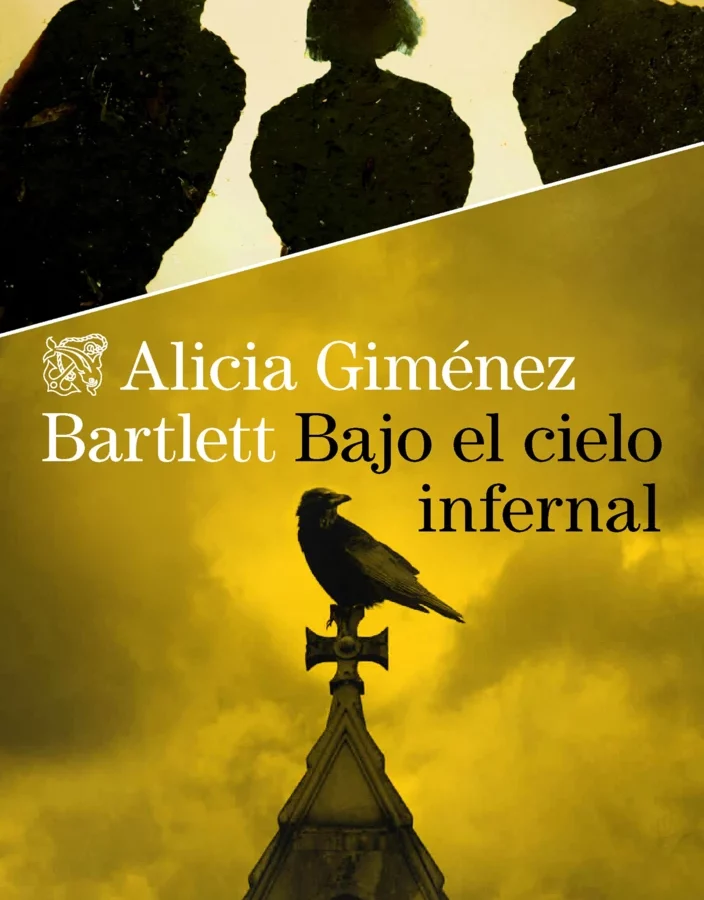
Alica Giménez Bartlett began writing the Petra Delicado series in 1996 with the novel Rites of Death, which already demonstrated the author’s mastery at the height of her craft. Thirty years later she publishes Under the Infernal Sky (2026), the fifteenth installment of an extraordinary body of work, built on the appeal of a character that readers take to immediately. Petra Delicado has won readers over for the consistency she has shown over time, for never betraying herself, and for generating a sense of familiarity that, however, never slides into routine. Despite her rough exterior, she possesses self-criticism, feels compassion for the vulnerable, and remains loyal to her own people.
In principle,
Under the Infernal Sky
follows the usual structure of a mystery tale: confronted with a horrific murder, the investigation begins with the close circle of family and, if nothing convincing emerges, it probes the social or professional surroundings.
But Alicia Giménez Bartlett has too much talent and wisdom to overlook the risk of repetition
and immediately gives Petra Delicado a line of reflection that feels more meta-literary than police-driven: “I am tired of always using the same dynamic: visit, question, answer, we find no evidence and, therefore, goodbye. I feel the urge to have some fun.” And a few pages later, an unexpected event provides the novel with a new uplift.
In this instance, the stabbing death of a Jesuit directs the investigation toward the ecclesiastical world, a hermetic community governed by its own codes and laws. As a priest states, “the matters of the Church stay within the Church, whose wall of silence has been practiced and perfected for centuries”.
Although the theme of dead religious figures has not been a frequent topic in crime fiction—since it was almost taboo that the killer or the victim be a priest—it is not new. It already features in one of the pioneering Italian detective novels, the splendid The Priest’s Hat (1887), by Emilio de Marchi.
But now, in the twenty-first century, the candor of Father Brown is far in the rear view, and there is no shortage of contemporary works in which a priest is implicated in some way, not to mention the monk-killers of Umberto Eco and Lorenzo G. Acebedo in The Name of the Rose and The Tavern of Silos. In the short story The Death of the Photographer, by Henning Mankell, a Protestant pastor kills his wife’s lover and Wallander says: “Why not? Pastors are pastors, but you’ll agree with me that they are only people.”. And indeed Ricardo Piglia, Olga Tokarczuk, and Benjamin Black have also involved clergy in crimes. Giménez Bartlett herself had already ventured into this milieu in The Silence of the Cloisters (2009).
Beyond this thorny topic, the novel also vividly depicts the problems of troubled adolescents, in that confusing age when they are no longer children and are not required to shoulder the same responsibility as adults, even though they possess the same capacity to cause harm. Petra Delicado moves among them, balancing on a precarious edge, observing their issues within a harsh family and social environment (all the love they had received “could fit into a thimble”) and she exclaims to herself: “What a clairvoyance I had to decide that my lineage would end with me!”
Similarly, it is curious that in a crime novel, where the theme of death is central, there is talk of bereavement groups to ease the pain it generates. From this emerge excellent passages centered on Petra herself: she, who has seen so many deaths from the outside, must now confront the pain from within (a sense that is made even clearer by the opening dedication, so serene, so emotional and eloquent). And this is no spoiler, since in the very first sentence of Under the Infernal Sky it is stated that her husband, Marcos, has died, leaving her in a state of deep desolation.
As a character, Petra Delicado grows in this terrible situation, opening a new dimension for her. So rational in her professional work and so relentless before crime, she finds herself powerless before the intrusion of personal tragedy. The tenacity and common sense she brings to her investigations do not help against intimate grief. In both the opening and closing pages of the novel her humanity and fragility are laid bare, which she tries to hide behind her constant irony.
Yet her sorrow does not prevent Petra from dedicating all her energy to clarifying the Jesuit’s murder, and she attentively listens to every word from the suspects, all carefully sketched: a priest who resembles the dómine Cabra, a modern young cleric with earrings, a few disoriented teenagers, a persistent psychologist, a relentless businessman, and even a caveman-like peasant. The statements can be infinitely banal or infinitely relevant, but, as in any good detective story, none are indifferent. Though absorbed in mourning, her assistant, Fermín Garzón, understands that the best therapy for her is work, and he compels her to lift her head and look out at the world, so they both set to investigate with their usual tenacity, watching how passions and desires drive people toward destruction while their God remains indifferent in the depths of the sky.
And everything is narrated with a very agile rhythm, full of dialogue, among which are occasionally inserted Petra’s interpretations of what she hears and sees, always timely and well integrated into the plot.
When selecting the names of her protagonists, Alicia Giménez Bartlett had already shown a fondness for oxymorons. In the name Petra Delicado, two opposing meanings are harmonized: the hardness of stone coexists with a hidden tenderness. The same device appears in the name of her partner, colleague and friend Fermín Garzón. Fermín is to Petra what Garzón is to Delicado.
In this latest novel, the oxymoron reappears occasionally in the text (“inactive activity”). And it also shines in the splendid title: Under the Infernal Sky.
—————————————
Author: Alicia Giménez Bartlett. Title: Under the Wintry Sky. Publisher: Destino. Sale: Todos tus libros.