
To commemorate the 90th anniversary of the Civil War, José Ángel Mañas recreates in Zenda, day by day in this section, what happened in 1936, perhaps the most pivotal year in all recent Spanish history.
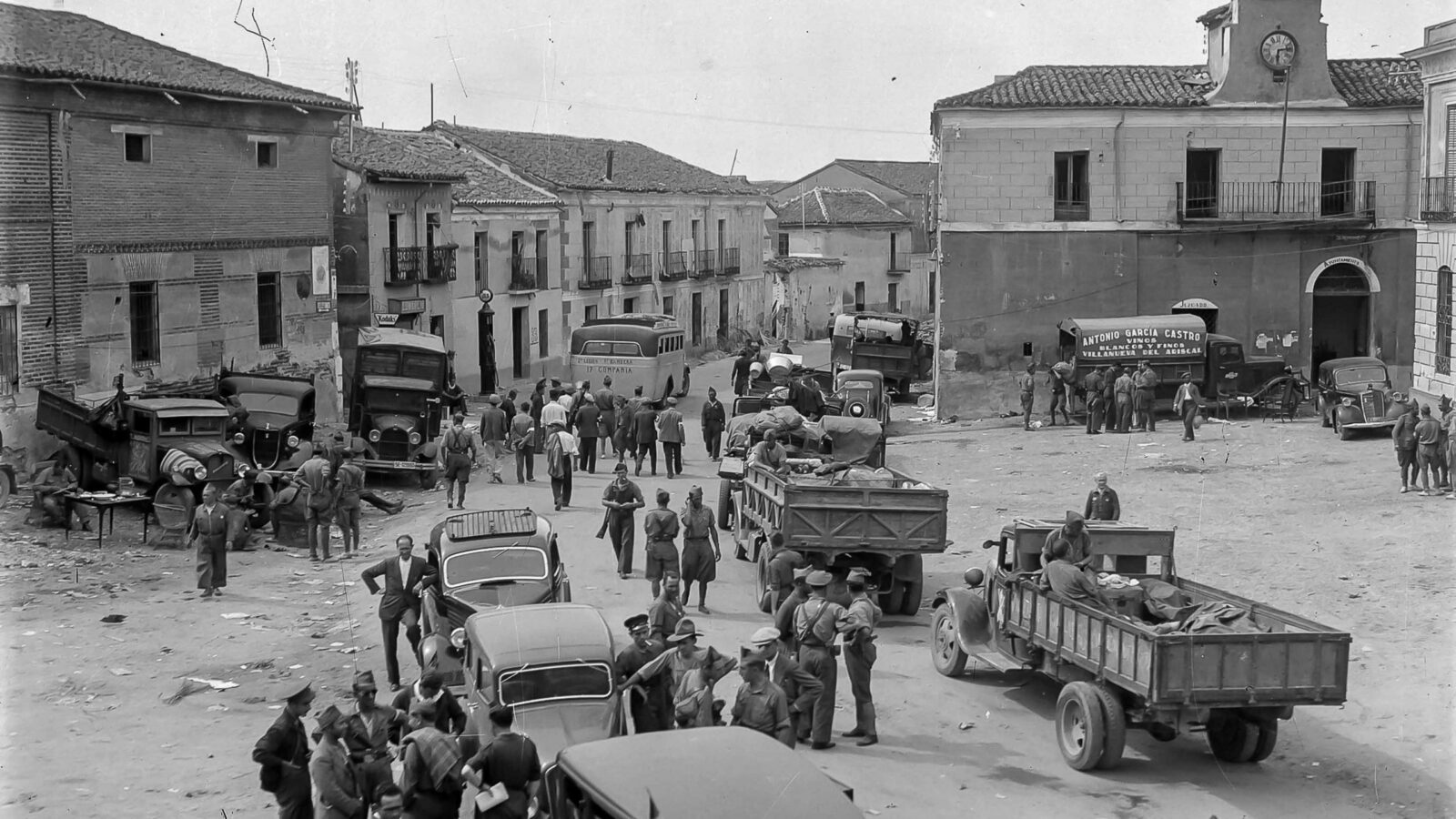
Thursday, September 3, 1936: The Fall of Talavera
The Soviet brigadier general Vladimir Gorev had arrived as a military advisor and was tasked by Moscow with distributing Soviet war materiel. That day, Gorev was seated beside Koltsov and an officer in the Republican positions on the hills surrounding Talavera de la Reina, along the road that linked Madrid with Badajoz, less than a hundred kilometers from the capital.
Around him, several Spaniards held old rifles, and the column’s military chief carried a short Winchester. Behind them, buildings hit by rebel artillery smoked. Koltsov, seated beside Gorev, looked toward the city with the twins. After a moment he murmured: “We will leave Spain without having seen Yagüe’s Moros.”
—Well, look, said the Republican officer, I, on the other hand, believe that within two hours, in this very spot where we stand, there will be a dark-skinned man wearing a turban or fez.
—You doubt the government’s forces —replied Koltsov, turning his head.
—I’m only stating the reality: look around you.
It was late in the afternoon. Bullets hissed overhead. The number of Republican fighters continued to dwindle. As the day wore on, more and more men rose to drink or relieve themselves, and did not return.
—Look at that one there, who forgets his rifle and abandons his post… At least take him to the rear, so someone else can have him! And in Madrid, drink a good vermouth to my health!
—Comrade! —reproved Gorev—You’re encouraging them to go, when your mission should be to keep your unit in place, even if it costs shooting deserters.
The fascist fire intensified. The Republicans replied with quick shots, and the officer fired his rifle, not hitting his mark.
—This is not Europe, boss —he said—, not even Russia. This is Africa. And it’s true that, unfortunately, I do not trust these militiamen, what can I do. I should now rally them and attack the enemy where they advance with little strength. The problem is I tried something similar this morning and they wanted to shoot me for leading them to where the enemy could enclose them. If it weren’t for your comrade Lister, I wouldn’t be alive. You Russians are tremendous. You pretend to give lessons to everyone. That gives you a bad reputation among almost everyone except the military, and with good reason. If I were Largo Caballero, instead of worrying about creating a professional Army, what I would do would be to send these men to spend three months in Russia, or at least in the Communist Party. From there they would indeed be trained.
There was a nearby explosion. Some militiamen rose, ran in all directions. Soon three Junkers flew over: Gorev and Koltsov lowered their heads. Gorev, beside himself, muttered that nowhere in the world was there so much indiscipline.
—But look at them. See how they all run. Like rabbits!
This time the Republican officer did not laugh. One thing is to criticize one’s homeland; another is for others to criticize it.
—You seem to have spent little time in Spain —he said. —But don’t be mistaken. Those men are capable of great sacrifices. When we tally the losses, the number will be very high. The problem is that most are workers and peasants, and that is all they have known. They lack training. And that cannot be obtained in two days.
The Junkers moved away. The militiamen crowded around the parked buses on one side of the road. Some got in. Others ran toward Talavera. Along the road, ruined by explosions, cars, carts, pack mules, and donkeys with belongings gathered. Refugees crossed in a long line the iron bridge over the Tagus. On the other side there were houses, factories, and churches in flames. At the base of the bridge, the dynamiters under General Riquelme worked, preparing the blast.
—Let us yield to the evidence, comrades. Talavera has fallen, and with it falls the last major obstacle for the rebels before reaching Madrid.
All 1936 day-by-day entries
Interview with José Ángel Mañas about 1936 day by day