
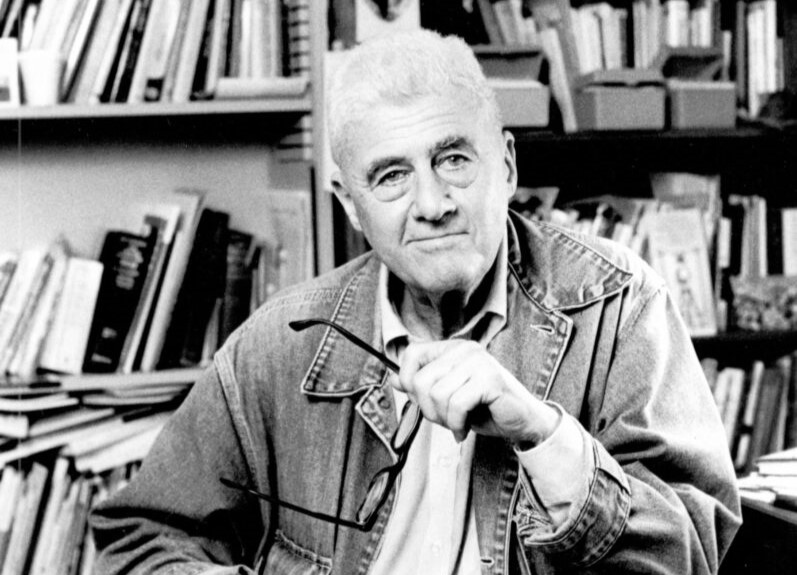
Cover: Howard Nemerov.
This Friday, within the section Not all who are here, we present the seventh list of great American poets whose work could rightly be regarded as classical or influential for the current generations of poets in their country. Step in and read. These are the ones who are here this week, and those who are not will come later.
***
TONY HOAGLAND
Tony Hoagland was a poet and critic born at Fort Bragg, North Carolina, in 1953. He published the poetry volumes Sweet Ruin (1992, Brittingham Prize), Donkey Gospel (1998, James Laughlin Award), What Narcissism Means to Me (2003), which was a finalist for the National Book Critics Circle Award, Rain (2005) and Unincorporated Persons in the Late Honda Dynasty (2010). He also published the poetry essay collection Real Sofistakashun (2006). He died in Santa Fe, New Mexico, in 2018. He is one of the essential critics for understanding contemporary American poetry. We present a poem with translation by Gustavo Osorio,
How It Adds Up
There is the day I swam in a river, a lake, and an ocean.
And the day I quit the job my father had gotten me
And the day I stood outside a door,
and heard my girlfriend making love
with someone, obviously not me, inside,
and I felt strange because I did not care.
There is the morning I was born,
and the year I was a loser,
and the night I won the prize
for which the audience applauded.
After that there is someone else I met,
whose face and voice I cannot forget,
and her memory
is like a prison in which I am trapped,
or perhaps she is just something I use
to keep my real life at a certain distance.
Happiness, says Joe, is a red wildflower
picked from a river of lava
and held aloft by a taut rope
dangling between two scrawny trees
over a canyon
in a manic-depressive windstorm.
No let it go, No let it go, No let it go –
And when you do, you’ll continue to search for it
everywhere, for years,
while behind you,
the footprints you leave
will look like notes
of a crazy song.
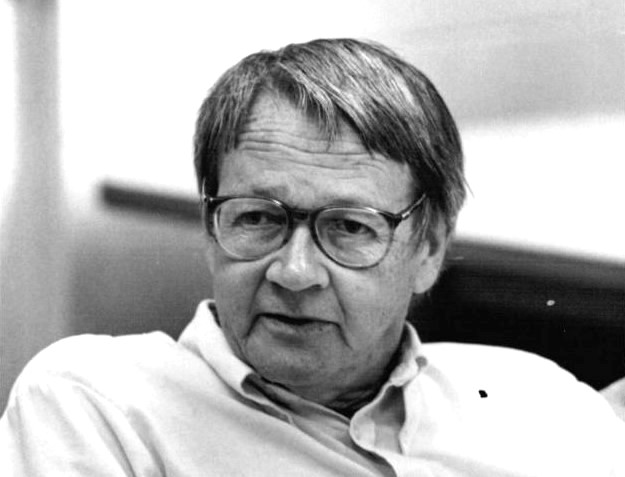
Donald Justice.
DONALD JUSTICE
Donald Rodney Justice was a writing professor and poet born in Miami, Florida, United States, in 1925. He taught many years in the writing program at the University of Iowa. He also taught at Syracuse University, the University of California at Irvine, Princeton, and the University of Virginia. He published thirteen poetry collections, notable among them The Summer Anniversaries (1960), for which he won the Lamont Poetry Prize awarded by the Academy of American Poets, or Selected Poems, for which he won the Pulitzer Prize for Poetry in 1980. His work has been compared to that of poets such as Elizabeth Bishop, Thom Gunn, or Philip Larkin. He died in 2004. We present a poem with translation by Mijail Lamas.
Men at Forty
Men at forty
Learn to close doors very slowly
To rooms they will not return to.
Stately on a step
They sense the deck move
Like the hull of a ship beneath them,
Even though the sea’s calm.
In the depths of the mirrors
They rediscover
The face of the boy who practices tying
In secret his father’s necktie
And the face of that father
Still warm beneath the mystery of shaving foam.
Now they are more fathers than sons.
Something fills them, something
That is like the crepuscular sound
Of crickets, immense,
Filling the woods at the foot of the slope
Behind their mortgaged houses.
***
PHILIP LEVINE
February 14
I wake at a dawn from thirty-six years ago and see
its eyelids opening,
welcoming me. I recall
how she surrounded me with her long arms, I remember
until the moment is lost
in the hours of forgetfulness.
The rest of our lives
is the tree behind the window
that moans with the wind. In other rooms one hears
the murmur of other houses, but we do not care
and we keep listening
until our names merge with the wind. A bare room,
without curtains,
in a city long forgotten,
welcomes us in the wide
and immeasurable light. Also
accompanies us a melody. We hear it
in the small lagoons
where winter’s waters meet,
in the cold raindrops that fall
from the eaves
to the puddles formed
on the tiny plains. Six weeks
and the whole world will have greened again.
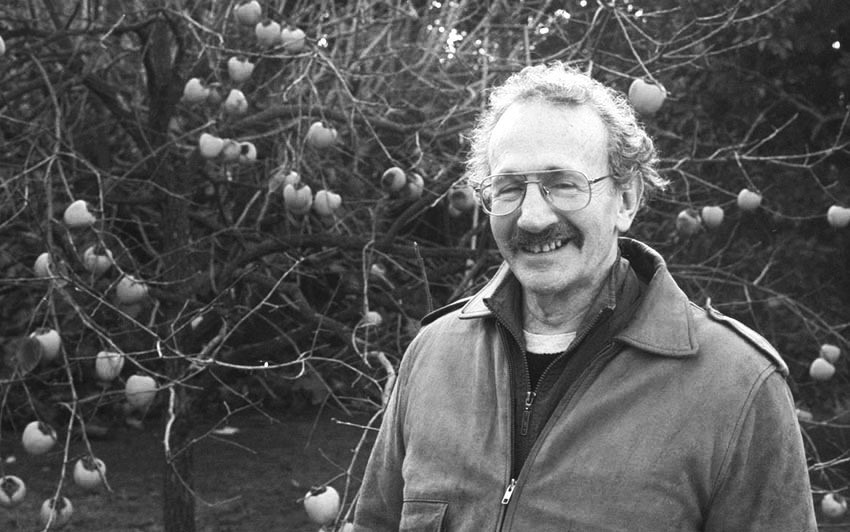
Philip Levine. Photo: Russell Frank.
HOWARD NEMEROV
Howard Nemerov was a poet, novelist, and literary critic born February 29, 1920, in New York. He was the third Poet Laureate of the United States and author of more than twenty books across poetry, criticism, fiction, and short stories. At the time of his death, he held the position of Distinguished Professor of English at Washington University in St. Louis. His work, recognized with honors such as the Pulitzer Prize (1978) and the Bollingen Prize (1981), leans toward formalism, employing meter, rhyme, and classical forms rather than the free verse that proliferated in twentieth-century American poetry. He died on July 5, 1991. We present a poem with translation by Germán Carrasco.
To the Mannequins
Adorable images,
plaster-white
field lilies,
you are not alive so that the pathos
will be out of place.
But I have learned
a fact about your fate,
and it is this:
after you go out of fashion
under your many fashions,
or when your elbows and knees
have been battered until they are white as dust,
so that you are of no use to anyone
they will strip you of your dresses,
your mourning gowns and your swimsuits,
leaving exposed to all men
your inaccessible wombs
and senseless nuptials.
The carriers will come at night
and load you into trucks
and take you to camps,
where soldiers, or the State Police,
will use you as targets
for small-arms practice,
which leads me to wonder,
since pathos is out of place,
what is it that they are practicing?
***
LAURA RIDING JACKSON
Laura Riding Jackson was a renowned North American poet and critic, born in New York in 1901, remembered for her landmark work, Collected Poems (1938), and for her radical renunciation of poetry in 1941 for deeming it “inadequate” in the face of the truth of language. Her modernist style seeks the pure essence of words beyond literary artifices. She died in Wabasso in 1991.
Saturday Night
The farmers’ wives and all the town’s wives,
the husbands, the young men who look at the feet
of the women as if they fear they might blush
if they looked at the rest,
the old men who politely spit in the sewers
and all the Salvation Army crowd
(There must be more than faith to sustain the voice
of those Salvation Army girls so high
above the indifferent crowds),
and also the bewildered children and dogs;
I wonder if they’ll like to think they have reached
heaven at last, that they walk vaguely among themselves as ghosts, knowing that ghosts
are silent and invisible, and that they themselves
blunder in the shadow of Saturday night business.