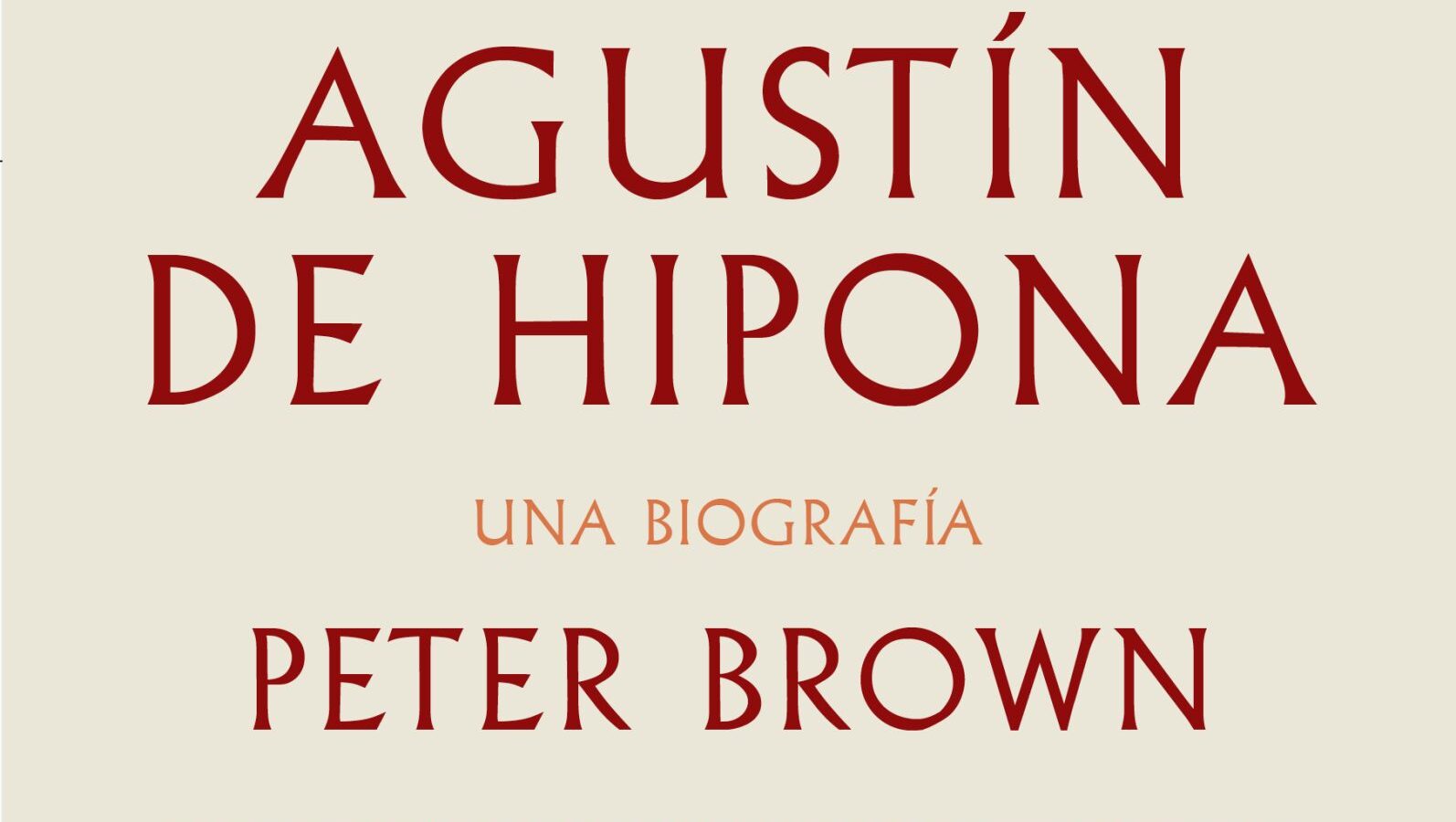
I’ve been pursuing Peter Brown’s book on Augustine for quite some time, and there was no way to find it, not even in that bazaar for bibliophiles into which Iberlibro has transformed. Luck — or perhaps, putting ourselves in Augustine’s shoes, providence — has deigned to grant us this careful reissue, including a substantial prologue. To be frank, however, once the volume sat on my desk, it resisted me. It took a few months for me to finally dare to take a bite and discover that what happened in a world as distant as the fourth century of our era has a great deal to do with us, the men of today.
The figure of Saint Augustine is as gigantic as the tangled events and vicissitudes of the late antique period in which he lived
. And surely Leo XIII, an Augustinian, will keep it in fashion from now on. Peter Brown, emeritus professor at Princeton University and a scholar of impeccable reputation, possesses a skill that is sometimes scarce among historians, but when he demonstrates it, it makes possible for them to offer works and studies as thrilling and staggering as the best novels. In this case, the Irish scholar provides strokes about the political and cultural situation in a zone of Romanization, namely the north of Africa, about which history books scarcely provide news.
No estamos, como ya habrá podido colegir el lector, ante una hagiografía. Agustín appears as what he was: a capable Roman, an intelligent man, a brave bishop, but with a soul sown with doubts and weaknesses. That is the most notable aspect that emerges from the analysis of this figure who helped to almost definitively shape Catholicism. He did so by facing, as the early Christians did, the philosophical currents of his time, in order to appropriate what in them he found compatible with the message of Christ, but also to condemn those postulates that did not accord with it.
The pages of Brown have the merit of countering the poison that decades and decades of presentism have inoculated into our way of understanding the centuries that precede us. Because of this, it would be a mistake to think barren or desolate intellectual wastelands extend into the periods before the Enlightenment. Brown reveals just the opposite: even in zones of Christendom today forgotten, the discussion and mingling of theological currents, sects, schools, and philosophical movements — without neglecting the diversity of political sensibilities — proved so explosive that they threatened life in villages and cities as well as the empire’s overall stability.
But before living outward and settling scores as a prelate, Augustine had to confront and master his interior. If it were not for the anachronism, we would be tempted to see him as a romantic. He had a volcanic spirit, a spirituality that erupted at the proximity of truth, as well as of sin, vulnerability, or tragedy. His wit owes to Catholic faith not only some of the most accomplished formulas of his dogmas, but also his familiarity with the miserable condition of humanity, his approach to forgiveness. The bishop of Hippo wished to retire, dedicate himself, after the successes of his public life in the Empire’s major cities, to philosophy, prayer, and the recitation of psalms. He sought, in short, to cultivate those contemplative pleasures in which the classics framed a happy existence. But the situation of the ecclesial community and, precisely, the zeal of the believers, pulled him from his quiet retreat.
Over the course of his long life, Augustine wrestled with the tension between his apostolic activism and his inclination toward silence, solitude, and study. It is precisely that duality that also shines through in his correspondence. Only a few months after the reissue of Brown’s voluminous biography appeared in bookstores, an exquisite edition of his Philosophical Letters surfaced, which reveals, beyond the saint’s varied intellectual interests and the detailed path of his intuitions, the high awareness he had of friendship, especially of a spiritual kind.
According to the editors of this work, the philosophical letters constitute roughly one-tenth of the saint’s total preserved correspondence. The letters collected in this volume begin precisely at the moment of his conversion and extend up to the year 415. There are those he wrote, for example, to Jerome, with whom he did not always get along: with him he debated aspects related to orthodoxy and Scripture. Be that as it may, we discover in all of them a sensitive soul, willing to dialogue about the nature of the spirit, virtue, or the drawbacks of certain philosophical postures without any holds barred. But there is also a discernible evolution, as well as the exercise of his responsibility as Bishop of Hippo.
Both the reissue of Brown’s work and that of the letters reveal not only that Augustine was a giant in the history of culture or philosophy, as we already knew, but also that his magnitude rests on reasons that the manuals of the history of thought barely sketch. In this sense, what has harmed Augustine most has undoubtedly been Augustinianism, that invention of a posterity that had only read Augustine of Tagaste between the lines. Brown lays bare his contradictions while explaining why he fell into them. The letters, for their part, reveal a Christian thinker who was always chasing truth and to whom the discovery of it in the Gospel did not fail to arouse as much admiration as doubt.
—————————————
Author: Peter Brown. Title: Augustine of Hippo. Translation: Santiago Tovar and Rosa Tovar. Publisher: Taurus. Sales: Todos tus libros.
Author: Augustine of Hippo. Title: Philosophical Letters. Translation: Manfred Svensson and Patricio Domínguez. Publisher: Trotta. Sales: Todos tus libros.