
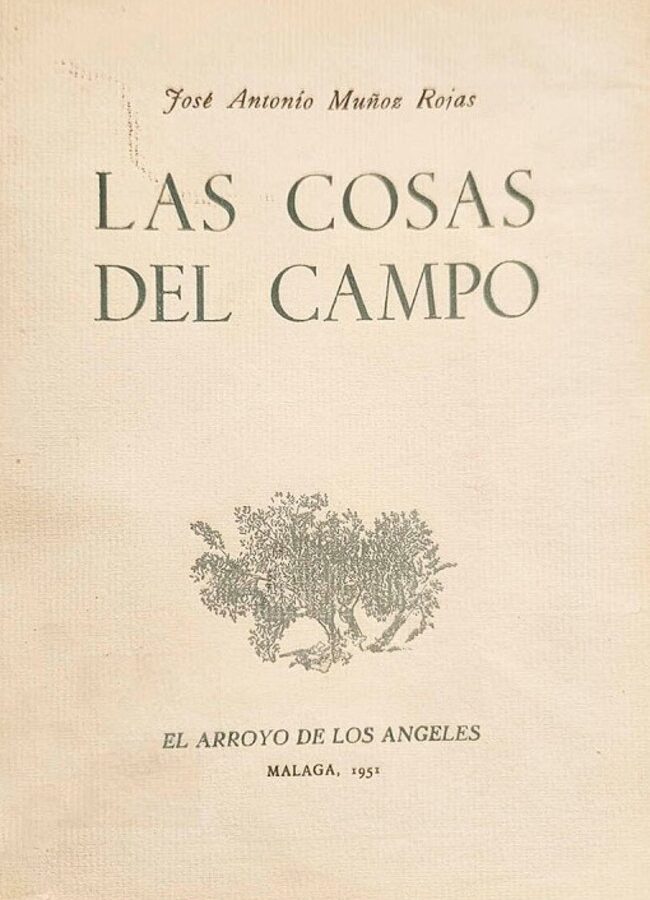
The passing of the years is beginning to render justice to Las cosas del campo. It now sits alongside Platero… and Ocnos to declare its significance. It is fitting, though it resembles them only vaguely, because this book by Muñoz Rojas is neither elegy nor mirror. In seeking its likeness, it lay in its own future. It has become, half a century later, the work of Mónica Fernández-Aceytuno, the closest to him and the one that has helped most to understand him: notes on nature, understood as a place of life (“we keep living”) and as a repository of a form of beauty assimilated to it: a whole without hierarchies or appearances, ubiquitous, with everyday secrets offered to the vigilant gaze (“one must know how to see them”).
And to name them, one must know how to name them (“how long will I keep ignoring your names?”), because in the writing of this bouquet of wild prose, nearly Franciscan in spirit (“so much beauty in so little space”), there is much of rescue, of salvation through the voices that name the creatures, the news, and the farm implements.
“We ride on a horse and I hear behind me: —Since the land is so sticky, the fences are draped in mourning and one cannot plow.” The poet remains thoughtful after the listening (“the tips of the fences darken, the tips of the fences darken”) and discovers in the accuracy of the land’s words his working tool and the reason to which his own craft must be devoted.
There are also people, portraits of beings who cling to the earth, who will return to the earth, and who pass into the pages of the imagination. In the same way, at the boundary between art and life, the book is made, aligning with the rural cycle, from spring to winter, and it bears the four movements of a sonata. Some leaves cross the borders, boarding the transitions from one season to another. The countryside, for José Antonio Muñoz Rojas, is the place where humanity lives with what completes a person and gives him a reason to be. The writing fixes the encounter through words and settles knowledge on the palm of the idyll. It is consummated in a tremor: “Have you not seen an oak in bloom? You have not seen anything of such tremor and nobility.”
That tremor begins in the gaze and is shared when it is noted (“when the holm oaks bloom, you have to tremble”). Such coexistence allows a transcendent feeling of life, the incorporation of the human into a natural time: “I feel strangely eternal.” “Tierra eterna” is precisely the title of the final entry in this lyrical peasant diary. “What dies? All of this goes on,” he notes. And he adds: “the countryside is the tale that never ends.”
————
Note regarding the 75th anniversary of the first edition ofLas cosas del campo, by José Antonio Muñoz Rojas. This year 2026 it is reissued within the first volume of hisObra completa en prosa, published by Pre-Textos.