
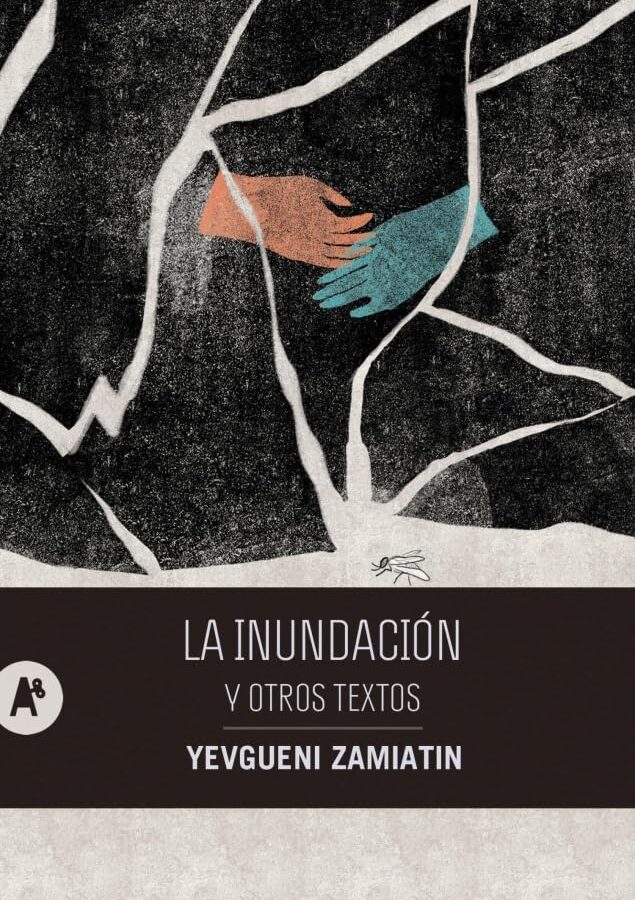
Automática revisits the author of We, the precursor to 1984 by George Orwell. In this volume it collects two stories — along with other texts — in which survival and the oppressive environment are central.
At Zenda we reproduce a fragment from The Cave, a story included in The Flood and Other Texts (Automática), by Yevgeny Zamyatin.
***
Glaciers, mammoths, tundras. Dark rocks, black, vaguely resembling houses; in the rocks, caves. And it’s not clear who prowls at night along the stone path between the rocks, sniffing the way, and whirls the white snowfall; perhaps a gray-trunked mammoth; perhaps the wind; or perhaps the wind itself is the icy roar of a truly enormous mammoth. One thing is clear: it is winter. And you must grit your teeth so they don’t chatter; and you must chop small firewood with a stone axe; and every night you must move the cavern’s hearth from cave to cave, deeper inside; and you must wrap yourself in more and more shaggy hides of beasts.
Among the rocks, where centuries ago there stood Saint Petersburg, a gray-trunked mammoth roamed at night. And, wrapped in furs, in coats, in blankets, in rags, the cavemen shuffled backward from cave to cave. For the Intercession feast, Martin Martinich and Masha sealed off the study; for the feast of the Virgin of Kazan, they left the dining room and crouched in the bedroom. Beyond there was nowhere to retreat: there one had to withstand the siege, or die.
In the bedroom-cavern of Saint Petersburg, everything was the same as not long ago in Noah’s Ark: pure and impure creatures, stirred by the flood. A mahogany desk; books; Stone Age cakes that looked like pottery; Scriabin, opus 74; a hot plate; five potatoes lovingly washed until they gleamed white; the nickel-plated bars of the beds; an axe; a wardrobe; firewood. And at the center of this universe, the stubby, rusty-red god of the caverns: the iron stove.
The god snores with a powerful voice. In the dark cavern, the great miracle of fire. Humans — Martin Martinich and Masha —, with reverence, in silence, grateful, stretch their hands toward it. For an hour, spring in the cavern; for an hour they shed the furs of beasts, the claws, the fangs, and through the frozen rind of the brain green shoots push through: thoughts.
—Mart, haven’t you forgotten that tomorrow…? Anyway, I can see you’ve forgotten.
In October, when the leaves are already yellow, withered, and vile, there are days with blue skies; if you tilt your head back on such a day, to avoid looking at the earth, you might believe there is still joy, that summer still remains. The same with Masha: if you close your eyes and only listen to her, you might believe she is the old her, that right now she will laugh, rise from the bed, embrace him; and that an hour ago — that knife through the glass — was not her voice, was not her at all…
—Oh, Mart, Mart! How is it that…? Before you didn’t forget. The twenty-ninth: Maria’s day,1 my saint…
The iron god kept snoring. As always, there was no light: they wouldn’t have it until ten. The cavern’s dark vaults, bristling with shadows, swayed. Martin Martinich, crouched, tied in a knot — even tighter! —, head thrown back, keeps looking at the October sky to avoid seeing the lips yellowed and withered. And Masha:
—Look, Mart. And if we light the stove tomorrow first thing? So the whole day is like now! Hm? Well, how much longer do we have? Is there still a battery in the study? It’s been a long time since Masha could go to the polar study and she didn’t know that there already… The knot tightens even more.
—A battery? More! I think there’s more there…
Suddenly, the light: exactly ten o’clock. And, without finishing, Martin Martinich closed his eyes hard and turned away: with light it was harder than in the dark. Moreover, with light you can clearly see: his face is wrinkled, clay-like (now many have clay faces: receding, toward Adam). And Masha:
—You know, Mart? I would try… perhaps I’ll get up if you light the stove from the morning.
—Of course, Masha, of course… A day like this… Of course, starting in the morning.
The cavern god was fading, shrinking, falling silent, barely crackling. You can hear: downstairs, at the Obértishev’s, logs are being chopped from a barge with a stone axe; with a stone axe they smash Martin Martinich to pieces. A fragment of Martin Martinich smiled at Masha with a clay smile and ground dry potato peels in the coffee grinder to make cakes; and another fragment of Martin Martinich, like a bird that had blown into the room, banged against the ceiling, dazed, blind, against the glass, against the walls: “Where to find firewood, where to find firewood.”
Martin Martinich put on the coat, cinched it with a leather belt (among cavemen there is a myth that this keeps you warmer), and in the corner, beside the wardrobe, he sounded the bucket with a loud clatter.
[…]
—————————————
Author: Yevgeny Zamyatin. Title: The Flood and Other Texts. Translation: Marta Rebón. Publisher: Automática. Available at: Todos tus libros.