
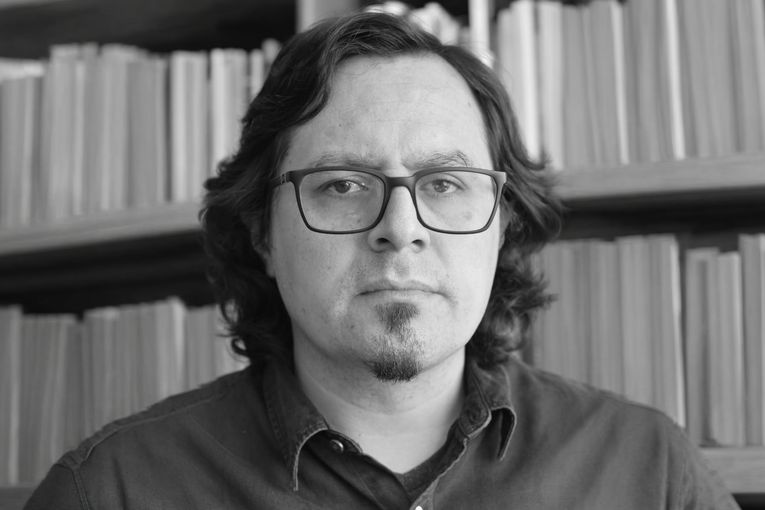
The Mexican narrator, essayist, and editor Alejandro Arteaga (Mexico City, 1977) has been recognized with the Xavier Villaurrutia Prize for Writers for Writers for his work Sala de máquinas (Editorial Gabinete Portátil), a remarkably original literary artifact whose proposal, described as poetic fiction, explores the links between technology, humanity, and literary creation through the stories of twenty-one conceptual, absurd, or impossible machines, revealing their foundations, construction methods, the testimony of their assembly, the incidents of their use, and the fate of their creators. In this manner, the narratives address, among other aspects, the adventures and misadventures of machines and fantastic technologies, such as an electronic magnifying glass that solves crimes and mysteries; a nineteenth-century aerostatic ship for landscape painters; a robot bard who wins a poetry contest; a walking tape that aids discernment; or an automaton city located in the Amazon. The storytelling, in a confident display of the author, employs diverse literary forms, including the epistle, the report, the journalistic article, the essay, the speech, and the sales sheet, which, in the words of the jury that awarded the Villaurrutia (Liliana Weinberg, Mónica Nepote, and Hugo Valdés), makes it “a fictional machine that shows an ability to overcome the distances between genres through a continuous practice of assemblage and transformation,” and opens the possibility for the book and literature to a “game between determinism and freedom, technology and humanity, automatism and creation.” As noted by maestro Roberto Pliego, if readers are enthused by his works such as Sick and McFarland: a pretentious novel, written in collaboration with Alfonso Nava, or Biblioteca mínima, a collection of notes in the manner of a back cover that comments on 33 apocryphal books, in Sala de máquinas the same temper exhibited in that book is recognized, but now ultra-concentrated, and it is highlighted as “one of the very sporadic earthquakes that in recent years have pulled Mexican narrative out of its slump.” A fair and well-deserved prize for an author who stands out with a work whose packaging is original and detached from the tired fashions of today. Salud.
APOYAR LA INDUSTRIA EDITORIAL MEXICANA ES URGENTE
Publishers and bookstores in Mexico face increasingly difficult conditions, including the reduction of spaces for the circulation of books and the absence of a permanent public policy to promote the book and reading. As recently warned by the Cámara Nacional de la Industria Editorial Mexicana (Caniem) in a statement signed by its general director, Antonio Alonso González, the guild is deeply concerned and has issued a message of alert and assistance to President Claudia Sheinbaum about the closure of Ediciones ERA, a case they insist is not isolated, and they have proposed an action plan “to work jointly” in response to the crisis afflicting the Mexican publishing sector, which has requested an urgent meeting with the Mexican president “to advance together, before the situation of more companies in the sector becomes unsustainable.” The editors urge Sheinbaum to “guarantee the application of the Book Law to generate fair competition conditions, including the effective enforcement of the single price; establish an impartial channel of communication between the sector and the Executive that is not limited to the State publishing house” (Fondo de Cultura Económica); the recovery of VAT through a policy that allows bookstores and distributors to reclaim the tax they pay in operation, as occurs in the food and medicine industries, which enjoy a Zero Tax rate; implement a policy for the acquisition and renewal of books for school and public libraries, and strengthen and energize the national reading policy.” The Mexican editors conclude that “access to the book cannot be left solely to market conditions, and requires the involvement of authorities and private actors to promote that books (not just the few chosen by the government establishment) reach schools, libraries, communities, and readers across the country.” Meanwhile, President Sheinbaum barely speaks about literature, and in her recent Government report she has only referenced it in a very scant manner. Thus, regarding the issue of reading, she has highlighted the Red Nacional de Bibliotecas Públicas (RNBP), considered the cultural infrastructure with the broadest territorial distribution in the country, which operates in 7,400 spaces with a presence in 94.6% of the country’s municipalities, and she asserts that through this infrastructure 10.3 million users were served. On the other hand, the Mexican president has indicated that the FCE, which for years has been led by our dear Paco Ignacio Taibo II, accumulated 16,562 clubs and reading rooms across the 32 federal entities that comprise Mexico, where 242 Reading Promotion Journeys and 95 activities in indigenous languages were carried out, and to top it off, she noted that the Vasconcelos Library, the premier representative of Mexican libraries, logged 83,909 home loans and 353,837 in-library loans. After this, a desolate plain where the universe of books drifts aimlessly, tossed to its unfortunate fate in a context where reading is thought of as scraps given to a mass of people as if it were chicken feed for the pullets.