
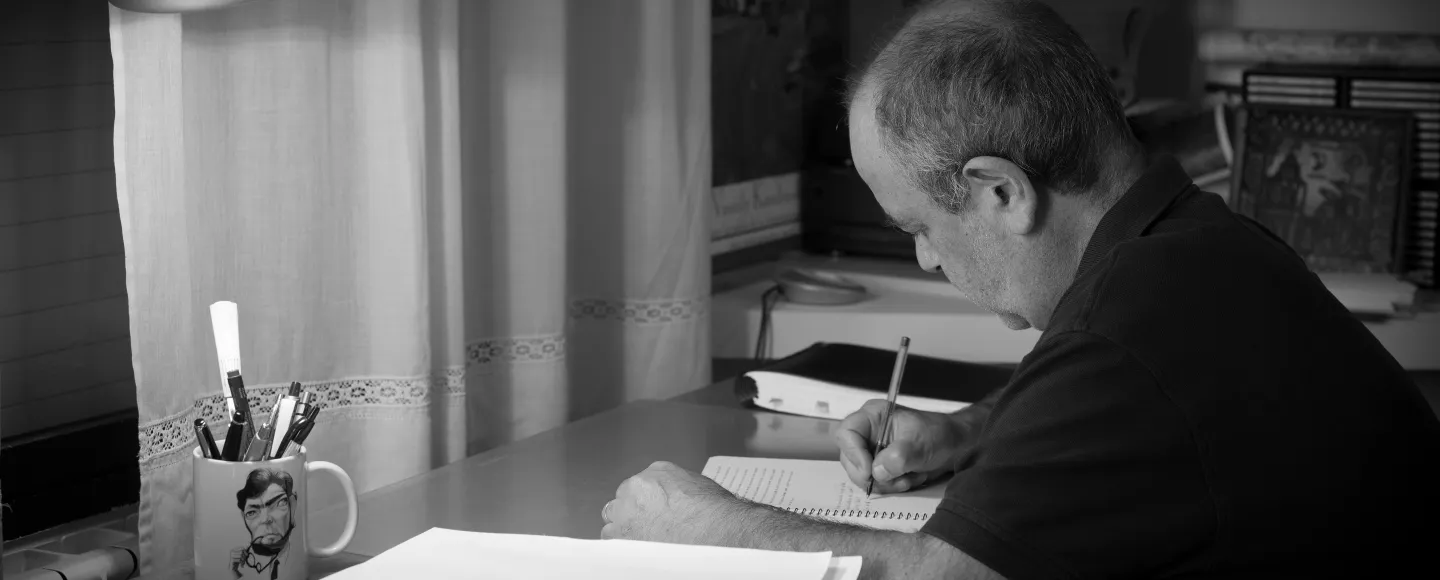
I also remember meeting him in Ourense, the city where he lived, back in 2016. I went to the city because my friend Fran Gayo, who also left us too soon, was making his debut that year as director of the film festival, and a handful of friends and I wanted to go to support him on his debut. I met Chesi at the doors of my hotel, and he took me to have a coffee on the terrace of the Latino, one of those renowned establishments that manage to survive to remind us that there was a time when city centers were not overrun by franchises. I think it took us less than five minutes to realize we clicked. We shared a few affinities and also a few phobias. We shared the unconditional devotion to Álvaro Cunqueiro and an addiction not always confessed to roaming through cemeteries — it was he who strongly recommended I visit the San Francisco cemetery, and I did the following morning —, and also that northern wit that is not always understood on the plateau, but which proves to be an indispensable tool if one intends to recognize equal minds.
José María, or Pérez Álvarez, or Chesi, was a colossal writer who never managed to gather the readership his talent deserved. The major publishers did not want him, nor did his publications receive much echo in the newspapers. And yet, each of his books stood as a masterclass in what is understood or should be understood as literature. I have mentioned the two main ones — that is, the ones that gained some resonance —, but I could dwell on the pleasure with which I read Final Exam, on how much I enjoyed his Catastrophic Predictions, on the entrancing gratitude with which I entered the stories of The Blurred Years on a summer night, in the shadow of a convent. His was a way of narration so languid as exact, and brutality and tenderness, humor and anger, the grotesque and the sublime were woven together in his paragraphs. A radical proposition, in the sense that it did not yield to concessions, which Juan Goytisolo could appreciate, and earned him the affection of a handful of followers scattered here and there, as we began to sense the pulse of his novels.
We met again —also in Ourense, the following year—, on the occasion that he graciously agreed to present one of my novels. I am not sure we ever crossed paths again, though we did maintain frequent conversations over time, sometimes by mail, other times by phone and very often through cross-messages on a social network during a period when we both frequented it quite a bit. Reading him was a joy, but talking to him was no less so, because he possessed a talkative and inexhaustible facility for conversation. Blessed with the gift of generosity, which is nothing more than the sum of intelligence and kindness —there is more than enough to see in the elegance and wit with which he resolved a matter he had with Bryce Echenique—, he was always ready to listen to friends and, what is more commendable, to read what we managed to bring into the street, for better or worse. Alfonso Armada says that when Chesi posed for photos, the shadow of the boy he had been would appear on his face. Now that I have a picture of him in hand as I write these lines, I can confirm that there is something childish in his half-smile, in the shyness that seems to peek from behind his glasses, in the care with which he holds a huge book whose title I cannot discern. Perhaps he was, at heart, no more than a boy who played at writing, and we all know that for children, play is the most serious thing there is in the world. The splendid narratives he left behind testify to this. I hope they find channels to keep flying and voices that continue to defend them. He deserves it. Literature too.