
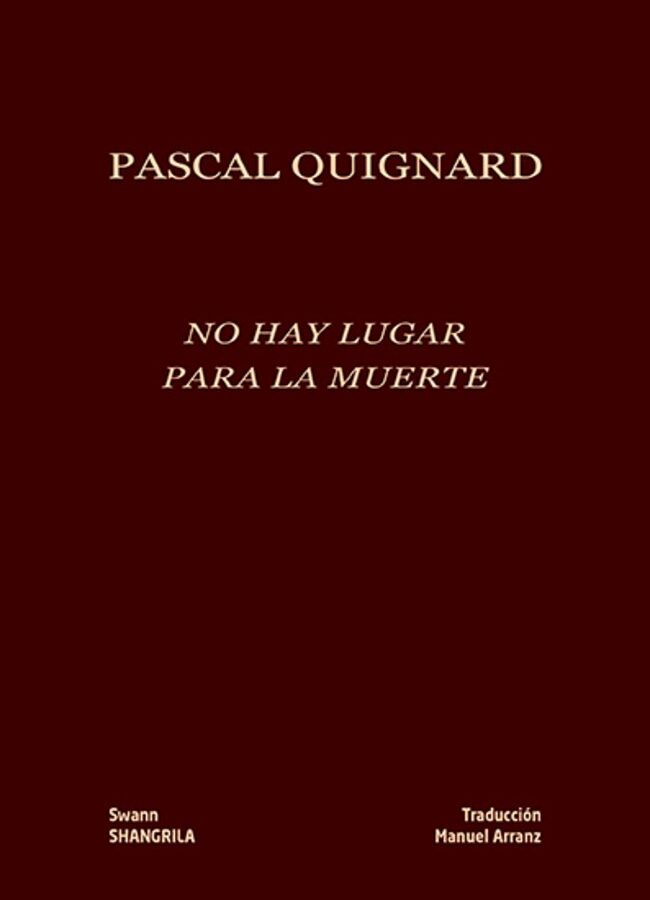
When lightness combines with density, the miracle of suggestion occurs. This is, in my view, the greatest charm of these beautiful and profound pages that compose Pascal Quignard’s latest literary work, There Is No Place for Death (Shangrila Editions, 2026). A book that emphasizes all that which neither the passage of time nor death can make disappear: a treasure of wise maturity written along the thread of memories that endure through the years and that we return to again and again, perhaps because they guard some important secret that has yet to be revealed to us. They are small narratives, halfway between fiction, essay and memory; feverish prose, sometimes mysterious, filled with suggestive images, written and developed with great freedom… Texts that at times thin and thicken until they become poems. This is the gaze the author directs toward the white and volatile seed of the dandelion, emblem of life that endures forever by repeating itself. Hence also the presence of haikus, of Bashō and Kobayashi Issa, figures who appear in Quignard’s dusky daydreams almost as ghosts, only the precise signal needed to give us some valuable hint. They are accompanied by other evanescent presences, equally elusive, barely named, like the tragic Brontë sisters (with their dogs weeping their deaths), like Chopin, Baudelaire… A mere touch of the string is enough for the sound to take over space.
There Is No Place for Death is a book that can accommodate almost anything: fictions, reveries, memories, poems, reflections…
Very often, the most ordinary situations become the unexpected source from which meditation and a fortunate discovery spring. A simple train journey may be the catalyst that provokes revelation. Nurtured by the voices of the other passengers, the traveler finds himself overwhelmed by an unstoppable surge of memories, readings, and fantasies that arise and chain together with no other order than that of beauty and its power of suggestion. Nor are there rare in the book some solitary or special, even wild, settings, transfigured by the beauty of what remains pristine: fog-shrouded peaks, interiors steeped in gloom, dark forests, labyrinthine forest tracks… all those, in short, where that healing close to danger, which Hölderlin spoke of, takes root. And it is in these spaces, common or extraordinary, where the stories unfold, always very close to the author, lightly sketched, enigmatic at times, all charged with that power of suggestion that returns us to life by placing us in communion with the forces of the spirit that sustain it, with the beauty and truth that illuminate deep and precise thinking.
Divided simply into numerically ordered chapters, Pascal Quignard’s book is far from being a novel. Each of the texts that comprise its five major sections forms an independent vignette, as free of labels as the movements of a grand chamber suite into which we would enter without knowing what treasures of suggestion await hidden within its measures. Brief and dense narratives where imagination always ends up initiating a meditative flight. Thus, the sudden death of a pianist offers us a sharp reflection on the strange mechanics of feelings, of pain or sadness, which seem to have a life of their own, almost always distant from the circumstances and stimuli that originated them (“true coincidences are never synchronous”). It is the same temporal lag that Rilke noted between his vital experiences and the birth of the work that sublimated them: a sign of that unconscious, mysterious, and quiet labor that operates in the deepest parts of us and where the action of time exerts a decisive authority over past experiences and their memory.
There is a great deal of fiction in this beautiful book, but above all there is memory. Memories that at times awaken the most modest objects: an old, faded swing, the little crystal of a great-grandmother’s powder box… A notebook full of notes from the past, fleeting revelations of adolescence, recollections of family and friends, of school, of discovering sexuality… Memories that do not end in a simple autobiographical note, but become deep reflections on the power of memory. A recent experience, seemingly trivial, can also become the engine of an intense reflection; and thus, a dinner with friends will extend into a solitary nocturnal vigil in the garden, which puts the author in an optimal emotional state to discover a significant facet of Chopin’s personality. The conjunction of favorable elements has prompted in the narrator the sudden revelation of a human enigma, the guessing of the most intimate secret of an artist with whom he believes sharing a similar attitude toward the world and its beauty: the silence “so particular that it forms after the music”; “the daydream beside the extinguished torches, beside the closed piano.”
Even though they do not specifically tackle music, all the vignettes (sine nomine, beautiful pieces of “pure music”) that make up There Is No Place for Death always retain something within them that recalls it, some significant element of its argument or setting: a musical metaphor, an instrument, a performer or composer, the chronicle of a rehearsal… It could be the fleeting appearance of an old Bechstein piano, seen and played in Nagasaki and which had stood there, in the city, before the bomb and survived; or the rehearsal of an organist, with his ritual repeated a thousand times, almost as sacred as the space where it takes place; or the evocation of the eve of a concert, anywhere, any time, with the loneliness of hotel rooms weighing on the mood, with the sum of other past solitudes piling up in memory… The author remains faithful to an art that has nourished his life and his work from the start. There are many ways to honor music, and the best of them all is to ensure that one’s thoughts, memory, and even words reach that flight, that lightness and power of suggestion that sounds possess.
—————————————
Author: Pascal Quignard. Title: There Is No Place for Death. Translation: Manuel Arranz. Publisher: Shangrila. For sale: All Your Books.