
To commemorate the 90th anniversary of the Civil War, José Ángel Mañas recreates on Zenda, day by day in this section, what happened in 1936, perhaps the most pivotal year in all of Spain’s recent history.
Wednesday, September 9, 1936: The Non-Intervention Committee
Azaña was talking on the phone with his brother-in-law.
—What a joy to hear your voice,
Cipriano
! How is everything in
Ginebra
?
—Bad, I can’t tell you otherwise, Manolo. Is the embassy keeping you informed of what happens in London?
—Daily. Today I’ve spoken with our new ambassador, Pablo de Azcárate, about the first meeting of that shameful Non-Intervention Committee.
—Here the chatter continues to be the lamentable farce that England and France are pulling off. Those coming from Paris say that when we went to request planes this summer from Léon Blum, he, in the courtyard of the Matignon Hotel, accepted immediately. But it was enough for him to pass by the British embassy for the English to raise the alarm. There they told him that if he did not sign the Non-Intervention pact, London would withdraw its commitment to defend the border with Germany and would consider itself freed from the obligations under the Locarno Pact. It has been an ultimatum from the Foreign Office, Manolo.
—I know it, Cipri. What a lamentable thing! Moreover, at the worst moment. London knew perfectly well that the defense of Irún was essential. And, at its most critical moment, the trucks with arms and ammunition for the defenders stop crossing the international bridge. The French closed it at the last moment. What Mola had not managed to achieve, the Non-Intervention Pact has achieved. They say that in Irún many Republicans have burned their houses before fleeing with their belongings toward the border.
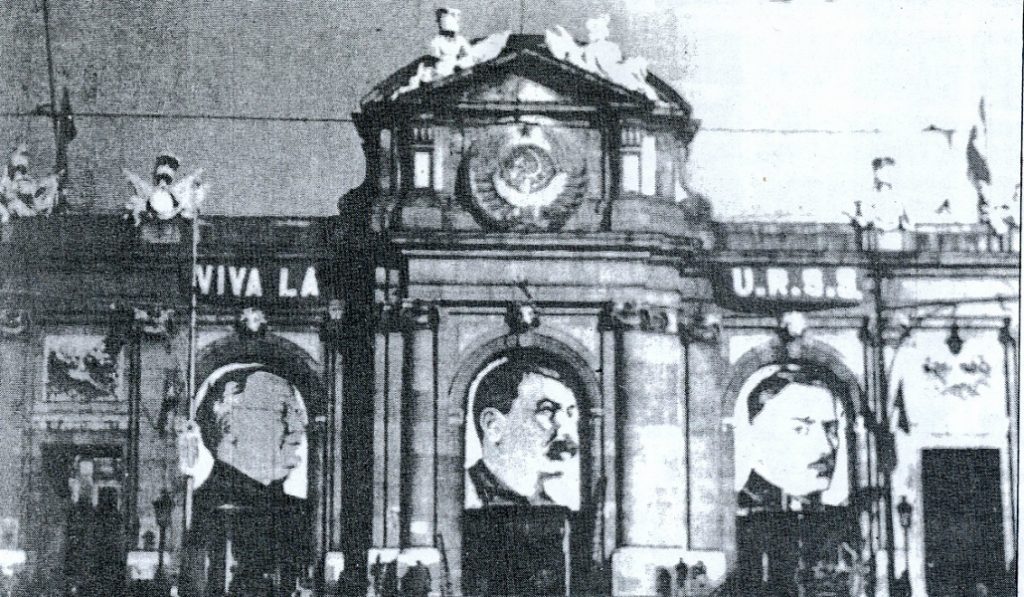
Azaña looked saddened. As a Francophile, it was a bitter draught to be betrayed by his natural allies. And, worse, to have to throw himself into the arms of that unpleasant and arrogant Rosenberg. Now he had him daily at the palace, prying into any matter, thriving right before everyone’s eyes. He knew that if Cipriano could see how Madrid was faring, he would become depressed. At the very Gate of Alcalá they had to place, on the central arch, a large sign bearing Stalin’s face, flanked on the side arches by portraits of Litvínov and Voroshílov, the Russian foreign and defense commissioners. All this to please this unbearable ambassador who arranged the arrival of Soviet armaments for him.
—And how has the London matter been resolved, Manolo?
—It’s a farce, Manolo. Italy, Germany, and also Portugal, openly aid Franco.
—I know, Cipri, but what can we do? They deny us the possibility of arming ourselves legally. That has cost us the fall of Irún and, soon, according to Largo Caballero, possibly San Sebastián.
—Are things going that badly?
—Worse than we ever imagined. The Non-Intervention Committee ties our hands behind our backs. We have no choice but to accept the help of Russia. I never thought that Britain and France, especially France, with the Popular Front in government, could do this to us… It is an outrage, Cipri.
All the entries of 1936 day by day
Interview with José Ángel Mañas about 1936 day by day