
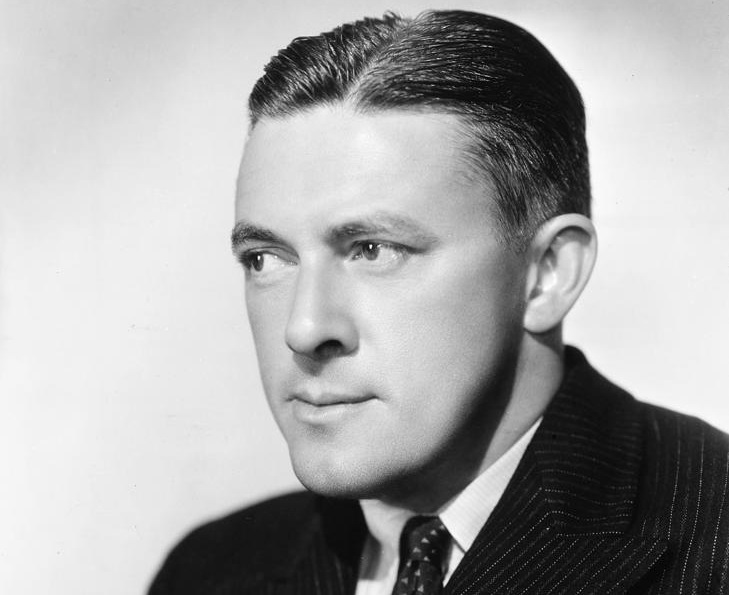
Born in that Europe which Stefan Zweig called “the world of yesterday,” the pre-World War I world, James Hilton saw the light for the first time in Lancashire County (United Kingdom) on a day that today marks 126 years. And even then, when he opened his eyes to life, his fate was written somewhere, in a script like the ones he would conceive for classic Hollywood. Yes indeed, his luck was already cast, as was everyone’s, probably, each with its own particularities. Birth, writing, and death could be summarized, in broad strokes, as the existential itinerary of the young Hilton. He died at fifty-six winters. However, although today it may seem that Death took him prematurely (1954), given the mid-20th-century life expectancy, which hovered around sixty-two years, the Grim Reaper did not strike him as early as it might seem now. It is said that tobacco was what cut short those eight springs of life of this writer of uncertain glory, who smoked heavily, as was customary in the world of yesterday, in the interwar years, throughout the past century, and who, until his last days, did not renounce tobacco.
En effet, although in its day he was much celebrated by the reading public, the author we commemorate today is not always valued as he deserves. Because
James Hilton, in truth, was a utopian, perhaps the last, since
Men Like Gods (1923), H. G. Wells’s utopia — who earlier had been one of the first dystopians in The Time Machine (1895) — predates Lost Horizon (1933), the James Hilton utopia that we celebrate today, although this writer is remembered — the few times he is remembered in the Spanish-speaking world — as one of the authors of the screenplay for Mrs. Miniver (William Wyler, 1942), based on the 1939 novel by Jan Struther, the pseudonym under which Joyce Anstruther, a writer of psalms and hymns, hid herself.
It was published in the interwar period, when the world of yesterday had left no trace: mustard gas, trenches, and all the slaughter of the First World War gave way to an era marked by disillusionment after the Great War and the growing geopolitical tension in Europe, which began to illuminate the conflict that would end the old world as a prelude to a new confrontation, the one of total destruction, the definitive one.
That was what there was when Hilton wrote Lost Horizon and brought to Shangri-La that Western longing for a sanctuary safe from the destruction of the modern world. Shangri-La is a mythical valley, located in the remotest of the Kunlun mountains, in Tibet. Just as Thomas More placed Utopia—“a little to the south of the coasts of South America,” in his time—“the place where Utopia stood once, connected by an isthmus,” the place presents itself as an ideal refuge. In Shangri-La the days pass much more slowly. Its inhabitants enjoy extraordinary longevity, perhaps due to their unshakable peace: fanaticism and excesses are avoided like a stone cloud. Although fundamentally Buddhist—speaking of a monastery perched in a fertile valley, protected from the harsh climate of the mountains—the Great Lama who leads the community is, in fact, a former Franciscan born in the eighteenth century.
Being a synthesis of Eastern and Western thought, the monastery, which was founded by a Franciscan as well, houses a vast library, musical instruments, and works of art from both European and Oriental sources. The explicit purpose of those treasures is to preserve the best achievements of humanity in the face of a possible self-destruction of civilization. Until then, an accidental group of Anglo-Saxon settlers led by English diplomat Hugh Conway arrives. They flee a rebellion against the British Raj in Baskul (Afghanistan) and believe their plane has been hijacked, when the aircraft crashes in the mountains and a mysterious group of sherpas comes to their aid to take them to the fabulous valley..
Sí señor: Hilton, in our humble opinion, was as utopian as Francis Bacon in The New Atlantis (1626), Étienne Cabet in Travels and Adventures of Lord William Carisdall in Icaria (1840), or Samuel Butler in Erewhon (1872). Indeed, the very breath of his discourse was diffuse, though pronounced. At least that is how Sigmund Freud, one of the few interwar figures who truly appreciated that last utopian James Hilton, judged him.
More than ninety years later, with the perspective that time affords, it seems fitting to say that Lost Horizon arrived at a moment when utopias had already transformed into dystopias, radically changing their sense.
Indeed, since the communists began theirs, and the utopia of those giants who could storm the skies proved to be one of the most perverse and criminally conceived states by humankind—the great Soviet famine (1921-1922) and the Ukrainian Genocide perpetrated by Stalin (1932-1934) already gave a hint of it—one of the first victims of red terror was utopias as a literary genre. Orwell asserts this in 1984 (1948): there was no future, no ideal, except “a boot stamping on a human face.” The numerous torturers of the regime of the miserable began to apply themselves. It is for this reason that the great Evgueni Ivánovich Zamiátin, a former Bolshevik, in We (1929) wrote the first dystopia and radically altered the sense of the genre. Orwell himself acknowledged in the great Zamiátin his model, asked about his inspiration for 1984, and Aldous Huxley cited the dissident Soviet master in matters of dystopia.
Lost Horizon arrived at a bad moment. It could not save it from its unjust fate nor the Frank Capra screen adaptation in 1937, “one of those stories that Grandma Capra used to tell us,” according to Juan Antonio Bardem. Franklin D. Roosevelt, during his presidency (1933-1945), gave the name Shangri-La to the presidential residence now known as Camp David. It should not have done much for Hilton’s prestige as a utopian writer. And even less that a feared battleship of the U.S. Navy during World War II, the USS Sangri-La, bore the name of the utopian valley.
Thus James Hilton is remembered—readers in the Spanish-speaking world barely remember him—for A Farewell to Mr. Chips (1934), for the Oscar his work earned for Mrs. Miniver, or for the dialogues he wrote for Hitchcock in Foreign Correspondent (1940). But I have the sense that even English-speaking readers judge him more as a best-seller author than as the last utopian. It is a pity. Hilton, to me, seems much closer to the Italian Dominican Tommaso Campanella, who wrote The City of the Sun, one of the great Renaissance utopias, than to Harold Robbins, a publishing phenomenon since The Inquisitors (1961). That is how history is written. Yet it is unjust, as well as sad. “The utopia kills slowly,” they used to say in my days.