
To commemorate the 90th anniversary of the Civil War, José Ángel Mañas retraces in Zenda, day by day in this section, what happened in 1936, perhaps the most pivotal year in all of Spain’s recent history.
Thursday, September 10, 1936: Conference on the Banks of the Tagus
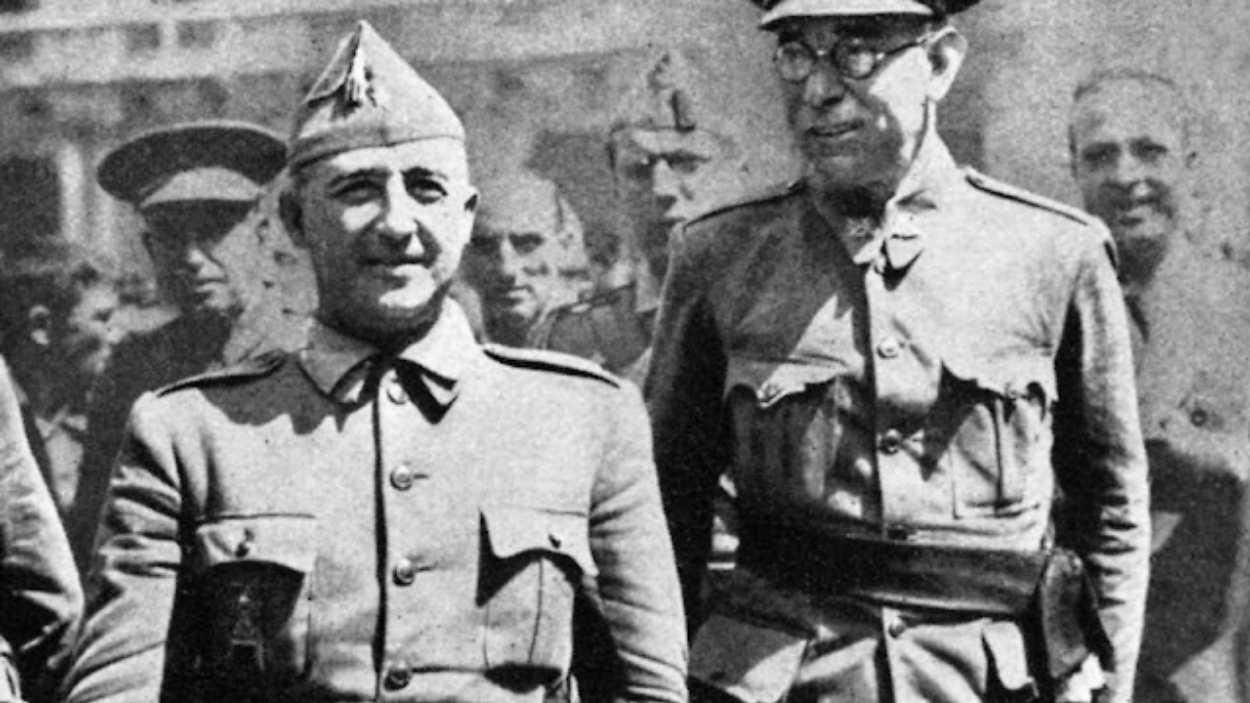
Finally, the Generals Franco and Mola had managed to meet on the banks of the Tagus, in the shade of some weeping willows.
—A long time since we’ve seen each other, Mola.
—Indeed, my general. I can only be glad to meet you on the banks of this deeply Spanish Tagus river, which used to separate us and now serves to unite contingents. The war drags on, as you predicted, but the men maintain high morale. They are convinced that victory will be ours. Since the supply of ammunition to Irun was cut off, the Republican collapse in Gipuzkoa was a matter of hours. Those who did not surrender perished, and today my troops will enter San Sebastián.
—How many casualties?
—A thousand casualties in Gipuzkoa, but it has been worth it. We control a large part of the border with France. The action of the Non-Intervention Committee has been crucial. The northern campaign is a success, and I hope to advance toward Asturias and liberate Oviedo. In the central area we remain stalled at the Alto del León, in Guadarrama. Had we passed through Somosierra or Navacerrada, history would have been different, but my officers felt the need to get as close as possible to your troops. This is a phenomenon that recurs in war: the attraction between armies. That’s why we leaned toward Alto del León. There we still suffer casualties, we don’t progress. That is why since yesterday I have moved my headquarters to Ávila and some of my columns have already linked up with yours in Arenas de San Pedro. How are things in the south?
—Very well —Franco nodded—. I have Varela defending Córdoba, and my troops control Talavera, despite the Republican counterattacks led by Asensio Torrado. Two attempts in recent days, both unsuccessful. We have solidified our positions.
—So the road to Madrid is open.
—It could be open, yes.
—I know you too well, general. I understand from your words that what my men tell me is true: that you intend to divert to Toledo instead of continuing to Madrid, which is why you have so upset Juanito Yagüe.
—Juanito Yagüe does not see beyond military logic —replied Franco, in his high-pitched voice—. But in this case that isn’t the most important thing. Liberating the Alcázar would provide a morale boost for our troops. It would be a coup with wide international repercussions. Everywhere people talk only about the heroic resistance of Moscardó. Juanito thinks we will waste precious time. He believes the enemy is completely demoralized and our troops are elated. He thinks Madrid could fall within weeks. And with Madrid fallen, the Marxists of Toledo will fall too. But what I notice is that as we approach Madrid, resistance increases. It won’t be that easy, Mola.
—My opinion, general, is that what should be done is to take El Escorial. And from there advance together, with our two armies, toward Madrid from the north. Along the eastern bank of the Manzanares, entry will be easy. By contrast, if we move up from Toledo we will encounter more natural obstacles and we’ll give them time to organize. But the one who commands your army is you.
—And you in yours, of course.
—Precisely, general. The Madrid issue can be debated. But what is unavoidable, given the circumstances, is a single command. I have already said: if within eight days there is no single command, I will abandon. This is what we must discuss the day after tomorrow when we meet with the other generals. I believe the only one who is not in agreement and stubbornly clings to a collegial direction is Cabanellas. The others agree that wars are not won this way. We lack a single leader.
Francisco Franco nodded. On that point, the two were in agreement.
All the daily entries of 1936 day by day
Interview with José Ángel Mañas about 1936 Day by Day