
There are works known by a wide majority, given their universal character, sincerity, and audacity. One of them is, without a doubt, Francisco de Goya’s famous engraving titled The Sleep of Reason Produces Monsters. Number 43 in the series The Caprichos, it was created by the brilliant Aragonese in 1799. Who at that date dared to unfold in an image all that unsettling scenography? Later would come others who, inspired or not by the Spaniard, would follow the innovative trail he started in art, also carrying it into other realms such as literature, music, theater, or cinema. Let a few names of authors and the titles of their works speak for themselves: Karl George Büchner with his Woyzeck, Hector Berlioz and his Symphonie Fantastique, Isidore Ducasse in The Songs of Maldoror, or Robert Wiene from The Cabinet of Dr. Caligari. All share the tragic feeling of the human being, the ghosts that dwell within him and illuminate his shadows. Goya exteriorized those demons and placed them on the tormented body capable of dreaming them. It takes courage to exorcise the forces that shape our psyche and, without which, we would be incomplete.
Quien sabe mucho de todo esto es el leonés
Vicente Muñoz Álvarez
(1966), ensayo, poeta y narrador capaz de fundir sus distintos registros en un estilo coherente e inconfundible. Sus filias y fobias, sus pasiones y temores, las experiencias vividas que han ido modelando su identidad dan cuerpo a una biografía que se funde con su pasión por el cine, la literatura o la música, dando lugar a reflexiones biográficas o a escenarios, situaciones y personajes ideados.
La personalidad de este escritor nos lleva a mundos extraños donde lo cotidiano puede tornarse en siniestro, casi siempre debido a esos monstruos que anidan dentro del individuo. Pero no es la persona individual la única responsable, sino también la sociedad que ha creado y en la que se funde, también el paisaje que ante sus ojos resulta hostil. Hay una lucha por la vida donde se puede resistir buscando la lucidez o aligerando el dolor a través de mundos alternativos, paraísos artificiales creadores a su vez de nuevos espíritus, más o menos perversos.
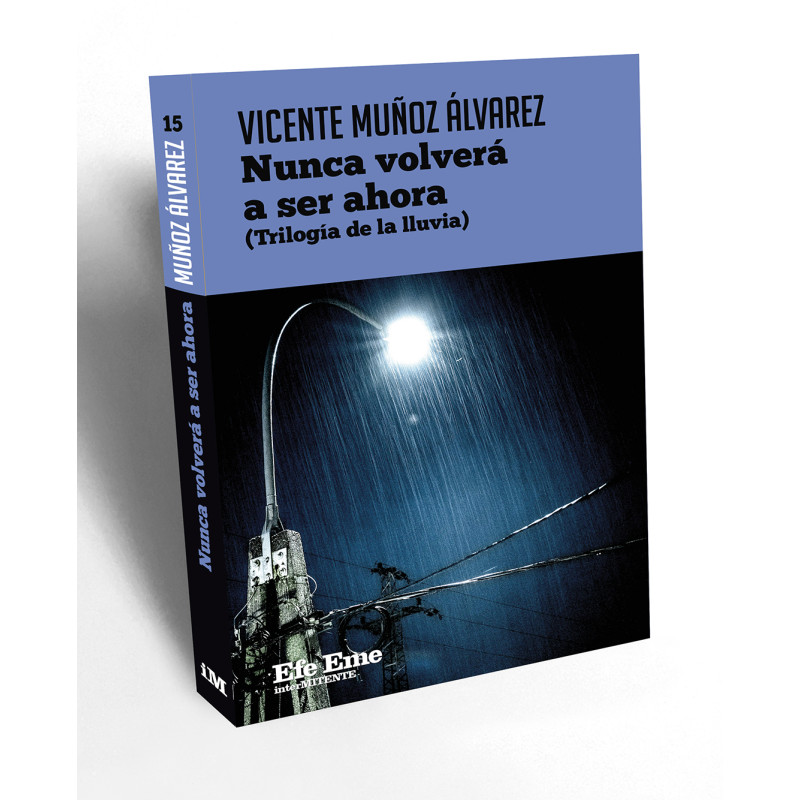
The last work of this creator came into the hands of the one who writes this after having traversed his texts on underground cinema in underground cinema in Spine-tingling Movies (Underdog Ventures, 2024) and after reading the poetic anthology Hombre de mimbre (Páramo, 2025) —associated by his name with the aforementioned cinema, specifically the film The Wicker Man (“The Wicker Man”, Robin Hardy, 1973). Thus, Nunca volverá a ser ahora (Trilogía de la lluvia) (Editorial Efe Eme), contains the concerns of these two preceding books and serves on a silver platter a succulent dish for lovers of good literature without frills. Undoubtedly, due to its original and daring characteristics, it is not a book within everyone’s reach, for its dark theme may scare away more than one curious. Nevertheless, beyond that first filter, the reward will come to those who have continued to bet on the genuineness of its pages.
We have already given some cultural references to shed light on where this volume is headed. A cultural heritage to which Muñoz Álvarez’s direct debt can be added, for his names and fragments of some of his works appear as quotes at the beginning of a good portion of the texts gathered in the volume, either as an appetizer of what we are going to find or as direct or indirect influence. The universe of our writer is made up of names as disparate as they are relatable, ranging from the Gothic Edgar Allan Poe to the honorary member of the Lost Generation Fernando Pessoa, passing through the representative of spleen Charles Baudelaire or the creator of monsters H. P. Lovecraft, the existentialist Jean-Paul Sartre and his precursor Miguel de Unamuno, Franz Kafka and the absurd, the mystic Osho, the beats Jack Kerouac, William Burroughs and Allen Ginsberg and the creators of dirty realism Charles Bukowski and Raymond Carver, the anthropologist Carlos Castaneda, the polymath Anthony Burgess or the Austrian novelist and playwright Thomas Bernhard.
We must clarify that the present trilogy is not a new work, but rather a recovery —with revision by the author— of three narrative works published previously. Their titles, which we can read in chronological order, are: Perro de lluvia (Iralka, 1997), Los que vienen detrás (DVD Ediciones, 2002) and El merodeador (Baile del Sol, 2007). The title that unites these three works is quite representative of the spirit underlying each one. It is a mood, composed of nostalgia, sadness, and even mystery. That emphatic expression, “Nunca volverá a ser ahora,” which emerges at different points within the book, functions as a warning, urging us to seize the present moment that will not come again. The characters that populate each of the stories in this volume seem to remember these five words with bitterness, for they did not know how or did not want to seize what life offered them. The subtitle of the work (Trilogía de la lluvia) adds even more introspection and suspense to this type of narrative, as well as greater heaviness and darkness in those who inhabit these somber, gray landscapes.
The first of the three books, Perro de lluvia, has as its enveloping atmosphere those pulp stories to which Tarantino, from cinema, has been and remains so indebted. Its imagery is formed by solitary and unhinged, if not disturbed and even psychopathic, characters who speak in the first person to the reader or are spoken about from another perspective —a police officer, for example—, justifying their actions by revealing their origins and evolution. The doubt always arises in these cases whether the individual is born thus or becomes so, though the important thing is always the present. It may be that they are fantastical and even mythological beings or that they appear invisible from science fiction, making their threat all the greater for it. Perhaps they have been conjured by another character’s imagination, their spirit exposed to adverse circumstances. Thus, the supernatural blends with gore or magical realism, and the geographies and times shift with each tale, testing the author’s ability to fabulate and the verisimilitude of the narrative.
The second title, Los que vienen detrás, largely leaves behind the gruesome and unreal tone to give way to greater realism, loaded with social content, pessimism, and bitterness. The protagonists are, in the end, losers or people who have experienced life’s cruel side, regardless of their age or status. The autobiographical content becomes increasingly evident —the author’s episodes as a conscientious objector, dissenter, or seller of shoes in the company of his father, the periods that forged his identity tied to the rural-urban dichotomy— to culminate in the last of the three books, El merodeador, where the author’s reality becomes evident even as it fuses with the invented. We find ourselves facing a literary tour de force, for it is a compendium of tales that, read separately, constitute an experimental novel in itself where its protagonist battles with his reality —his obsessive thought that prevents him from living in the present but in the past or the future, the conflicts with his partner, health problems, his thankless job, or the loss of a very close friend— in order to be able to do what he truly desires: to write a novel that bears exactly that title, El merodeador.
For this occasion, Muñoz Álvarez has enlisted two luxury hosts: on one hand, José Ángel Barrueco, who wrote the prologue and acknowledges that the writer’s work has influenced “to a greater or lesser extent” his own. On the other hand, Jesús Palacios, who, in the manner of an epilogue, closes the reading, in whose “minefield” and “land of traps, black holes, and forbidden zones” he assures that “our mind can get lost and, perhaps, become trapped forever.” Palacios praises the author’s ability to work with the short story, “a genre so little loved by many readers today, which sells so poorly and is so hard to do well for real, even though many believe the opposite”. These tales, although “like tears that will be lost in the rain,” will soak us and leave a real and true imprint, becoming part of our experience and our life. And indeed, after reading this Trilogía de la lluvia, we will never be the same again. And that is the minimum and the maximum that good literature can and should offer us.
—————————————
Author: Vicente Muñoz Álvarez. Title: Nunca volverá a ser ahora. Publisher: Efe Eme. Sales: Todos tus libros.