
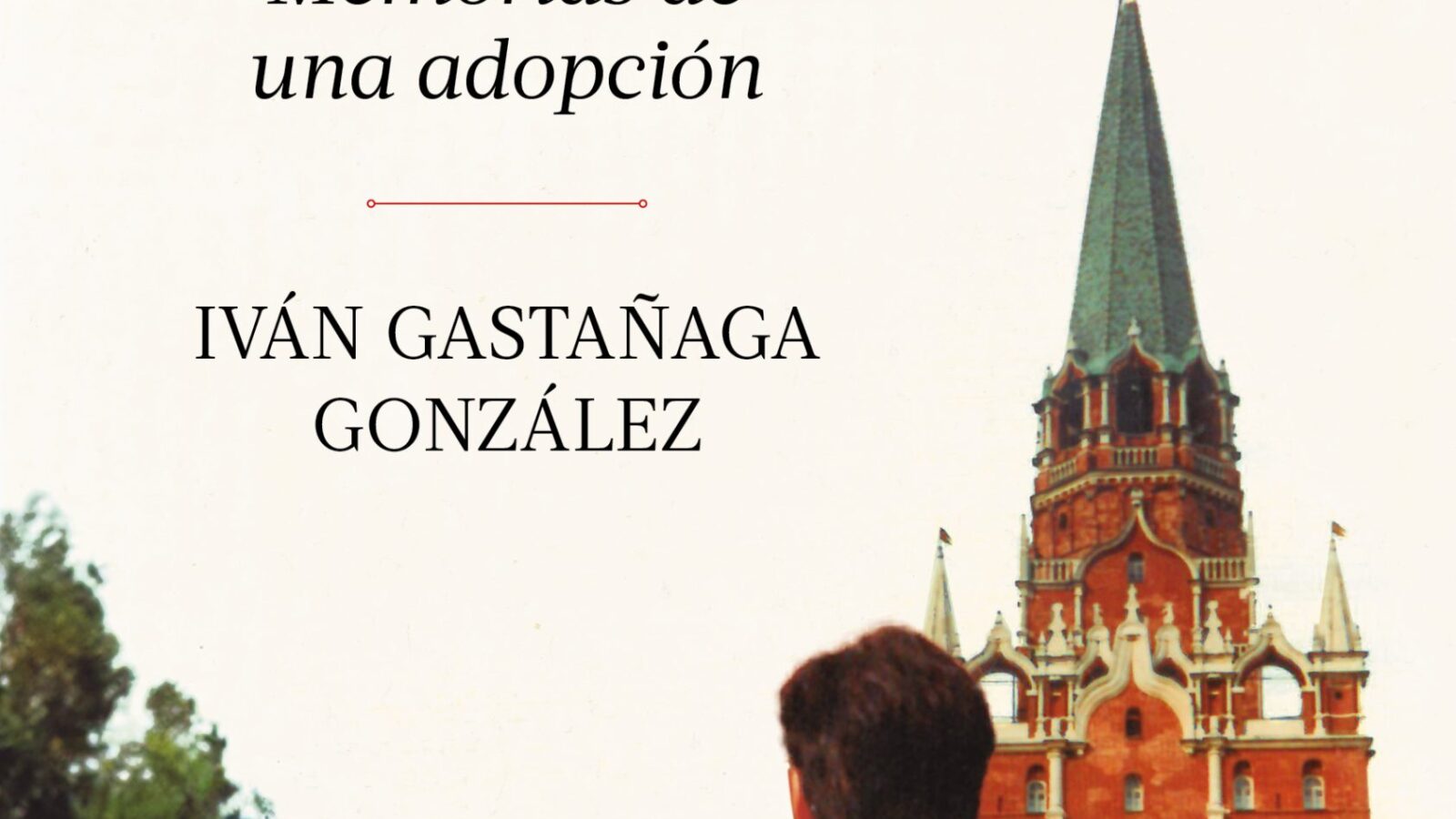
Iván Gastañaga was born in Moscow in 1990, in the last days of the Soviet Union. Not long after, he became the first Soviet child adopted by a Spanish family. He grew up in Cantabria surrounded by affection, but also tormented by two questions: who his biological parents were and why they had decided to abandon him.
In Zenda we reproduce the first pages of The Genealogy of Abandonment (Debate), by Iván Gastañaga González.
*****
1
The Origins
This story begins long before my birth, my abandonment and subsequent international adoption. It begins with my adoptive family and with those who became my parents. It was this family that took me out of Russia, fed me, gave me shelter, taught me a new language, educated me and, above all, offered me a second chance in a home where love, care and attention were always present. I had and still have a good Spanish family; I had and still have a happy life, no more and no less hectic than the lives of the other people around me.
My experience is not at odds with the feelings that many adopted people experience at different stages of life. Abandonment is the first skin, the one that marks our identity and does not let us live in peace. The doubt, the question, the intrigue about my origins have always been present, at least since I became aware that I was born in 1990, in July, in the Soviet Union, a country that, although it no longer exists, still extends its tentacles to me, thirty-five years later.
For a long time I heard, and was made to think, that my interest in the places of origin of my biological parents, Russia and Armenia, was due to personal revenge, a kind of betrayal against my adoptive parents. However, this undertaking, to which I have devoted two decades, of seeking and restoring my biological family, did not arise from a tragedy within my adoptive family, but from a process necessary in almost any adopted person. Thus, thanks to having found in my adoptive family a reparative structure and sufficient emotional support, I gathered the strength and courage enough to search for my biological parents. I was fortunate; other adoptees cannot claim the same.
They say that the desire to have a child is a human instinct. Yet, at times it can be a necessity; other times, an imposition and, in some cases, an unexpected fact that one must take charge of. The search for origins is also: it is born from the bowels, a vital need of self-knowledge. It can carry responsibility; it can also appear by surprise, after discovering papers whose existence we were unaware of. Looking for origins is, in a sense, creating a family, but in the opposite direction, ascending: it is birthing the biological parents and caring for the footprint of ancestors, both of heroes and of failures.
*
The Adoption of My Brother Samuel
Three months before the turn of the millennium we adopted my brother Samuel. I was ten years old, with a rosy face and nearly shaved black hair. My sister Lucía, also adopted, at that time was missing both molars and had strands of golden ringlets resting on her shoulders. Samuel came home on a warm day; the southern wind blew softly after a trip back from school with rains and floods that inundated the meadows. That was Cantabria’s coast: water and then fires. I held my new brother in my arms. I thought he would stay still, like puppies that roam our garden. I smelled him to know if he truly was a human being. That was the day I wondered how it was possible that his biological parents had abandoned him at birth. He was barely seven months old; he was as fragile as the dry shell of a chestnut. He could not have done anything wrong at so few months of life.
My sister Lucía and I had many questions about adoption, and few answers. It wasn’t clear to us who and why it had been decided that it had to be a boy and not a girl; nor why that particular baby, that one and no other, was going to fit into our family. Samuel was my first real contact with adoption. The arrival of a strange body into the home unsettled me, and at the same time the instinct to care for him arose in me. I tripped over the same thing several times: they were my siblings, they lived with me, but I did not feel that we were truly one, because we did not look alike at all, and, in a sense, we did not have the same parents. It is possible that this does not stem from adoption itself, but from the multitude of variations of the upbringing I received, for my parents were not the same when they adopted me in 1991 as when they adopted my sister later, and my brother a decade later.
Eva and Rubén, my parents, avoided the tale of the stork, the biological explanation of procreation, pregnancy and birth. We never saw my mother pregnant or felt with our hands her swollen belly seeking our future brother. To explain our adoption (mine in Russia and my sister’s in Spain) they told us: “We threw our love to the sky; it hit a star, a corner broke and fell. You were born from a mother in another city far away, and since she could not take care of you, we went to find you. Because we loved you even before you fell from the sky.” They thought that, at that age, being children, it was best to omit that our biological mothers did not want us by their side or could not take care of us. Anyway, we already knew.
We were used to going to the Residence, the Santander hospital where our aunts gave birth, to visit newborn cousins. At that time, we would slip into the elevator, hidden among an aunt’s coat. They did not allow children to go up to the maternity ward, for we were a dangerous cargo of viruses, although you could still smoke on the stair landings. My sister and brother had been born in that hospital, but no one came with flowers or chocolates for their mothers. I envied those families and their photos moments after the birth. She, still panting and sweating while holding in her arms three kilos of flesh with legs. The parents back then looked at the camera wearing mustaches and tracksuits. I wanted to know where I had been born and whose biological child I was. I looked at my body and wondered what deformities I had, and whether at birth I had been diagnosed with any strange disease and thus sent to a Soviet orphanage.
Iván the Bad. That is what my teachers called me from ages three to twelve. A label I believed, just like when religion teachers told us that anyone who did not believe in the Virgin would die in a hail of ice and fire. I trusted my father, who said that religion was “nonsense,” but I feared that he might die in a car struck by lightning because he hated priests. I prayed in silence, just in case. My father also criticized the women from social services calling them “witches” without my mother hearing it.
The period of adaptation to a new adoptive family lasted three months. This was called the “pre-adoptive period.” During this time, Samuel’s biological family could reclaim him. There was also the possibility that my parents might back out. To verify that everything was going well, we had to go to the Social Welfare offices in Santander. It smelled of tobacco, the phone rang, everything was loud and chaotic. A woman, with sunglasses on her head and elbows resting on a desk full of scratches, asked me: “Are you going to be a good older brother?” Then she pressed a folder to her chest awaiting my answer. I was convinced that she already knew I was Iván the Bad. Why speak then? I fell silent.
Just as a couple of months earlier they had brought Samuel to our doorstep in a maroon car and a tiny car seat, I was fully convinced they would do the same to me, but in reverse: one day I would hear that same car at the school gate and they would shove me into the trunk to take me back to Russia. “How can that be your brother if we’ve never seen your pregnant mother?” my classmates asked me. Others, who more or less suspected the truth about adoption because their mothers might have told them, called me “adopted.” The teachers did not hold back either and threatened: “If you talk, we will send you back to your country of s-.” I left class, went to the bathroom to drink large amounts of water and then fainted from fear.
I saw the mirage of a return to Russia. I woke up at night to check that my brother was still in his cradle, that my sister remained wrapped in her duvet and that those “witches” were not waiting outside with the engine running to take all three of us away.
————————
Author: Iván Gastañaga González. Title: The Genealogy of Abandonment. Publisher: Debate. Available at: Todostuslibros.