
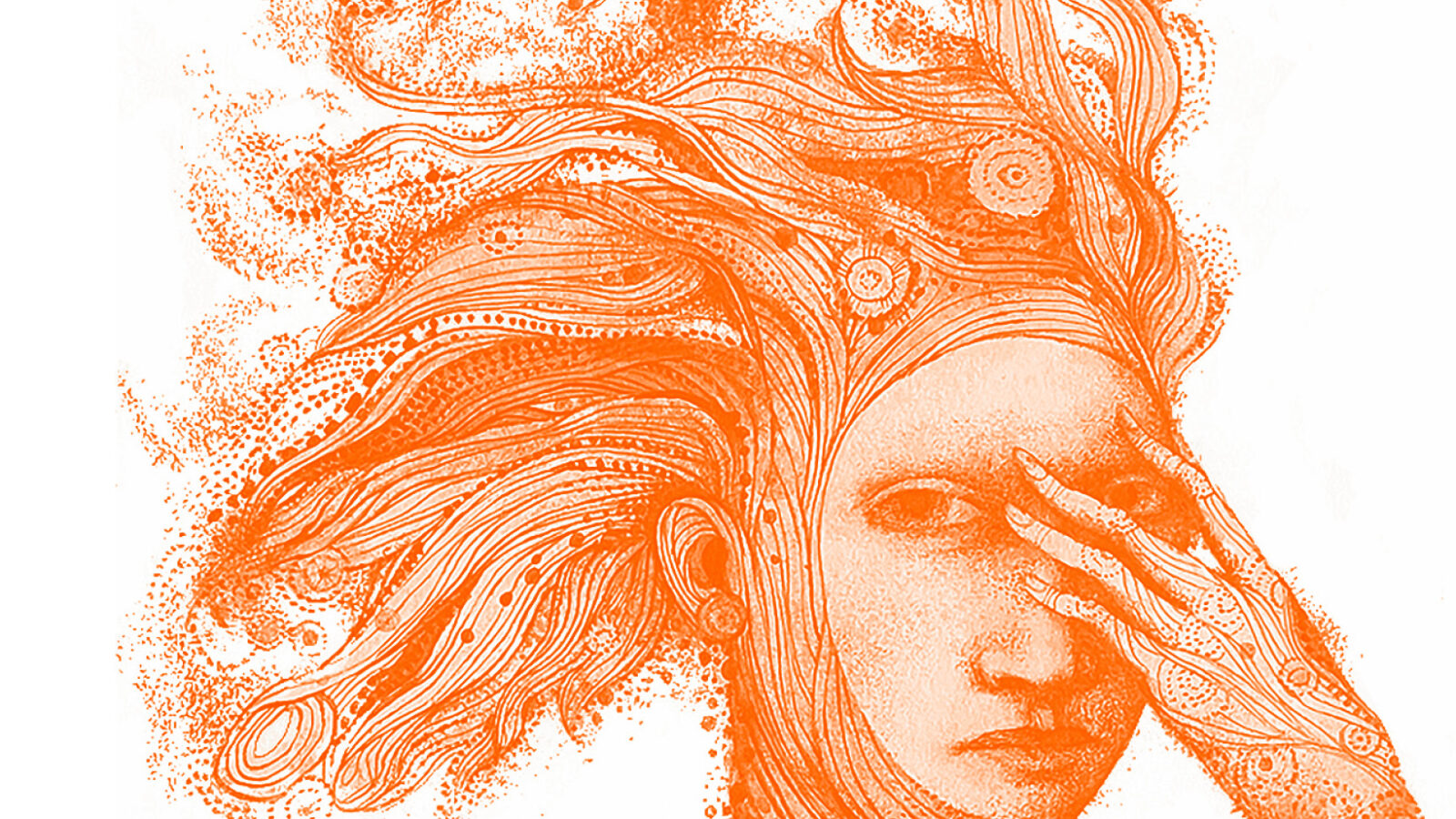
This novel is the story of a girl who was kidnapped. As soon as she was born, the demon of Txerren possessed her and endowed her with the soul of a writer; then he took away her name and, with it, her very essence.
In this making of Antxiñe Mendizabal Aranburu explains how she wrote Katona (Consonni).
***
Until yesterday I wrote according to the canons of realist literature. But how surprised I was to discover that since my last publication, Vínculos (Consonni, 2022), my gaze has changed: my near vision has shortened and my far vision has expanded; life no longer fits into what we deceitfully call reality.
From early on I had experienced that quality. However, I had never explored that possibility through language. To find this new voice I had to deconstruct the narrative I had known until then and let myself be led by
the language of witches,
those voices beyond reason, that do not arise from intellect, but from the heart, from intuition, from memory, turning writing into a game and into an intense search for beauty. The line from playwright Juan Antonio Mayorga was revealing: “
All works of art are born from an altered consciousness.
Thus, I already had the voice, but the story was missing. It was then that another phrase moved me deeply: “We have to transform our lives into myths if we want to understand the metaphor that reality always holds within itself.” I felt as if writer May Sarton were addressing me. I decided to tell my own story; I would turn my unfinished biography into a tale, a story that would represent me. And Katona is a tale hidden inside a novel. When I understood it, I discarded everything written up to then and wrote the first sentence of the text: “Once upon a time…”.
Like in fairy tales, I had found the door to access a reality that until then I had not known how to name. I felt that certainty when I remembered one of the many beliefs held in Basque memory: “Everything that has a name is.” During the writing process, every day, I stopped sweeping my kitchen before going to bed. By then, I no longer questioned what an old saying reminded me: a well-swept kitchen attracts the guardian angel each night; otherwise witches appear. So, every night I enjoyed a grand akelarre without leaving home, which inspired me to keep writing the next morning.
The rest of the making of you will find in the novel itself: “Aintxiñe began to write the draft of her love story, scribbling in her leather notebook. In the same way that masses are offered for the souls of the dead, she wanted to offer her heart to a story. A black veil covered the house. She lit two candles in the study: one for the living, another for the dead… Meanwhile, the witches began to have a grand time. There was no exorcism that could make them settle down. They encouraged an old woman with fingers deformed by osteoarthritis to tell the first tale of the night…”. The tales, songs, poems, ballads and proverbs of my madrinas showed me the path to follow.
“Like a medium between two worlds, where things exist but are not yet, Aintxiñe began to set into motion a shadow theater by candlelight. She stopped listening in order to pay attention; when silence fell, her ears opened. Writing is a space of listening. Unknowingly, she had moved away through her drafts, little by little, in search of the distance needed to see the totality, without getting lost in the details. She had left the control zone and sought the gravitational center, the perfect vantage point from which to observe the changes, the detours, and the surprises of life. Inspiration does not arrive; it is released when knowledge and soul unite “I am not the one who writes, but someone who inhabits me.”
Finally, to finish the tale, I chose among the different formulas of traditional fairy tales. The choice was transcendental. When I wrote “and if it wasn’t so, let it be so,” I realized that I had cast the spell, had summoned the protagonist’s heart’s desire: I had written a love story.
That is how everything happened, like in a fairy tale.
—————————————
Author: Antxiñe Mendizabal Aranburu. Title: Katona. Translation: María Ramos Salgado. Publisher: Consonni. Sales: Todos tus libros.