
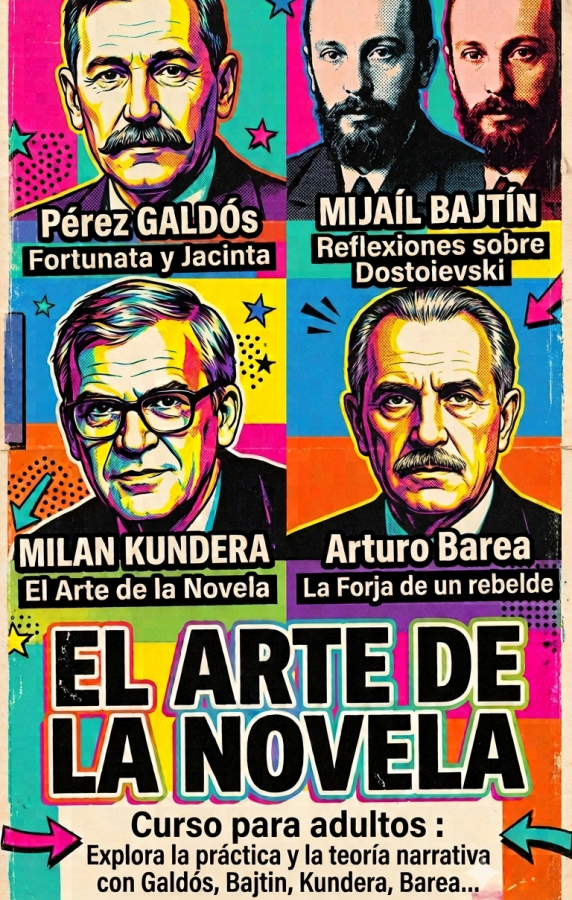
Is there a single kind of novel? This question always comes to mind during our discussions when a friend speaks of the novel as a concrete and well-defined genre. Is there a single type of novel? I think not. The novel, today, is a multiform, protean, in-formation, fermenting genre; it encompasses everything: the philosophical book, the psychological, the adventure, the utopia, the epic, absolutely everything.
—Pío Baroja
The novel is perhaps the most complicated of all genres because it has become the genre of indefinition par excellence. The genre of impurity, as a great theorist said. That open genre of which Baroja claimed is “a junk drawer where everything fits,” whose essence, according to Ortega, would be “not what happens but precisely everything that is not ‘to let something happen’.” An amorphous genre, without a fixed canon, capable of imitating and caricaturing any other genre, any narrative form, any language, that has died and revived eight hundred times yet remains in perpetual mutation.
Do not worry the most fervent postmoderns. I am not going to dismantle this definition. I would not dare to discredit in this matter intellectually as sharp as Baroja and Ortega.
The fortunate conception of the novel exists. It is one facet of it.
But it is not the only one and, above all, it is not as canonical as certain contemporary aesthetic thinkers would have it appear.
In reality, despite appearances to the contrary, it is… anti-canonical.
To explain it, I permit myself to momentarily widen the scope of these reflections.
I take as a given that we agree that all the arts are born with the discovery of fundamental laws and that from experimentation with those laws the molds arise that eventually culminate in the classical canons that fix them.
This is especially perceptible in music, where the practice and refinement of the laws of harmony culminate in that great canonical moment that will be the eighteenth century, with works, among others, by Mozart and Beethoven.
From then on, contemporary music appears, which is to classical music what contemporary painting is to classical painting —that is, a radical reversal of values, a repetition, alongside the witches in Macbeth, “the beautiful is ugly, and the ugly is beautiful”— and what it pursues is to seek the infinite ways of doing things, if not badly, at least differently. In short, to dismantle stone by stone the classical edifice, until that structure degenerates into the most dreadful noise or into absolute silence, which are the two most radical extremes of contemporary art.
As for the novel, it is in the nineteenth century when what I will call the classical novel is formalized, to differentiate it from the modern. The novel form had already crystallized in various eras, with its own codes (the romance of chivalry, the picaresque of the Golden Age, the epistolary novel of the XVIII century), but its creators were not as aware of it as those of the XIX century, who were the ones who theorized about the phenomenon with greater seriousness.
The moment in which the canons of the novel, still in effect, become formalized will be in the second half of the nineteenth century, with texts such as Madame Bovary (1859), The Treasure Island (1883) or La Regenta (1884), the Spanish nineteenth-century canon.
From there begins the modern novel, which does to the classical mold what contemporary music does to classical music, and which, as the classical novel does not fully die, enters into a dialectical relationship with it.
There are essentially two ways to understand the genre:
a) A classical conception, which adheres as closely as possible to the backbone of the narrative, with maximum muscle and a minimum of fluff or fat. The classical ideal is the closed work that leaves nothing superfluous, where there is no idle element. Where, as Chekhov for the theatre desired, if a revolver appears on stage when the curtain rises, that necessarily implies that by the end of the first act someone will kill someone, since all the pieces are perfectly fitted to build a unitary story.
b) A modern conception, which is, indeed, that Bakhtinian impurity novel, I repeat. That open novel Baroja described as a junk drawer in which everything fits; whose essence, according to Ortega, would be not what happens but precisely everything that is not happening, etc.
The main characteristic of this modern novel is the will to break with the classical narrative mold.
The nivolas of Unamuno, the contemplative texts of Azorín, the cinematic novels of Valle-Inclán, the idea-laden novel of Baroja, the lyric or poetic novel of Gabriel Miró, Hortelano’s behaviorism or objectivism, the works of Benet, of Martín Santos, the experiments of Cela or Goytisolo, Torrente Ballester’s torrential fantasy, the idiomatic pyrotechnics of Julián Ríos, what we call postmodern novel, would be only some of the successive forms it has taken…
And it will continue to take them on because, in a sense, the history of the genre could be understood as a perpetual oscillation between centripetal forces that lead to classicism and centrifugal forces that drive toward modernity.
And this struggle between opposing forces is evident not only in the often pendular evolution of the genre but even in the evolution of each artist…
(Preview of the course “The Art of the Novel,” which José Ángel Mañas will teach at UNED starting in October)
————————————
For those interested, the syllabus is available at this link: https://extension.uned.es/…/elartedelanovelacursounedse…
And at this other link the enrollment: https://extension.uned.es/actividad/53551&codigo=SEN2627CV