
To commemorate the 90th anniversary of the Civil War, José Ángel Mañas recreates in Zenda, day by day in this section, what happened in 1936, perhaps the most pivotal year in all of Spain’s recent history.
Tuesday, September 15, 1936: The queues
My dear Pepe:
How complicated everything is in Ciudad Real! Today Dad was beside himself with joy after reading in the ABC that Pius XI has received in the Vatican a group of Spanish priests to explain the situation. It is said that he endorses their statements, and Father thinks this is the beginning of the end for the Reds.
As for me, I worry about what is said about Madrid. The last thing I read in the papers is that Madrid women are being asked to knit sweaters for the militiamen. Is that so? Are they so poorly clothed? How are you faring? Do you know if you’re going to be militarized? Since some of your letters don’t arrive, I worry.
Here the militiamen control everything. They have even occupied the cathedral itself. They have destroyed images, especially the pasos that went out in Holy Week, which were so valuable. Now it seems things are beginning to calm down, after too many deaths from vengeance and denunciation, though there is fear.
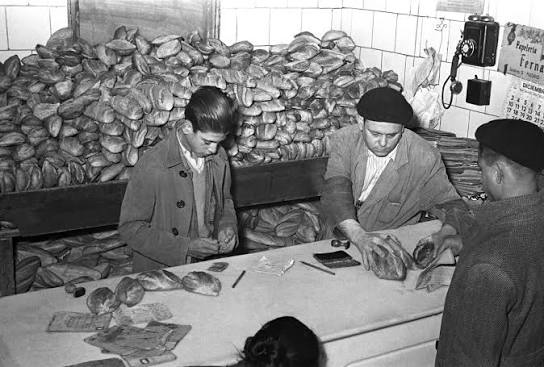
In day-to-day life, what we suffer most are the queues. I imagine it’s the same in Madrid. There is a shortage of everything, money has lost its value, and hundreds of refugees fleeing the fronts reach us. In front of the dairy there are housewives with hungry, undernourished children in tow. The kids, when a plane passes overhead, shout and try to tell whether it’s a Junkers or a Fiat. And when there’s shooting, they guess whether it’s a pistol or a rifle. They have learned to tell shots apart, but they have forgotten the taste of meat.
Our luck is that men smoke even more than before. Sometimes, at the tobacconist, they pay us with potatoes or garden produce, or a chicken, so at least we can eat. I don’t complain. And the same happens with the neighbors at the Arévalo cellars, who sell a lot because the wine is consumed by Republicans as well as by Socialists. When I go to buy for Father, who enjoys his wine with meals, lately they don’t charge me. That’s why I give them tobacco, and everyone is so happy. It’s a pity that such good relations among neighbors aren’t more common. Here everyone knows what everyone thinks, and who denounced whom. But for now the people on the right are swallowing their pride. No one says anything.
What I miss most right now, and if it weren’t for the war we’d be at parties, is the theater. You know that Father and Mother used to take me to Cervantes, which is on our street, almost on the same sidewalk up to the Pilar square. Mother, being a lifelong local, still calls it Circo Theater: that’s what it was called when she was young. In its day, María Guerrero’s company passed through there, and I remember having seen Margarita Xirgu there. Before summer there were talks of bringing Pablo Sorozábal with some zarzuela, but I suppose we’ll have to settle for our Orfeón Manchego, directed by Don Salomón Buitrago, who dares to include Bohemios. In any case, my parents don’t feel up to going, and you know that what I really enjoy are Conchita Piquer’s songs.
As you can imagine, Ambrosio, who loves music as much as he is left-wing, is so far to the left that he won’t even attend the performance of La rosa del azafrán, his favorite zarzuela, and he remains at odds with Father. Of course Father stays silent, because he knows that if they leave him alone it’s because Ambrosio has come back to live with us. Well, that, and because he has started giving tobacco to the militiamen. He says that if this lasts much longer, we’ll go broke.
You love him very much and miss you, your Merche.
(From my family archive)
All the entries of 1936 Day by Day
Interview with José Ángel Mañas about 1936 Day by Day