
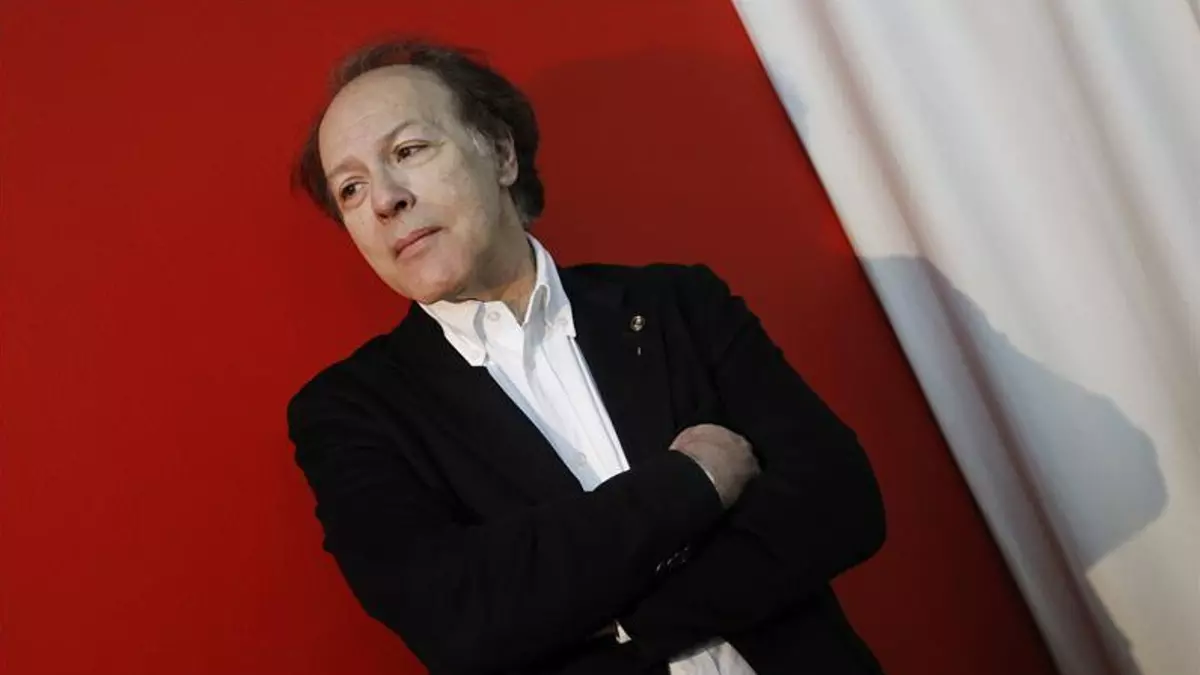
The text that is reproduced below is the laudatio, the speech delivered in praise of Javier Marías in Salzburg in 2011, the year I traveled to Austria with Javier for the presentation of the Austrian State Prize for European Literature by invitation of the country’s Ministry of Culture. Subsequently, this speech was published in a monograph of the magazine Ínsula that we coordinated Domingo Ródenas and I in 2012.
*****
Javier Marías is the fourth of five children born to Dolores Franco and Julián Marías. His father was a writer, philosopher, professor, intellectual, and a figure rarely found in Spain, as Paul Ingendaay remarked upon his death: a man of principles truly upright, religious yet politically progressive, who, regrettably, sought the center amid political polarization and blind party loyalty, and who was incapable not only of exile due to his deep attachment to his homeland but of any complicity with the prevailing situation during Franco’s regime; as a senator by royal designation and through dialogues with King Juan Carlos I and President Adolfo Suárez he contributed to prudent reform and the democratization of Spanish society. His children are known in Spain as film critics, art historians, musicians and music critics, and, in Javier Marías’s case, as writers (Ingendaay, 2005: 41).
The writer whom they have chosen to honor this year with the European Literature Prize is distinguished by a set of literary virtues that makes him an exceptional case in the world of Spanish and, indeed, European letters. Many of Javier Marías’s novels are true works of art if we follow the well-known definition Walter Benjamin invoked regarding À la Recherche du temps perdu, when he noted that one can rightly observe that all great literary works invent or dissolve an existing genre, that is, they are exceptional cases (Benjamin, 1999: 197). As with Proust, in Marías’s work—from the structure that unites fiction, autobiography, and commentary to the syntax of boundaryless sentences (the Nile of language, in Benjamin’s metaphor, which overflows to fertilize the banks of truth)—everything exceeds the norm (cf. Benjamin, 1999: 197).
On the other hand, Marías is a writer supremely European, a quality quite uncommon for a Spanish author. As the Federal Minister Dr. Schmied rightly noted in the Ministry’s press release, Marías is indeed “a writer who narrates from the very center of Europe’s twentieth-century history and whose books have been written in ‘European’ style.” Nevertheless, few writers have forged such a distinctive, refined, and unmistakably recognizable voice, a voice that allows one to delineate the man’s individuality within the overall contour of the whole; a voice that is not merely a formal aspect of writing, but nothing less than a way of contemplating the world.
Like Jorge Luis Borges, who, though of Argentine origin, in a sense became a decidedly European writer with a distinctive style, Marías’s style reveals a prodigious and ever-alert mind, drawing a relentlessly independent, strangely coherent, and fully engaged thought, one that does not yield to carelessness, imprecision, or laziness, and that demonstrates the intent embedded in every element and in the form that it takes.
He is an extraordinary writer: an extreme instance of scrupulous literary conscience. Each of his works, from the outset, constitutes a construction problem; and the problem recurs with demands for a rigorous solution in every sentence, where not a single word can be found that has not required the author’s utmost care and literary responsibility, and in which the arrangement of words has been weighed to serve the demands of expression (and that is also why, in his prose, so many words acquire a novel or renewed meaning, and why many of his characters reflect on words and their meanings, whether Spanish or foreign). In that way he has contributed as few Spanish writers of the XX and XXI centuries to the renewal of Castilian. Marías’s ultimate goal, as it was for Marcel Proust, seems to be to write his books so that they may be read aloud like poems.
Marías’s style is especially digressive and unfolds a prose whose form is the result of a particular vision. He has stated that he writes to waste time but also to devote it to observing the world clearly and attentively. And his style immerses us in a mind that contemplates the world in all its complexity, whose aim is to penetrate, understand, and uncover the nature or essence of the things of the world. It is precisely for this reason that the narrators in his novels often pause their accounts to reflect on the meaning of what has been observed or heard.
The digressive style is the vehicle through which they seek, as Marcel in the Recherche, to grasp “beneath matter, beneath experience, beneath words, something other than their appearance” (Proust, 1944: 247); thus, art and literature lead us to “the depths where the unknown essence of the real resides” and “make us pursue it” (Proust, 1944: 247–8). One could say of Marías’s prose what Leo Spitzer said of Proust: “Ces phrases complexes, que le lecteur doit démêler, […] reflètent l’univers complexe que Proust contemple. Rien n’est simple dans le monde et rien n’est simple dans le style de Proust” (Spitzer, 1970: 398). Also in Marías, nothing is simple in the universe contemplated, and the complex, digressive sentences and style reflect that complexity or, to be precise, reflect the consciousness that contemplates complexity.
As readers, we follow the labor of a mind in search of a truth, a writing that is not the product of a meditation but a thought in motion. The work of Marías, exactly like that of Proust or Rilke (to name another favored author of his), represents a literature of expanded consciousness, shaped by heightened perception and acute attention, especially during moments or stretches that are significant and immensely amplified in each novel where duration expands and time stretches. During such moments, consciousness enlarges — nothing lies beyond its reach, nothing is irrelevant — and reality is experienced, as in music, as a harmonious whole, while past, present, and future merge into a single variable totality (cf. Jephcott, 1972).
The meanders of Marías’s writing are a direct consequence of the tangled multiplicity of things observed by a mind, by a gaze, that associates and dissociates, draws near and distances, relates and orders. Because as in Proust—where, although the chaotic caprice of the earth is restored, one provides it with an organizing vision—in Marías complexity does not exclude order, even though this order is of a particular kind and depends on the whims of the human eye (cf. Spitzer 1970: 400, 402). In short, his style reflects a mind that perceives the network of interconnections that span the world — for, as Henry James reminded us, “really, universally, relations stop nowhere” (cited in Bell, 2011: 66) — but from a sufficient distance to be able to map out his labyrinthine entanglements. That distance is what allows the creation of order and makes prose denote serenity. The style orders the chaos of the world.
Order is generated by the scrupulousness that characterizes Marías’s style; writing seems guided by a pursuit of precision that reveals a longing for fidelity to reality and truth as experienced by the narrators. The effort toward precision is what produces the unsettling impression; the search for clarity is what brings diversity in expression and naturally leads to the digressive form, a tool particularly suited to tracing the intricate multiplicity of the connections of things in our world. His books are books of digressions, only that we progress with them, as the narrator of Negra espalda del tiempo uses to describe the shape of his narration (Marías, 1998: 57).
And like all great works of art, Marías’s work offers us the mysterious evidence of having been born and matured at a pace dictated by its own essence, not subjugated to any external demand; Marías’s novels have their own time, and reading them aligns with the tempo created by the outlines and serpentine paths of a mind. And through the expansion of the consciousness that the narration embodies, the reader’s consciousness also expands. There are not many writers whose works reveal such a caliber of conceptual excellence in harmony with a style. And Marías has achieved something that few others have managed: generations of readers viewing the world through his eyes.
————————————
Bibliography cited
BELL, Ian F. A. (2011): “Henry James, in Parenthesis,” in Digressions in European Literature. From Cervantes to Sebald, eds. Alexis Grohmann and Caragh Wells, Basingstoke, Palgrave Macmillan, pp. 64-81.
BENJAMIN, W. (1999): “The Image of Proust,” in Illuminations, London, Pimlico, pp. 197-210.
INGENDAAY, P. (2005): “Gegen den Neid und die Rachsucht des eigenen Volkes,” in Frankfurter Allgemeine Zeitung, 16/12/2005, p. 41.
JEPHCOTT, E. F. N. (1972): Proust and Rilke: The Literature of Expanded Consciousness, London, Chatto & Windus.
MARÍAS, J. (1998): Negra espalda del tiempo, Madrid, Alfaguara.
— (2000): “The Life and Death of Marcelino Iturriaga,” in Mientras ellas duermen. Edición ampliada, Madrid, Alfaguara, pp. 15-20.
PROUST, M. (1944): Time Regained, translated by Stephen Hudson, London, Chatto & Windus.
SPITZER, L. (1970): «Le Style de Marcel Proust», in Études de style, Paris, Gallimard, pp. 397-473.