
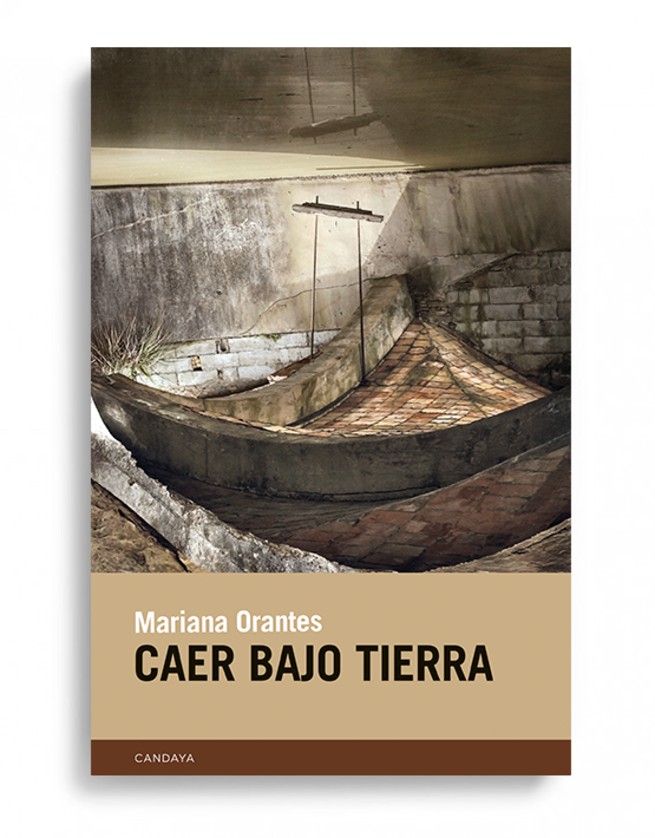
Some books demand that the reader learn to read them as they progress. Falling Beneath the Earth (Candaya, 2025), the first novel by Mexican poet and essayist Mariana Orantes (Mexico City, 1986), is one of those, and it’s worth stating right away so that no one should feel misled. It compels you to go back, cross-check dates, recognize phrases that migrate from one voice to another, and discover connections between manuscripts, case files, or computer screens. The difficulty is not the whim of someone trying to impress: it reproduces the effort of those who attempt to reconstruct a story fractured into pieces. The act of reassembling them is both the book’s price and part of its argument.
The central story can be summarized rather straightforwardly. In 2001, Cecilia, a nine-year-old girl, is abducted on her way to school in Santa Rosa del Volcán, a fictional town to the south of Mexico City. She is found dead days later in a forest. Julia Mazatl, her best friend, will spend the following years moving in and out of a psychiatric institution, convinced that the volcano’s caves communicate with the Mictlán—the realm of the dead in ancient Mexico—and that Cecilia still waits for her. In November 2018, Julia escapes from the hospital. The manuscript traces her journey through the volcano Xitle’s cave system. In December, her trail disappears for good. Her writings, dreams, and phone calls link her to Mercedes Petrona, a neuropsychologist whom she never met in person. Decades after the murder, Ana Laura Ek Dzib makes the case the subject of her degree thesis.
Orantes divides that history into four writings: Ana Laura’s investigation, Julia’s typed text, the numbered fragments of Mercedes’s final manuscript, and the screens of a MS-DOS conversational game named Klavis. The investigation also includes character sheets, photographs, and newspaper clippings. Each block has its own typography, its own rhythm, and its own notion of truth. The narrative unfolds at the intersections, disagreements, and correspondences established among them.
Ana Laura provides the frame. In her inquiry, the consultation of documents and the reconstruction of timelines coexist with imagination. In the epilogue she is included “as a character, as fiction, or as part of the fiction” and she recognizes that her work is a form of mourning and repair: “This is our altar. For everyone.” In that endeavor to rebuild a victim beyond a file, she confronts a memory that had been previously managed by those who left the murder unpunished, the character’s work recalling Cristina Rivera Garza’s El invencible verano de Liliana, and dialoguing with Sara Uribe’s Antígona González, where documentary appropriation and the collage of voices sustain the search for the disappeared.
The typed text of Julia is accompanied by Ana Laura’s annotations, one of the book’s great formal discoveries. The notes correct dates, identify places, contradict the account, and anticipate events, so that the voice rescuing Julia also exposes her. The particular katabasis of Julia, her crossing between clinical confinement and subterranean mythology, recalls the descent into the underworld in Leonora Carrington’s Memorias de abajo, where delirium serves as a portal to other dimensions.
The last manuscript of Mercedes Petrona, for its part, consists of brief numbered fragments. The form reveals its need to impose a sequence on a reality perceived as threaded with invisible correspondences. Her prose asserts more than the rest of the book allows, and that bluntness leaves the reader with less room than the other sections.
Finally, the most singular device is Klavis, where one senses the author’s work on the archive and the visual poetry of Joan Brossa. The black screens, printed with white characters, force the reader to navigate between commands, menus, questions, and files. In any conversational game, the reader becomes an interlocutor, the exact position of someone consulting an oracle. Orantes also chooses a dead technology, contemporary with Cecilia’s childhood, so that to talk with the girl one must pull out a machine buried as deeply as she is. The name appears to refer to clavis, Latin for key, from which clavícula and the title of Ana Laura’s investigation derive. On one screen, a chat between users attempts to define femicide and traces the element <-cidio> back to caedere: to kill, slaughter, or cut down life at the root. Killing a girl and felling a forest can be expressed in Latin with the same verb, and that coincidence is the grammar of the book.
Orantes thus connects Cecilia’s murder with the vegetal imagery that threads through the novel and with the erasure of the place where she lived, much more than a mythical territory. Santa Rosa del Volcán is being plundered by real estate developers who privatize community lands, seize the water, erect tourist complexes, and force inhabitants to leave. Cecilia lives in a house with asbestos sheets; Julia in a small brick dwelling. The crime occurs in a forest inhabited by gods and ghosts, but also in a space converted into a business.
The crucial point is that this symbolic unfolding does not cast doubt on the crime. The novel establishes with almost forensic precision what happened to Cecilia and shows how the investigation was steered away from truth and dissolved, but reserves the dreams, the Mictlán, and the game for what a formal report cannot contain.
Falling Beneath the Earth is a debut novel of unusually lofty ambitions, whose greatest merit lies in the way each format transforms and enriches the reading of the others. Orantes accomplishes what literature can achieve: reconstructs the events and reveals the mechanisms that condemned the crime to oblivion. It does not name the killers or offer a judicial remedy, because that absence is the book’s true outcome. From there, the work undertakes a more modest and perhaps more difficult task: to prevent Cecilia’s death from being the only story left of her.
—————————————
Author: Mariana Orantes. Title: Falling Beneath the Earth. Publisher: Candaya. Retail: Todos tus libros.