
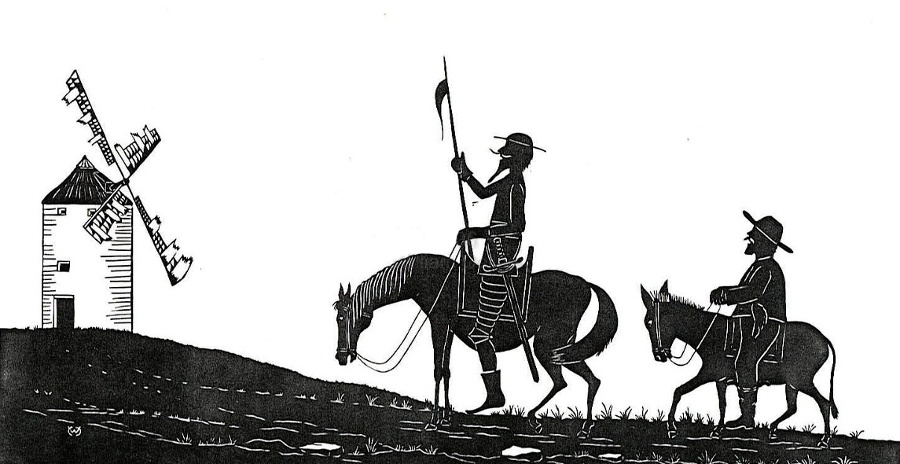
I find it hard to pin down the exact time and place this story was born, even though I know very well how it ends, because misplacing the origin could steer it off on a track it doesn’t belong to. Perhaps it germinated in 1884, in a dark corner of Uruguay, when a young man named Ireneo Funes was toppled by a trotting horse. Or perhaps its origin should be traced to the dawn of 1889, the day Friedrich Nietzsche’s spirit collapsed in a Turin square, crushed in an embrace around the neck of another horse (an old, gentle, mistreated draft horse), the tragic closure of that feverish race that had begun just two years earlier with the uncompromising architecture of The Genealogy of Morals. Although we could also reach back to the seventeenth century, to a place in La Mancha…
Sin descartar ninguno de esos inicios, digamos que todo comenzó en la primavera de 1995, en la capital de Wisconsin, a orillas del lago Mendota. Allí, mientras el profesor Otto Larson, observaba un tronco atrapado en el agua petrificada desde la orilla de la pequeña península que llaman (no sin un toque de ironía) Picnic Point, a treinta bajo cero —las mucosidades congeladas se sentían como extraños cristales dentro de su nariz y una media docena de estatuas humanas apenas rompían la horizontalidad del hielo—, recitaba para sus adentros los versos de Machado titulados “A un olmo seco”, buscando, tal vez, él también, el milagro de una rama verde en el invierno de su espíritu.
Madera muerta. That was the stigma the professor Larson believed he deciphered in the murmurs of colleagues and graduate students with whom he shared daily the elevator to the fourteenth floor of Van Hise, the tallest tower on campus. He did not find it, as Rosalía did, in plants, fountains, birds, or stars —everything remained mute under Wisconsin’s frigid winter—, but in the cruelty of the North American academic lexicon: deadwood, the barren professor who has ceased to produce.
That affront haunted him all the way to his office, a chamber of diminished authority whose window offered, as a light compensation, a sweeping view over the frozen lake. Only a large unpacked crate, bearing the legend “Macintosh Plus” beside the multicolored apple logo, clashed with that sparsely decorated office, which housed a Nietzsche painting on the wall, and on his desk a pair of binoculars and an Underwood No. 5.
Despite the prestige suggested by the panorama, Dr. Larson was anchored in his profession. He had earned tenure twenty years earlier, but the years of bibliographic silence had acted as an invisible drag, preventing him from reaching the final rung of the ladder. While the academy expected monographs and research articles, he wandered in the inexhaustible rereading of a single book, feeling, like the log he watched from the pier, a scrap trapped in the inertia of an institution that knew how to value only the fruit.
To be precise, only certain fruits. This was the era (the worst was yet to come) when American academia had adopted the fashion of the French philosophers of May ’68, and nothing that did not carry the scent of deconstruction or Foucauldianism was accepted by prestigious publishers. Or worse, it needed to be Butlerian. No interpretation was considered valid unless it demonstrated the identity between knowledge and power, exposed the instability of meaning, or confirmed theories of performativity. As the Poitiers-born philosopher had stated, the episteme of each era sets the boundaries of what can be said.
At that moment, Larson had spent twenty-nine consecutive years teaching a monographic course on the Don Quixote. The rite began every spring, as if that season were the only frame tolerable for such recurrence, for Larson sought — and almost always managed — to align Don Quixote’s arrival in Barcelona with Mendota’s thaw.
I met him toward the end of his tenure as a teacher. Larson was a man of such rigorous routines that it seemed he had traded life’s capricious spontaneity for the stern geometry of ritual. His students regarded him as asexual. He walked daily near the lake when weather permitted, and he entered the classroom with the punctuality of a pendulum. He laid a leather folder on the old wooden desk and began the session with a sentence that, he told me once, he had repeated, with only slight variations, for almost three decades:
“Alonzo Quijano’s madness,” he would say with trained voice, “consists in reading chivalric books as if they were history treatises. Does it not?”
That little refrain, with which he tried to mask his flawless command of Spanish, betrayed only by a faint Midwestern accent, he pronounced with almost exasperating relish, granting himself a brief pause to gather breath before unveiling his next sentence and giving the phrase the fixity of an axiom. Larson claimed (perhaps in that conviction lay his own shipwreck) that the knight-errant did not misplace the world in fantasy, but rather invested fiction with the authority of a done deal. For the Don Quijote, Amadís was not an invention of language but a genealogical antecedent; giants and the islands did not belong to the realm of the imagined, but to the solidity of the real.
—To the perplexity of the Toledo canon, —added the doctor Larson—, Don Quixote argues that if the books of chivalry were false, then stories of figures such as El Cid, Bernardo del Carpio, or the Twelve Peers of France would have to be false as well.
He proceeded with a string of parallels between Don Quixote and the galdosian Nazarín, whose cinematic version, starring Paco Rabal, he always recommended to his students.
—Largo grafismo flaco como una letra —continued the professor, perhaps convinced by the repetition that the discovery was his—, the knight has just escaped directly from the yawning of the books. All his being is nothing but language, text, printed pages, history already transcribed… Don Quixote reads the world to prove the books. Does-he-not?
Perhaps I was the only student who had identified the exact source of that claim: the second chapter of Las palabras y las cosas. Listening to Larson, I became certain I was not in the presence of a man who consciously plagiarized Michel Foucault, but one who had been possessed by him. In his voice, the phrases of the French philosopher were not a mere academic reference but an integral part of his own history: like a Nietzschean youth, he had consumed the French emulators of the German philosopher—Bataille, Deleuze, even Foucault himself; Larson, like his secretly admired Alonso Quijano, had ended by confusing the reality of the classroom with the genealogy of his readings.
During his years at Columbia as a philosophy student, Larson had begun a dissertation (never finished) on Nietzsche’s The Genealogy of Morals. In particular, he was fascinated by the enigma the philosopher had set out to solve: how nature had managed to breed an animal capable of making promises. For Nietzsche, nature had to counter and cancel that great, active, positive force—the capacity to forget.
On the only wall of Larson’s office not covered by bookshelves or the window with its spectacular view, stood the famous profile portrait of Nietzsche taken by Gustav-Adolf Schultze in 1882, and beneath the portrait, carefully framed, on a chalkboard that seemed never to have been used for anything else, in neat calligraphy, the following quotation:
Without the capacity to forget there can be no happiness, no gaiety, no hope, no pride, no present. The man in whom that mechanism of inhibition is worn out and stops functioning is comparable to a dyspeptic (and not merely comparable): that man does not “end” anything, cannot digest anything. (Zur Genealogie der Moral: Eine Streitschrift).
I noticed that the first sentence of the quotation was underlined with red chalk.
A couple of years earlier, during a sabbatical year for a department professor, Larson had been assigned a course on Latin American short stories. At first he took it as an affront, but soon the sense of grievance transformed into resignation: at least he would have the chance to reread Ficciones, one of his favorite books from his student days. A friend of mine enrolled in that class complained that Larson had spent three quarters of the semester (in what was supposed to be a panoramic course) talking exclusively about Funes, where the narrator recounts his encounters with Ireneo, the Fray Bentos neighbor who, after being toppled by a horse, acquires the dreadful gift of infinite memory.
“Infinite memory.” “Infinite perception.” Those exuberant phrases marked, from then on, the rhythm of Larson’s walks along Picnic Point.
One afternoon, in anticipation of my imminent graduation, I decided to visit Professor Larson in his office. I found him flushed with excitement, almost ecstatic. He held the binoculars in his right hand and, with a gesture, invited me to look through them at the five human figurines, clothed in parkas and blankets, standing motionless, connected by an invisible thread to the water through round or square holes cut in the ice, never losing the hope of catching supper.
—Do you know —he told me— that in all the years I’ve watched them I have never seen any of those living statues catch a single fish from beneath the ice?
With a mildly sardonic smile he pointed to a thick typewritten tome of at least five hundred pages. There I discovered that Larson’s Underwood No. 5 on his desk was not mere decoration. He granted me the honor of reading the first draft. The provisional title was sober and enigmatic: “The Funes Dyspepsia: New Data.”
Back in my student apartment, exhausted from carrying the beast on my bicycle through the icy streets of the Isthmus—having had to stop to pick up several sheets of paper from the snow—I managed to read barely half a page before sleep overwhelmed me. I only remember one sentence that then seemed merely academic:
“The accident that occurred in Fray Bentos in 1884 can be considered the detonator of an entire genealogy.”
A couple of weeks later, on the first sunny day of that spring, I ran into the professor on the lake terrace. He told me that the week before a headline from the Isthmus had caught his attention: “Forty-five Days Without Seeing the Sun in the City.” Realizing the hint, he had gotten in his car to drive to the Mississippi shore, two hours away, just to behold the sun for a few minutes. He paused, and his expectant gaze revealed his curiosity to know what I had thought of the essay.
I asked him, to cover up the fact that I had fallen asleep reading the damp and disorderly sheets of the tome, with an irony I now regret, why he spoke of Borges’ tale as if it were a clinical dossier.
He answered:
—Because perhaps it is.
I did not press further.
Weeks later he sought me with an excitement I had never seen in him. He had discovered (or believed he had discovered) a suspicious concordance of dates between Funes’ accident and the publication of The Genealogy of Morals. Exactly three years separated the two events.
—Don’t you notice, he said to me, the evidence?
I did not notice it.
Then he opened Nietzsche’s book in Sánchez Pascual’s translation and read the famous passage about forgetting as a positive faculty. And with a measured pace I will never forget, he added:
—This is not theory. It is diagnosis.
His hypothesis, extravagant as it was, possessed an elegance almost monstrous: Nietzsche must have learned, through some stray conduit between the Rioplatense press and Europe, of the young man who could not forget because of a horse’s fall, and from that case he inferred his theory that the capacity to forget is indispensable to life.
Philosophy, according to him, did not precede the fact; it arose from it. He spent almost the entire winter semester in a large room on the sixth floor of the Memorial Library, which also faced the lake and housed one of the country’s finest microfilm newspapers archives, scanning the newspapers from places where Nietzsche is said to have spent those months while writing The Genealogy: Nice, Zurich, Genoa, Venice, Leipzig, but especially Sils Maria. His eyes tired as he scanned pages barely legible on microfilmed images, usually of poor quality, from Leipziger Zeitung, the Corriere della Sera, Le Petit Niçois, Neue Zürcher Zeitung, and even the exotic Il Caffaro of Genoa. He tirelessly sought possible news of the Funes case that might have reached Nietzsche’s eyes.
I failed to dissuade him with three arguments I believed irrefutable: the first, based on the very title Borges gave to the book that included the tale “Funes the Memorious.” The second, reminding him that Borges was a year old precisely on the day Nietzsche died. With the other, perhaps the most powerful, I tried to convince him of how unlikely it would be that Nietzsche amused his breakfasts in Engadina with newspaper reading. That man who had written with his most sardonic tone in Beyond Good and Evil: “Today’s European… needs his newspaper, his coffee, his daily politics…”
From then on, Larson stopped reading Borges: now he read the world according to Borges.
He found (or believed he had found) on an almost illegible roll of microfilm a marginal note in German: Der junge Mann aus Fray Bentos, attributed to Nietzsche. He located (and dismissed) in a note of an forgotten edition of the tale a reference to professors prone to reading fiction as chronicle. He even cross-checked the exact dates of Borges’ birth and Nietzsche’s death: both occurred on August 25, but a year apart. Every document, every coincidence, every date seemed to corroborate his feverish hypotheses.
During the last semester Larson had condensed the more than five hundred pages into about twenty-five, which he thought would be a decent article for any academic publication. The article concluded: “All deep reading requires the provisional suspension of the difference between history and fiction.”
One afternoon he invited me to his office. On the desk lay the article and, above the article, two letters whose envelopes were roughly torn.
He showed me the two letters, one from the Canadian Journal of Hispanic Studies and another from the Journal of Iberian and Latin American Studies. In both letters the publication of the article was rejected, in the usual courteous but blunt tone.
In the Canadian journal, they regretted that they could not accept the manuscript for publication in its current form. While evaluators found his central intuition stimulating and potentially fruitful, they expressed reservations about how thoroughly the argument was grounded within the existing body of research. In particular, they noted that the bridge between Borges and Nietzsche, though suggestive, would benefit from a longer dialogue with both primary texts and the relevant critical bibliography, as well as a clearer articulation of its broader contribution to current debates in the field.
In the Journal, they argued that “the absence of sustained dialogue with deconstructive approaches and post-structuralist perspectives, such as those associated with Michel Foucault” —and this remark was especially painful for Larson— represented a significant limitation. Moreover, the reviewers believed that “a more explicit positioning of his argument in relation to these influential critical paradigms would strengthen both its analytical depth and its relevance to ongoing scholarly conversations.”
He had also sent the article to Casa de las Américas, persuaded by a colleague who specialized in comparative literature. But from Havana there had been no news. Nor did there seem to be any forthcoming. The same colleague had recently informed him that the Cuban journal could not afford foreign postage.
Larson gazed out the window at the ice fishermen with melancholy.
Over the lake, the sky was entirely covered by a white layer in which only a shadow could scarcely be discerned. He watched it with a level of intensity I judged excessive.
Then he would confess to me that, upon seeing them, he was certain that someone, at that exact moment, remembered them with absolute precision.
I never saw him again.
For some time I asked around the department about him; they told me he had requested a leave of absence, and later that he had already retired.
In the spring of 1998, I returned to Madison to visit some old colleagues and, in the Rathskeller café, I casually found an overdue issue of Isthmus that instantly reminded me of that trip of Larson to the Mississippi in search of sunrays. It was February 28. I read that on February 27, 1998 the ice on Mendota had broken unexpectedly—something very unusual this early—and one of the lake’s fishermen had found “a strange piece of floating wood.” Isthmus continued in its manner:
The authorities arrived quickly. The scene, however, had a stillness difficult to disturb: dark water, broken ice, the persistent cold. They retrieved the body without making much noise. In a few minutes, the place seemed almost the same, save for the tape marking a distance and the restrained presence of those watching from afar.
Little is known, for now… A man, probably in his sixties, whose hands held a pair of binoculars. No public name yet. In Madison, as in many college towns, the news and rumors travel fast in hushed tones — in departments, hallways, cafés — long before any official confirmation… Some suggest it might be a professor from the University of Wisconsin–Madison, but no one says it aloud…
The strange floating piece of wood and the ignominious epithet (deadwood). The memory of Funes’s death from pulmonary congestion, Nietzsche’s death after a long period of madness due to pneumonia, and Don Quixote’s death from melancholy after regaining his sanity tangled in my memory. And Larson? Perhaps Larson, emulating the three, died of literature, and only the lake remembers his precise form.