
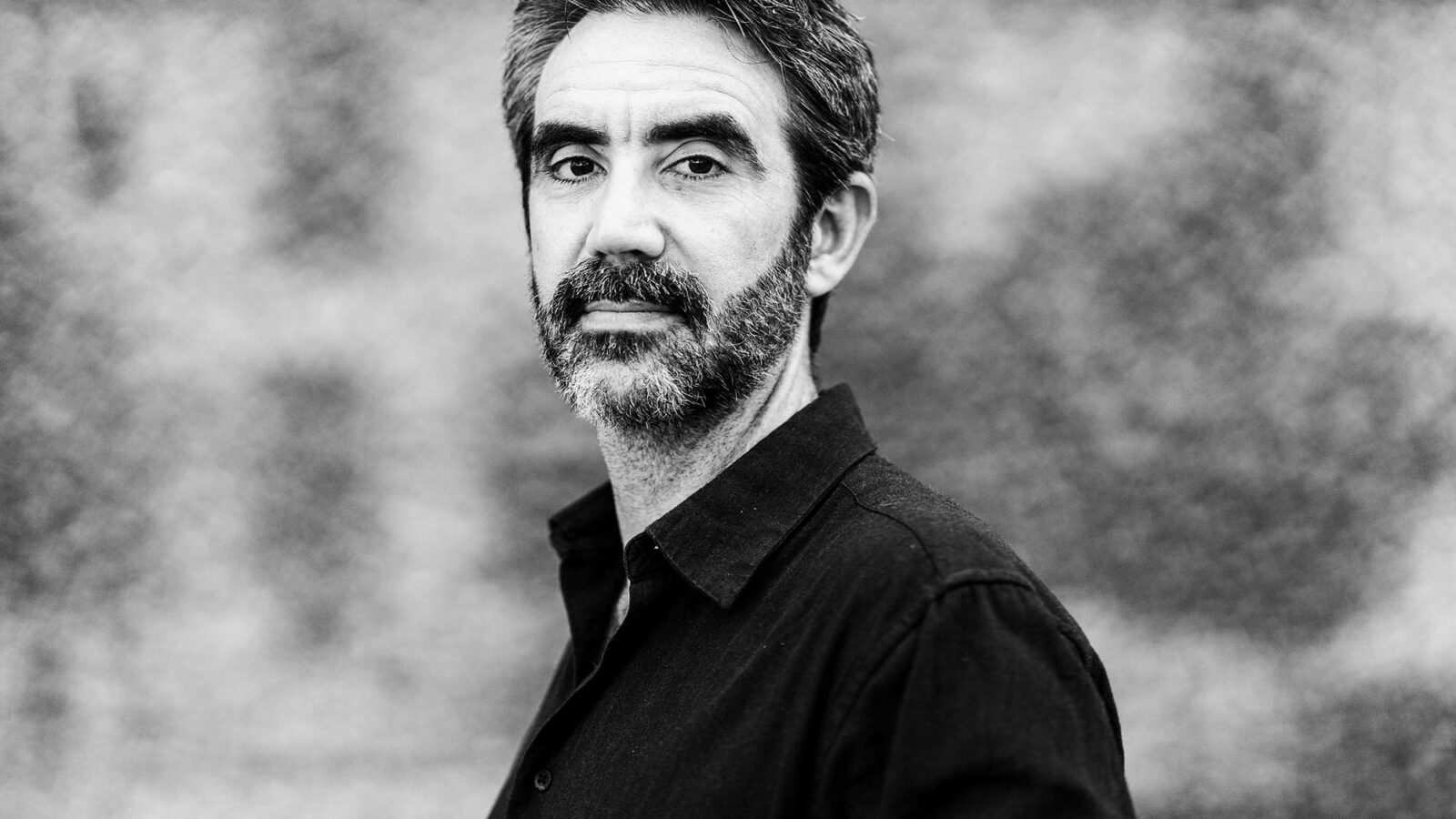
Half a century after the birth of Interviú, and eight years after its demise, Jerónimo Andreu (Cádiz, 1981) publishes Los desnudos y los muertos (Península, 2026), a deep dive into a magazine defined by Manuel Vázquez Montalbán as “a bold weekly Christmas basket that fed the public’s every lingering hunger” in the post‑Franco era. The author, an eclectic reporter who has covered corruption, wars, crimes; now focused on documentaries, presents a story populated by eccentric characters, scandals, and solid journalism. We discuss an essay with a title that feels Mailer-esque:
*****
—Do you like Norman Mailer?
—Yes, of course.
—Many will recognize the title of his book…
—It’s a homage to Norman Mailer, but I don’t do it directly: Manuel Vázquez Montalbán does. I took the title from him. Los desnudos y los muertos is a novel I like very much. So, I found that parody amusing and tried to set myself on the Mailer trail (laughter).
—How do you write a book about Interviú?
—Writing it is simple. What’s more difficult is the documentation and the interviews. It did take me a while at first; it was laborious to enter the Interviú universe. Getting people to talk to me: they’re all journalists with very particular backgrounds, who worked in a special newsroom and who carry a certain wariness about how the magazine is perceived or about themselves.
—Some of your sources asked not to be listed among the participants. Was that out of shame?
—Not out of shame, but they don’t have a clear sense of what their legacy looks like. They understand that many people might regard them as pornographers, as sexist relics of another era… So, although they are very proud of their experience and of all they contributed, when someone approaches them they become wary because they don’t know what they will encounter. The magazine was badly mistreated in its last chapter. The closure was a traumatic farewell. These are people with a complicated sentimental baggage regarding that period. Convincing them that this book wouldn’t be a hatchet job, that it wouldn’t declare Interviú an atrocity, is a task. Once you get in, writing a book about Interviú means talking to many people, collecting many versions of the stories, cross‑checking them, calling, correcting… in the end, this is a oral history. At one point I considered doing it by pulling quotes from people giving their version of events, but I abandoned it because I thought it would be a bit cumbersome for the reader.

—On the cover, the most precious asset was the female breasts.
—That’s right. It was a magazine with a very commercial aim. They knew what Spanish society demanded, and there was an absolute dependence on the nude: how popular the photographed model was, how erotic the pose was… in the end, it determined the sales. And they were very clear about that.
—Beyond the debate about the objectification of women, he notes that the magazine “waged brutal wars against women who attempted to defend their rights.” The Umbral interview with the rapist of the Ensanche is, in short…
—On the other hand, one must acknowledge that Interviú did very good journalism.
—It did very good journalism. Interviú has been a journalistic benchmark in many respects. Not only did it publish a tremendous number of exclusives, stories that no one else dared to reveal, but the treatment given to many issues, the language it used… it marked a remarkable renewal of journalism.
—How did the Zeta Group transition from being “the mischievous child of Spanish press” to becoming a holding that needed to bend every which way to publish pieces that wouldn’t tread on creditors’ or clients’ interests?
—Antonio Asensio was a man of strong instincts, a person who loved journalism but, above all, a businessman: someone who wanted to make money. Interviú was conceived with that aim. Asensio did not have a grand academic background, but he understood life well. He knew that to climb and close deals, you had to wield both a sharp and a soft hand. He understood that the journalism he sold was the sensational, attention‑grabbing kind; at the same time, you couldn’t go around stomping on people’s toes forever. So he balanced the two. What happened is that, as he ventured into more complex business projects—especially in communications—he began to see the limitations. The moment Interviú stops being a predatory dog or a free animal is when Asensio enters the television business. The government, more or less explicitly, required that if you wanted a license, you had to be a respectable, trusted medium that wouldn’t cause trouble. So Asensio said, “We’ll shut the taps on the scandalous stuff; we won’t upset the PSOE for these years.” Then they didn’t grant the TV license, Asensio got angry, reopened the gates, and said: “Take whatever you want.”
—Tell me about his role in the “antenicidio”.
—He plays an important and necessary part, but he doesn’t do it with any malicious intent: he simply wanted television. Once he kept the Godó share, Antena 3 Radio didn’t interest him at all. It was when he handed it to Polanco and told him, “Do as you wish.” He did have a radio project, but the ambition of his life was television. Asensio was a very clever man, always negotiating with a thousand different people and in many camps. If, for some reason, he had to clash with Polanco, he clashed; but then he did him a favor or something… he was a born businessman, with no prejudices.
—Dead, did Asensio cause Interviú to begin its decline?
—Certainly, the pace accelerates. Interviú would probably have died regardless—after all, it was a product of a particular time that was disappearing, but Asensio kept himself tightly involved with the magazine. He enjoyed and cared about it, even though at times there was a love‑hate relationship. Of course, once he is no longer monitoring it… For example, Interviú changed editors every few years; in the last eighteen years, it did not. Because he was no longer around. No one maintains that vigilant, tightening oversight. He also looked after his workers carefully: given his background, he liked them to have certain conditions. When he disappears and his son arrives, with very different circumstances, that carefulness is lost.
—Big Brother was a breath of fresh air.
—Just as heroin can be a breath of fresh air, you know? (Laughs) It can work for a while, but in the long run, it doesn’t solve anything.
—Then, you say, did Interviú lose its purpose?
—Completely. Interviú was a driver of modernization for the country in many ways. The magazine, with all its flaws and gaps, pushed to widen the boundaries of democratic debate: sexuality, the control of politicians… Spain changed so much and opened up so widely that Interviú lost its place. Spanish society no longer needed such erotic content, it didn’t need a product that tried to fuse so many different pieces into one magazine.
—What would you rescue from it? Do contemporary media miss something that Interviú did and that isn’t done today?
—Journalists are often nostalgic, but overall I think the level of journalism has advanced. It has diversified greatly, with a wealth of options: you can find analytic outlets comparable to the Financial Times, but there is also a lot of roguish journalism, investigative reporting… The conditions under which we practice the profession have worsened, as have media budgets. Yet they still produce very good journalism, and the legacy of the Interviú school continues to be strong. When I spoke with journalists from Interviú, they’d say: “Now, with the Ábalos affair, we’d have a field day. We’d run the mistress on the cover, then the wife…”. And all of that has appeared in the press, one way or another.