
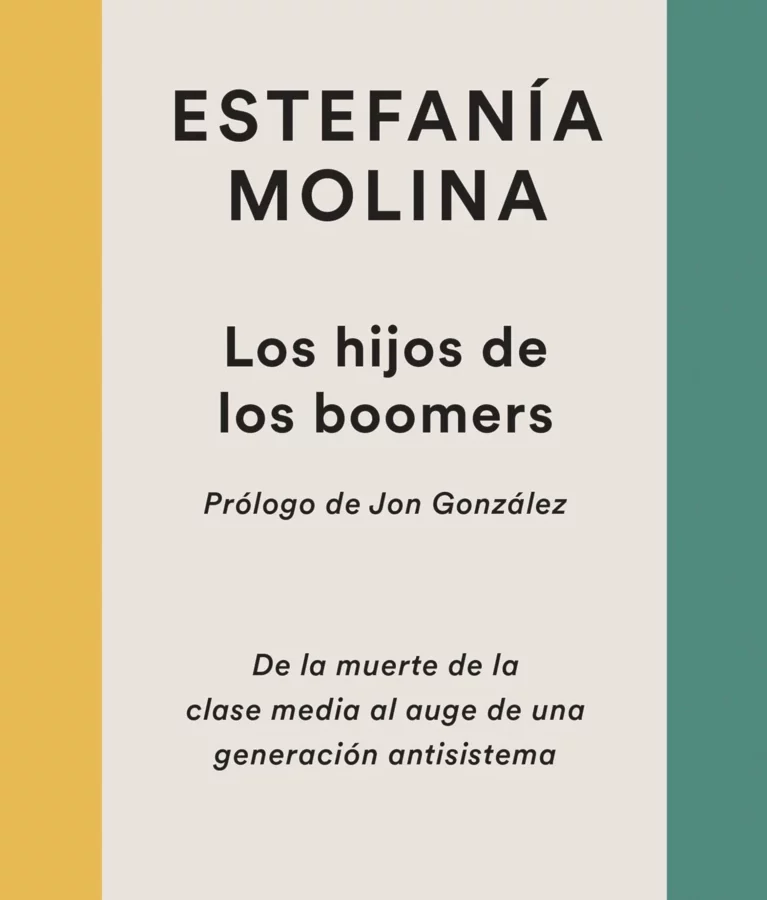
Estefanía Molina had been warning—almost from her earliest pieces in El País, dating back to 2021—about the gradual deterioration of material conditions in Spain and the grim horizon toward which the country is heading if this trend is not reversed, in a horizon that would increasingly stop being distant. The implosion of social ascent and the ensuing impoverishment of a middle class that now only keeps the name, thirty-somethings stripped of autonomy, returned to the rooms of their adolescence and waiting for the scraps of a State that is ever more welfare-oriented, and the growing weight of family wealth, already painted something more than a poor economic cycle: it revealed the rupture of that promise of progress from which the system had drawn its legitimacy for the previous generation. The Children of the Boomers is, to a large extent, the book toward which Molina has been steering those reflections.
Con la forma de un ensayo político de intervención, la autora alterna el análisis estructural con la experiencia personal, haciendo tangible un problema macroeconómico.
The book opens precisely with one of the values Molina most admires in the generation of her parents: the culture of effort. For the boomers, between work and material improvement there existed a relationship strong enough to render sacrifice an investment in the future. Saving allowed accumulation, owning a home was within reach for a working life, and children could aspire to live better than their parents. That continuity has been broken. A large portion of subsequent generations works to sustain themselves, saves without accumulating, and is forced to delay an emancipation that biological age ultimately makes seem ridiculous.
The most striking aspect of Molina’s analysis lies less in the symptoms of the problem — already hard to ignore at this point — than in the generational key from which she proposes to read them. For her, the deterioration of the middle class, the housing crisis, and precarious work would be manifestations of a single imbalance: a political and economic system concerned only with protecting the conquests of those who arrived first, even when doing so compromises the opportunities of those who come after. This is what Molina calls “boomercentrism,” a bias she recognizes, for example, in the valuation of pensions or in the tolerance of runaway rents that continue to provide returns for much of the homeowner generation, while reserving for their children measures of rather cosmetic scope — from a cultural voucher to Interrail discounts — unable to bring them closer to housing or savings. In the face of criticisms that see this fracture as a class issue more than a generational one, Molina argues that one does not exclude the other and that, in fact, the second threatens to aggravate the first. As soon as wages lose the capacity to procure housing and autonomy, the wealth accumulated by parents gains greater weight in the destiny of their children.
That dependence on patrimony returns to the family a function that the welfare state had helped to diminish in decisiveness. When the wage is no longer enough to sustain an independent life, parents cover the gap by prolonging cohabitation, ceding a home, or supplementing insufficient incomes. Molina here targets a left that would have ended up confusing protection with progress, to the extent of presenting as a progressive achievement — as a former minister did — that a grandmother’s pension contributes to maintaining the rest of the family. What that celebration overlooks is that that family solidarity is precisely what prevents precariousness from tipping into destitution, and that, precisely because of this, it helps conceal the failure that makes it necessary. The familial cushion saves the individual and, in doing so, the system that has left him without autonomy.
Also in the vogue of decrecentism among certain sectors of the left Molina finds a loss of realism. On housing, her argument appeals almost to common sense: if the number of families grows and the supply is insufficient, more housing must be built. That such an evident truth has come under suspicion measures, for the author, how far ideology can drift away from a straightforward reading of reality. Not surprisingly, therefore, is the severity with which she revisits the 15-M movement, perhaps the great episode of gatopardismo in this story. It transformed the party system much more than it managed to transform the conditions that had led almost an entire generation to the squares. Fifteen years later, some of those indignados have walked the path to the ministries, and much less has the material fortune of those who aspired to represent advanced. According to INE data that Molina collects, their purchasing power is today three points lower than at that time.
It is worth clarifying, nonetheless, that Molina is not writing against social democracy, but from her disappointment. What she reproaches the welfare state for is not having gone too far — the aftermath of austerity remains, she insists, in the collective imagination — but for having settled with merely mitigating the effects of a deterioration that previously aimed to correct it. Thus, the “Legacy Pact” with which the book ends has less of a rupture than of restoration. Her tribute to certain values of the generation of her parents ultimately demands, at bottom, something harder than recovering them: reconstructing the material conditions that once made it possible to believe in them. Molina also shuns the temptation to moralize a debate that has long since become crowded with trenches. She prefers to bring back to the realm of arguments questions that public conversation tends to settle with adhesions and anathemas. There you have another small boomer legacy.
—————————————
Author: Estefanía Molina. Title: The Children of the Boomers. Publisher: Destino. Sales: Todos tus libros.