
To commemorate the 90th anniversary of the Civil War, José Ángel Mañas recreates in Zenda, day by day in this section, what happened in 1936, perhaps the most pivotal year in all recent Spanish history.
Thursday, September 17, 1936: The Chilean Embassy
The Chilean embassy is today located on Lagasca Street, in the heart of the Salamanca district. It is surrounded by modern fashion boutiques of the finest brands, and the flag waves from the first floor of a six-story building, modern, with a marble-clad facade.
But in 1936 it occupied an old house on Prado Street, number twenty-six, owned by the Marquess of Campo Real and providentially rented a few weeks before the war. In the surrounding area there were no shops, and instead of police, at the door stood a dozen militiamen linked to the Popular Front to prevent any fascist entry. Thus instructed a veteran to the others this Thursday:
—If they arrive with an armband you let them pass. For those without one, detention. And inside, the same. Without an armband you do not pass. And those detained go to the Directorate General of Security or to the Bellas Artes Cheka where it provokes more anger.
Two months had passed since the supporters of the uprising had taken refuge in embassies. The diplomatic missions that remained open were South American. France, Britain and the United States had moved to the border. Germany was weighing having its representatives leave Madrid and settle in Portugal. In the Nazi embassy, intrigues simmered constantly. Among other things, the blame for the burning of mattresses at the Modelo prison was laid, which led to the entry of militiamen and the execution of prisoners.
In Madrid’s embassies, led by those of Chile, Argentina and Norway, sheltering an ever-growing number of refugees was the norm. Given the milician surveillance, the staff members always wore an armband bearing their country’s flag. Normally they were not disturbed, although from time to time some aggression sparked diplomatic indignation, in the face of the evident impotence of the government of Largo Caballero.
—And what do we do about the trucks? —said the young militiaman. Now one arrived loaded with food. The truck braked on the opposite curb.
—With them, the same. No pass without a little flag.
—What a quantity of food! But how many are inside?
—At this stage? Judging by the sacks of potatoes —said the veteran, noting how the truck driver honked to urge those inside to come out and collect the load—, at least five hundred. At first we did not control the entrances. The chancery is upstairs. Through there hundreds of fascists passed. But gradually the government realized that many remained inside the embassy. Inside, it’s a henhouse. There are two thousand meal slots.
And indeed, inside the embassy there were not only meal slots at large tables set up in one of the reception rooms, but the refugees slept crammed on the carpets, shoulder to shoulder. There were queues to access the bathrooms, and a witty former CEDA deputy, a colleague of Gil-Robles on a not-so-distant bench, cracked jokes about the soap: “This is the taking of the Pill!” Humor helped to endure the discomforts.
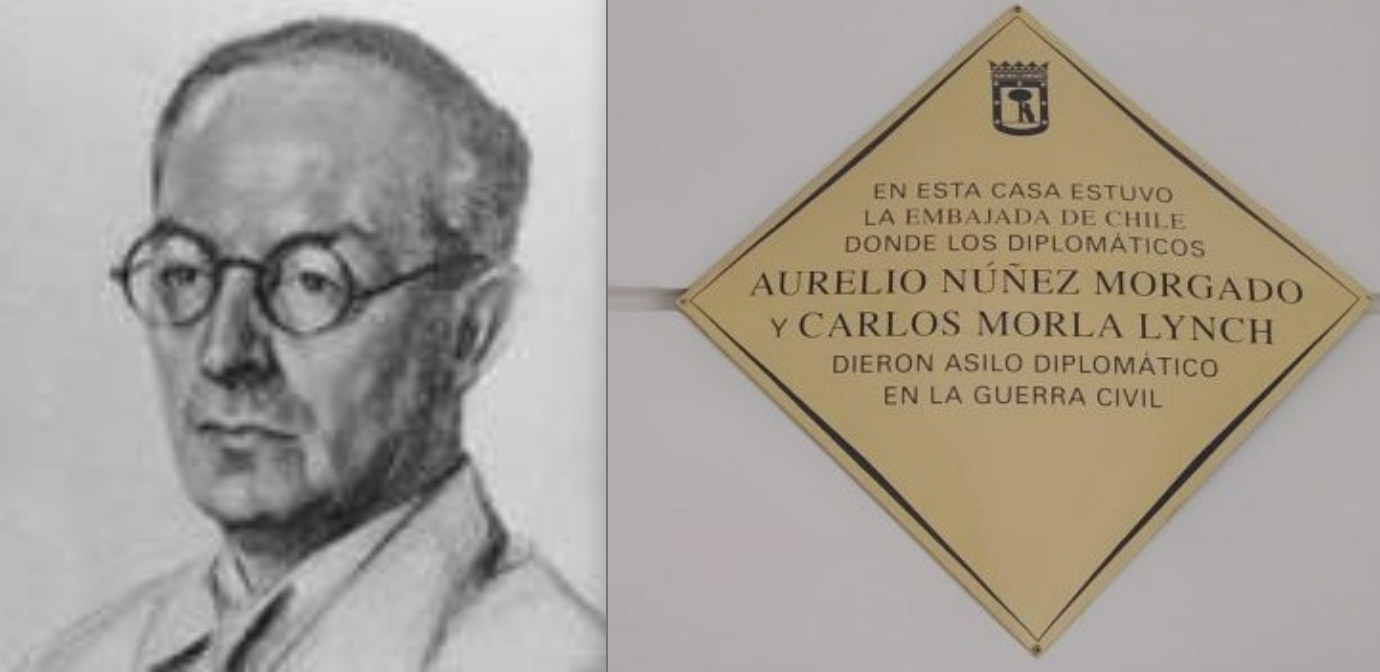
The Chilean ambassador, Aurelio Núñez Morgado, was the head of the mission who took a clearer stance in the conflict. It was precisely this diplomat, with his stern expression and elegant manners, who today drew aside a curtain in his office and gazed through the wide window from the first floor at the freshly arrived truck.
—Do you think it arrives with everything needed? —he asked his secretary.
—I hope so. They have gone as far as Valencia to stock up. It should be enough for the next few days.
Below, two embassy staff members, with armbands on their jackets, helped unload sacks of potatoes from the rear of the truck. Inside, the news was already spreading. It was ten in the morning, and soon the bell would ring with which Núñez Morgado’s secretary would walk through the embassy to announce the hour of Mass.
Todas las entradas de 1936 día a día
Entrevista con José Ángel Mañas sobre 1936 día a día