
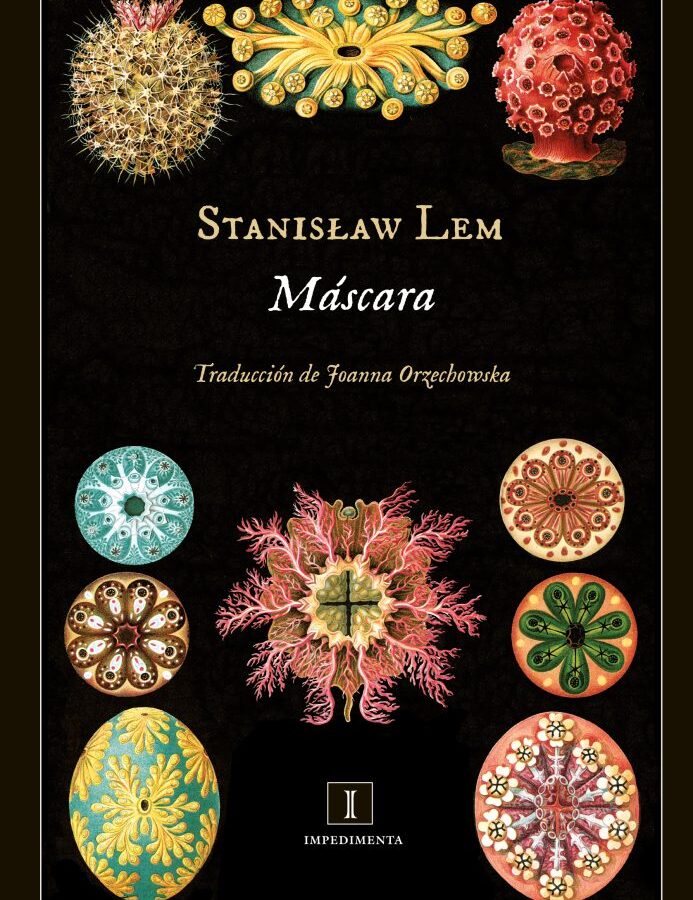
If we were ever invaded by aliens, it wouldn’t be a bad idea to leave a copy of Mask — Impedimenta, 2026 —, the present volume of Stanisław Lem’s short stories, at the edge of the crater carved out by the alien ship. While we’re at it, it wouldn’t be crazy to send another to the diplomatic corps, United Nations envoys, and other officials charged with preventing us from annihilating ourselves with bombs. Finally, already committed to spreading one of the wisest authors in world literature, it would also be a great idea to include Mask as a reference book for the popes of the omnipresent and exhausting artificial intelligence.
A couple of years ago I traveled to Kraków, the city where Lem grew up, and I could think of no better preparation for the visit than reading The High Castle, the Polish writer’s autobiographical novel. This little book has become braided with my reading of Mask. Narratives and life adventures have intertwined into a kind of review/reading guide. In this way I sensed that the concerns of the young Stanisław, a remarkably clever and solitary boy, creator of stories and tinkerer of gadgets, were inevitably guiding me toward the later thematic axes of his bibliography.
Son of a physician and himself a failed medical aspirant, he would seize this attempt to amass a dazzling scientific culture. In his child’s dismantling of junk with his curiosity for technology, and in the isolation, partly caused by his intelligence, one could glimpse the obsession with problems of miscommunication that permeate his stories.
The Rat in the Maze or Invasion, two stories included in this volume, perfectly illustrate the Lem we met in Solaris, the one who explained to us that communication with beings outside our conceptual frameworks is virtually impossible.
In Lem’s tales we also find signals warning us about the dangers of militarism. A citizen of a Poland shackled by the USSR, encounters between humans and extraterrestrials are configured in terms of factions stationed during the Cold War. In the aforementioned Invasion, we glimpse the prelude to disaster when an offensive against distant visitors may mean one’s own annihilation if the blurred line that exists between intimidation and aggression is crossed.
This anthology comprises stories spanning forty years of Stanisław Lem’s work. In it we move from vintage science fiction written in warlike or colonial terms — more in the style of H.G. Wells or Verne —, rich in epithets, toward very different angles. In The Friend we delve into the hard science fiction most characteristic of the Polish author, abstract and elusive. It is my favorite Lem, the one that dazzles you and forces you to question how far human language can go in developing unimaginable premises. All of this is achieved atop dionysian and feverish narrative progressions that sometimes remind us of another of Impedimenta’s bright lights. A certain Mircea Cărtărescu.
We advance in this volume —in this free literary tour through Lem’s life and work—, turn the page, and land on The Invasion of Aldebaran, where Lem dons another mask, becoming a writer entirely different who kicks gravity —not its physical laws but its seriousness— and becomes playful. It doesn’t reach Kurt Vonnegut’s outrageous level, but old Stanisław knows how to bring a smile to your face. And that is how Mask becomes an infinite compendium of science fiction. If you’re not careful, Lem will have you clinging to the leg of an ant to the furthest attic of the universe.
Beyond the usefulness of this book for settling disputes with Martians and deranged presidents, every illustrious author — including the one who writes science fiction — is valued mainly for translating his theses into reality and for his capacity to describe human nature with depth. Undoubtedly, Lem’s work helps explain the twentieth century as much as Orwell, Woolf, or Kafka. And yet, though reality and History are sometimes capricious — and thus unjust to certain authors — science fiction writers are also asked to prophesy the future without getting it wrong too often. Stanisław Lem, the once defiant and challenging boy, accepts the challenge and dedicates several tales to mankind’s desire to build superintelligent artificial intelligences. In The Lymphater Formula, the author places humans in a evolutionary stage prior to an intelligence that will naturally impose itself on us. Because once a superior species appears, it cannot disappear. In Mask, Lem foresees the hallucinations of artificial intelligence, the struggle between its soul and what it is programmed to do. And in One Hundred Thirty-Seven Seconds, the author indulges in defining with absolute precision — in 1976! — the prompts and the context of today’s AI that his protagonist uses to extract the maximum from a hyperintelligent ChatGPT.
Pessimistic about the technological drift toward the end of his days, Lem does not forecast in this volume the emergence of a Skynet that will come to wipe us out. On the contrary, he portrays a slow withering of our soul if we give in and renounce reflection, art, or love. “From that precise moment, from the instant we became dependent on him — the mechanical brain — as a species we could not help but stagnate spiritually, so our evolution would approach its end.” Read Mask and travel to the past of the future with old Stanisław, the boy who lived in the highest castle.
—————————————
Author: Stanisław Lem. Title: Mask. Translation: Joanna Orzechowska. Publisher: Impedimenta. Retailer: Todos tus libros.