
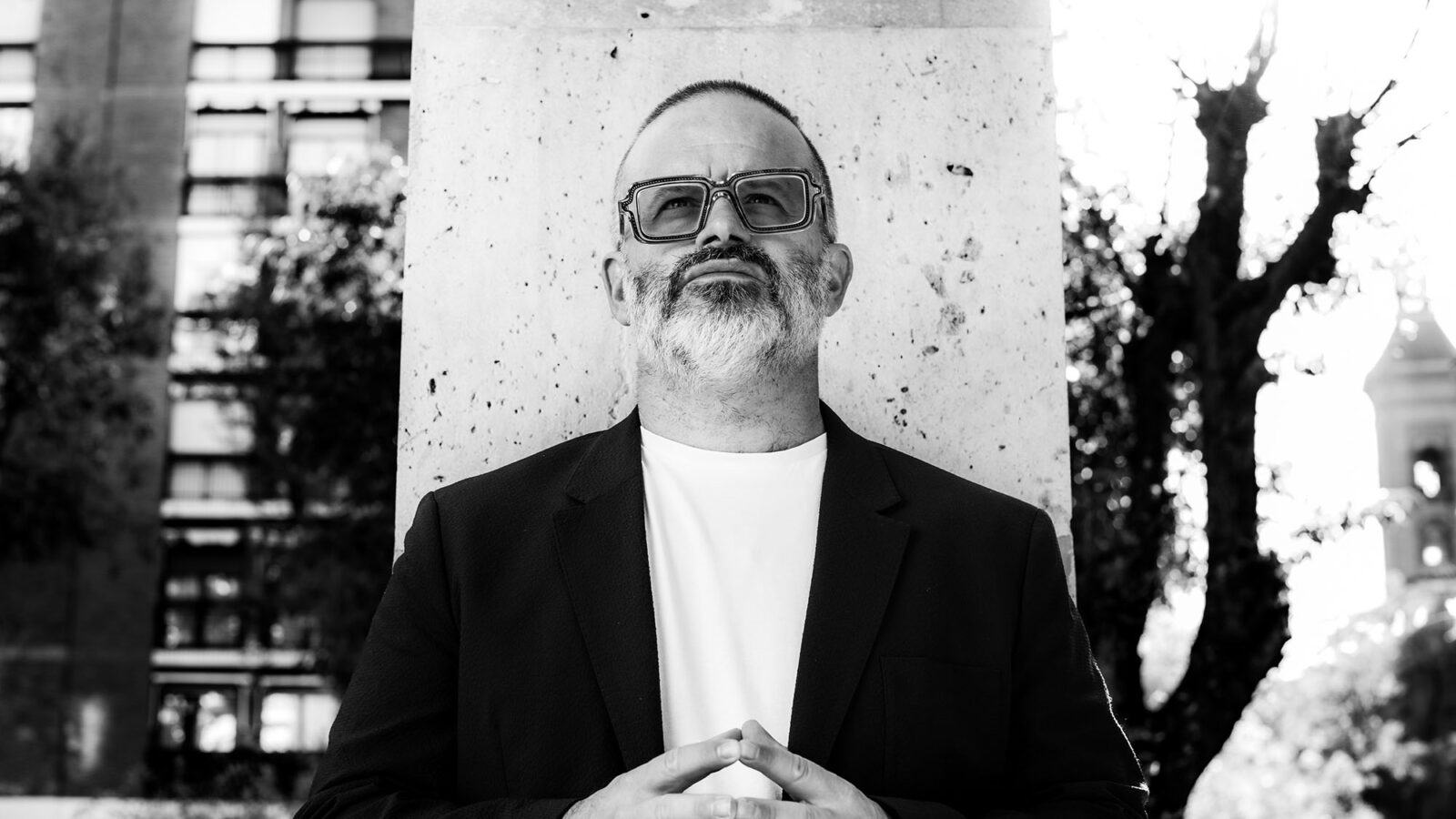
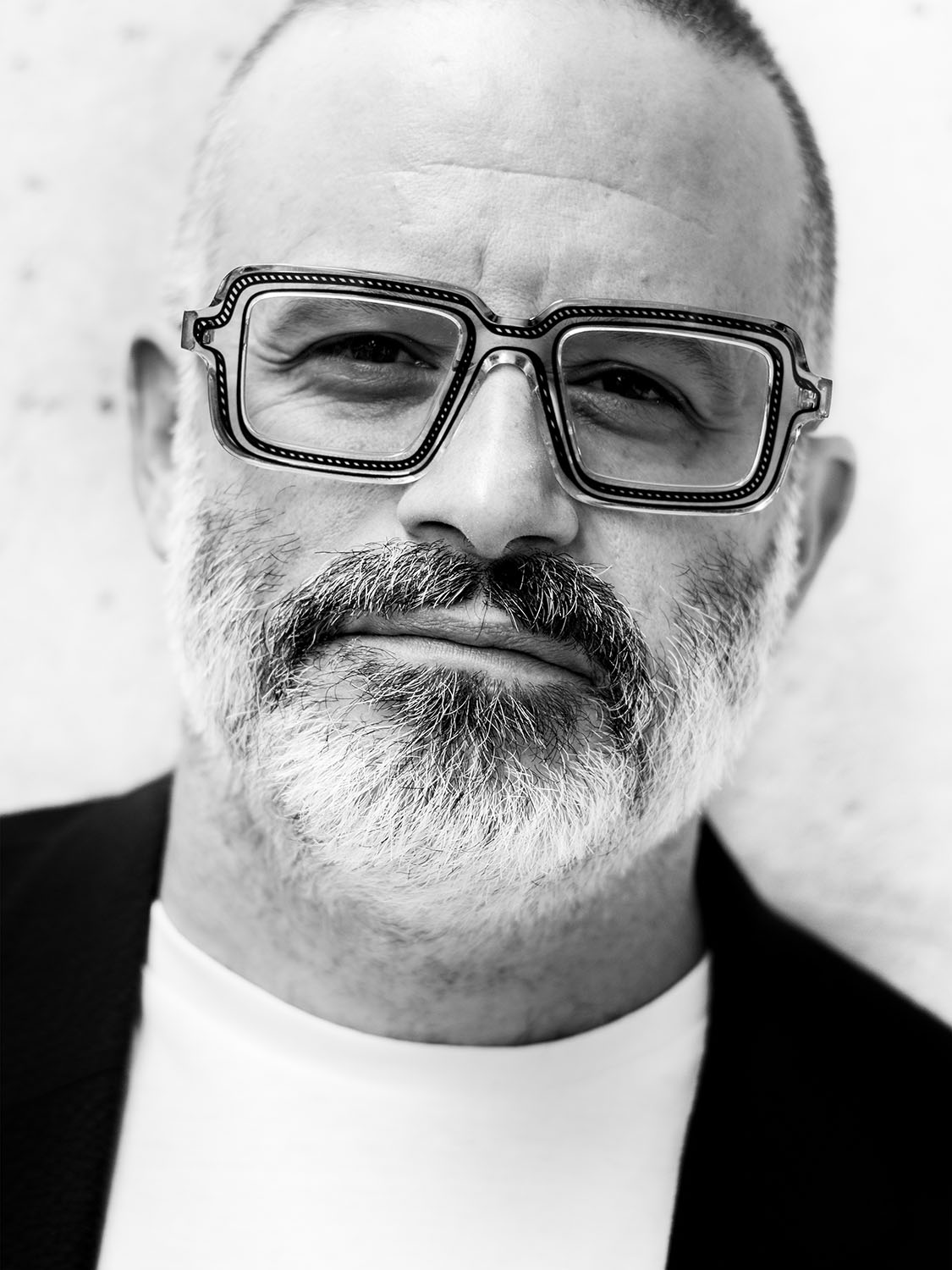
Edu Galán pulls back the mask from fame, unmasks its world of interests, hypocrisies, and vacuity, and shows, clearly and without makeup or filters, his naked face. In this society obsessed with recognition and shaped by the audiovisual imprint of influencers, wannabe celebrities and celebrities, the writer, without cruelty but without smoothing anything over, reveals his itineraries, which are diverse, sometimes radiant, other times dark, in More Famous Than Jesus (Debate), an urgent and timely essay that addresses a necessary reflection on a phenomenon that is embodied by a few, but affects everyone, that shows its evolution while reflecting on the relationship between the famous and consumption and urges to warn children about the dangers of premature fame.
*****
—Do you consider yourself famous, well-known, recognizable…?
—I would say I’m a niche celebrity. It’s clear that, having appeared on television for years and with Mongolia, although not at a massive level, many tell me “I know you from something,” “you sound familiar” or “I see you all the time, I know you.” From time to time people stop me. That helps me understand, apart from seeing it among famous friends, what that must be like, which happens to me occasionally, that it happens to them all the time, to such an extent that, I won’t say they can’t go out, but that going out becomes a nuisance. I, being a niche famous person and, let’s say, politically significant, find that people encourage me to keep saying what I say. Well, and there are people who call me a son of a bitch in the street. That has happened to me as well.
—And how do you handle that?
—I’ve been famous since I was a child because I was a referee. When I was in high school, I wouldn’t say it was common, but it wasn’t rare for a footballer my age to say, “There goes that son of a bitch.” I’ve been called a son of a bitch since I was 14. Now, when they call me that on social media, I couldn’t care less, of course.
—Have you seen the face and the dark underside of popularity?
—Yes… But look, cinema has taught me more than my parents did. The first time I glimpse fame’s effects is in films. I realized that, contrary to the catechism I heard at home—“it’s a story,” “that happens on screen,” “monsters are on screen, not in reality”—it wasn’t like that. I began to notice what happened in life, that films are manuals, sometimes with dragons and licenses, but they spoke about my life. The place I first saw the sinister underside of fame was in cinema. The luck I have is that I got famous quite late, at 31, when I started with Mongolia and we took the stages…
—Did those experiences help you?
—They give you a different perspective, and in that sense, refereeing was beneficial. Going out somewhere and having people watch you make decisions… Football is a stage, and it’s not limited to the field. There I began to see how people react when they are perceived by a crowd they don’t know, even though the crowd thinks they know them. For me it’s very interesting as a psychologist, and I think there has been very little time devoted to talking about fame.
—What bothered you, to put it colloquially?
—The anxiety it produces and the disconnection from reality that it can cause, which can be harmful. We know of thousands of famous people who have problems, not only with anxiety but with addictions, because dedicating yourself to fame is a very hard job. Then there are celebrities who have fame attached to their profession. Writers, politicians, bullfighters… But managing fame is a different job… In the case of monarchies, I argue it should be treated as a job tied to that dedication. If you do public work, you must approach it with great respect and know what you share with others, to what level of commitment you want to reach, and not thinking that posting a photo on social networks is simply posting a photo on social media, but that it means more.
—Are we giving fame to people who don’t deserve it?
—That’s a fair point, but the verb “deserve” is complex… In the sense that if someone has it, perhaps they deserve it, right? It’s more that, according to this society, those people deserve it. Those people to whom we give fame and who might seem vacuous are another facet of the consumer society. They keep us attentive, stuck in a consumerist leisure. That’s why the famous man isn’t the current famous man. The qualitative famous no longer exists. Only the quantitative one remains. If you’re a bricklayer who makes stunning viral videos and you’re nice and you gain popularity, well, that’s it. But that’s quantitative, not qualitative. If you look at their stories, everything implies consumption: travel, clothes, food… The kind of leisure being installed in our society isn’t a leisure where you sit in the park telling a story to a child. It’s a leisure where you go to the mall and do activities that perhaps don’t involve buying, but are surrounded by brands and consumption.
—Do you think the great difference between current fame and past fame is that before only those who had achieved some reputation in their field were famous?
—Yes, but the biggest change isn’t that those kinds of celebrities didn’t exist—the socialites, who had neither trade nor benefit… There are countless examples of people who became famous by marrying, divorcing… The big news is that fame seems within reach of anyone. This current fame, the notoriety, has swept away the old one, and anyone, even if it’s only on their social networks with twenty followers, is already known by a few people they don’t know. In that sense, fame is within everyone’s reach.
—Do you include warnings in your essay?
—Especially for parents whose children are starting to upload videos and such on social networks. The book isn’t aimed exclusively at celebrities. It tries to explain them, but I think it speaks to society at large, to anyone who presents themselves in public, in videos, on a social network, in groups among people they don’t know.
—The monarchy was a pioneer in exhibition.
—They were the ones who began to exploit fame in a banal way, even when they didn’t matter much or their influence declined. They’re somewhat responsible. They gave us a world that was beginning to feel hollow, because their role was lagging behind. The monarchy maintains distance from the public, though less and less so over time. Now you see Leonor entering university. She is increasingly sacrificed in the name of authenticity or truth. That didn’t happen not long ago. But distance is necessary to preserve the mystique of the monarchy. This is important. I hope Letizia and Felipe read this book, because it’s key that that distance remains, just as the rites… The monarchy cannot become Big Brother. It must be an institution that keeps its distance from citizens. It cannot be assimilated because, if it becomes assimilated into society, people begin to behave like ordinary citizens, losing the mystique.
—Does the monarchy carry so much weight?
—Whether we’re monarchists or not, my emotional memory is structured by the monarchy. I am an atheist, but a Catholic atheist, and a republican monarchist in that sense, because I remember when Don Felipe and Doña Letizia married, the abdication, when the king went to the Marivent Palace, Lady Di’s visit. My sentimental memory of Spain is irretrievably linked to the monarchy. That is due to distance, isn’t it? That importance it has in shaping the lives of people living under a monarchy makes it, for many, a stable and comfortable presence amid chaos.
—They fulfill a social function.
—And that social function costs a tremendous amount of work. One only has to look at the queen’s case. It’s a job, and everyone should understand it as such, because any monarch who thinks the office was handed to them by the hand of God and that they can do whatever they like should face the consequences. There’s our dear friend Marie Antoinette.
—In fame, social media play a decisive role.
—The media change; fame changes with them. The book is also a history of technology, of how it intervenes in psychology and how we perceive things. The printing press, cinema, close-ups alter our way of feeling. Radio, television, vinyl records—all of that changes our perception and fame. The advent of the Internet was vital to fragment fame and create a presentist, ephemeral kind of fame; this 15 minutes of fame thing was no joke. What we must understand is that fame is always mediated. The presentation of the famous is always through a medium, never face to face. That medium offers, delivers, so to speak, little bits of the famous. What the audience receives is a mediated image framed by the technological specifications of each medium.
—Is there an emotional component?
—Emotions are central in this society. The mass-famous acts like a methadone in relationships. It’s gossip, storytelling. Humans live by narrative, and one of the most powerful today is the celebrity narrative: who marries whom, who divorces, whether there’s a quarrel, whether they release a new album… One of the tasks of the celebrity who does this is to keep that emotion at the surface with stories. And crafting those stories is a monumental task, because they appeal to society to keep watching the celebrity and consuming them, because the famous person is both a showcase and a product.
—Should we prepare young people for fame?
—Definitely. Let’s return to the definition of fame: a mass that knows you, but you don’t know them. It’s common for young people to share a video in a WhatsApp group and, when the child enters secondary school, people they don’t know from other grades look at them. By looking at them they already form an impression of them. That, to some extent, is what makes you famous. And there are cases of child celebrities, from actors to those who appear on YouTube doing unboxings, who are not protected at all.
—Social networks…
—Social networks are the embodiment of evil, managed by unscrupulous multi-billionaires who should be expelled from the temple, as Christ drove merchants out. We would need to hold a Nuremberg-like trial for them. As José Luis Cuerda used to say, there is no creature more stupid in creation than the multi-billionaire, because he believes he won’t die. And it has been proven, day by day, that he is also the most evil creature. He is the epitome of evil. I fear Jeff Bezos, Elon Musk. I don’t like the mega-rich, especially those who control networks where there is no protection for children. There is none because governments cannot. Or perhaps they can, but they’re not doing what they should. Disney Channel or Televisión Española, private networks or Netflix, are subject to one standard, but on YouTube you find a child watching an unboxing, and other children doing unboxings, and a powerful dialectic arises, because children reveal intimacies and the child who does it could lose complete contact with reality. We are very worried about what we feed our children and not at all worried about these issues, about how they’re managed or prevented.
—Young people today see how easy it can be to become famous, and that can substitute for certain values, like willpower, study, sacrifice.
—I’ll keep hammering this point, but networks are controlled by a Protestant American ideology that views money and making money by any means as moral. It’s the United States, its president, that is valued the most. It’s the summit. When human relationships are based only on money, they become dehumanized and savage. Because money, by definition, only understands competition. And there are domains where competition should be banished, it shouldn’t exist. But when the moral metronome is money and the prevailing ideology is this, the easiest and most valued path, morally, is the one most praised by the morality of money. Yet we also live in a presentist society where there is no clear future plan. The only future is when Marvel’s next film premieres. It’s logical that things requiring five years of your life will seem absurd. If I can get quick reinforcement, money, and I go and pay fewer taxes… They don’t think paying taxes is about considering the future. If what I value is going to Andorra and keeping all that money as the ultimate moral, then why would I study engineering?
—Consumimos famosos?
—Yes, all the time. We consume celebrities, and to a certain extent they consume us, and they push us to consume. One aspect that interested me was the idea of how the famous injects narratives into you and you give them a lot of attention. But that attention isn’t free. In exchange, they introduce you to a lifestyle, a philosophy of life, and values, all tied to consumption. This is a central part of our leisure because it’s another facet of consumerist leisure. It pushes you to consume a lifestyle. If you analyze it, you’ll see that everything is linked to consumption: houses, the kids’ clothes, cars, travel. That constant aspirational and appealing chatter is everywhere.
—And there is loneliness.
—Yes, I mention it in the book. Urban societies are defined by people who are very lonely, and celebrities fill that void with parasocial relationships, with their stories. For people who do not have enough social relationships, they form one with them. Hence micro-celebrities, the Internet ones, generate content frequently to establish a closer emotional relationship with them, which can be beneficial in some cases, because we are social animals.

—Celebrities compete with one another.
—I’m talking about extreme cases. Influencers who dedicate thirteen or fourteen hours to it. They are slaves, despite the money they make, which is the minority, by the way. But they are slaves to companies that certify certain results for them that have no independent certification. It’s like someone tells you: for writing 300 words I’ll pay you this, but I decide when you hit 300 words. View counts on streaming services, and on social networks, are the most opaque things in the world. The reality is that nobody raises their voice, and since there are no unions of YouTubers—because that’s how they are—maybe there are a million and a half views, maybe there are only two, but it doesn’t matter, because they are so happy in that system, producing thirteen hours of content until, suddenly, they realize that, in economic terms, as Víctor Manuel’s song says, they burn their life. Poor the celebrity, for the psychological cost this entails.
—He speaks about the illnesses behind fame.
—It’s very hard to maintain privacy in the sight of the public, because privacy is private. Creating a sense of intimacy without realizing that this is not your real privacy is tricky, because people want the truth, they want to know everything about you, they want a piece of you, and that piece costs many disappointments, because the celebrity does not realize that they are performing. What they show on social media is a representation. There is no celebrity whose social media content reflects the truth.
—It’s a theater of life.
—A theater of life conditioned by social networks and a society that increasingly demands more authenticity from the famous, not satisfied merely with the famous who work, but wanting to know what they are like. In fact, there are celebrities who only dedicate themselves to exposing, in inverted commas, how they are. And that is a theater of life, something you must be very clear about: it is thus, it is conditioned by technology, and it says: “Put emojis, put this…”. This is an artifice that people consume and they believe they truly know the person.
—Then there are illnesses and people who expose their illnesses.
—That is a narrative that works a lot, the one of overcoming, overcoming an illness, as if you, suddenly, with your own strength, overcome an illness, when overcoming is always thanks to medicine. It is the narrative of the self-made man, of redemption, which is very powerful these days, both in politics and in this. I’m referring to the victim narrative. The victim is one of the protagonists of this society. Victimhood is tremendous. It works very well with the audience. Celebrities live off the audience and from appearing human, and nothing makes you more human than saying that you have overcome an illness and that you keep fighting. Then, of course, there are celebrities who, with their story of overcoming, can serve as consolation for others, but just as such stories exist, there are also victimhood stories.
—Should we return to fame as authority?
—We should recover those who have merits and have done something. I’m not a relativist, and I believe there are astonishing achievements in science and literature that should be given their proper weight. What’s happening with public figures goes beyond criticism and ranges from cynicism to insults. But that which I propose will not happen because there are technological tools that determine the how, and the how of those tools is to undermine authority. That does not foster a kind of false democracy in which we are all equal. We live in a customer-service society where we’re made to believe that social classes don’t exist… I see that return as complex, because the technological machinery does not move in that direction; it moves in the opposite. The society we live in, that kind of authority that says you are valued, does not. And it will be very difficult to change because, being such a presentist society, memory has been eroded. People think they are composing great musical hits and they are only rewriting Latin American music from the 70s. The references don’t go further back than yesterday.
—Celebrities create needs.
—Many people haven’t realized this, that they are creating a need. Celebrities, apart from being a tool of consumption, are aspirational, but beware of the distance between reality and your dreams. There is another entrenched myth: dream your dreams. Perhaps we should focus more on your realities than your dreams. The dream thing is a nauseating idea. A person from a rough neighborhood and another from Serrano Street can dream the same: being in Málaga sipping a mojito. But I think the Serrano Street person gets to Málaga by plane, and the other, if they ever get there, arrives at San Sebastián de los Reyes. Beware of dreams. Keep your feet on the ground. The book aims to reveal the backstage of fame and plant a little stone to hold onto reality. Instead of dreaming of living in Sergio Ramos’s house, you can aim to, like Sergio Ramos, be content with your own work. There is always the most plausible path. And I am not saying that one should be conformist. Not at all. It’s about being realistic in the face of the false chatter they’re selling us.
—Are there beneficial celebrities and celebrities that are harmful?
—Without any doubt. There are celebrities who promote values that can be interesting for your children, and others who don’t. Hence you study the celebrity in question with the same care you study their friends. We worry about who my child hangs around with, who the parents of the child are, who the aunt is, where they go, and we don’t pay attention to the child’s parasocial relationships, the relationships they form with their idols. Now girls are obsessed with K-pop heroines. The questions are: “Have you watched the movie? Have you sat through an hour and a half?” Well, sit down and watch the movie, see what it says, and understand what it means that your daughter forms a parasocial relationship with three cartoon characters. And who are those three characters? Who controls those three characters? What do they represent? If you ace the test, good; if you do okay, fine; but if you do poorly, damn… If you look at what they eat or whether you prevent smoking, why not check whether parasocial relationships are beneficial?