
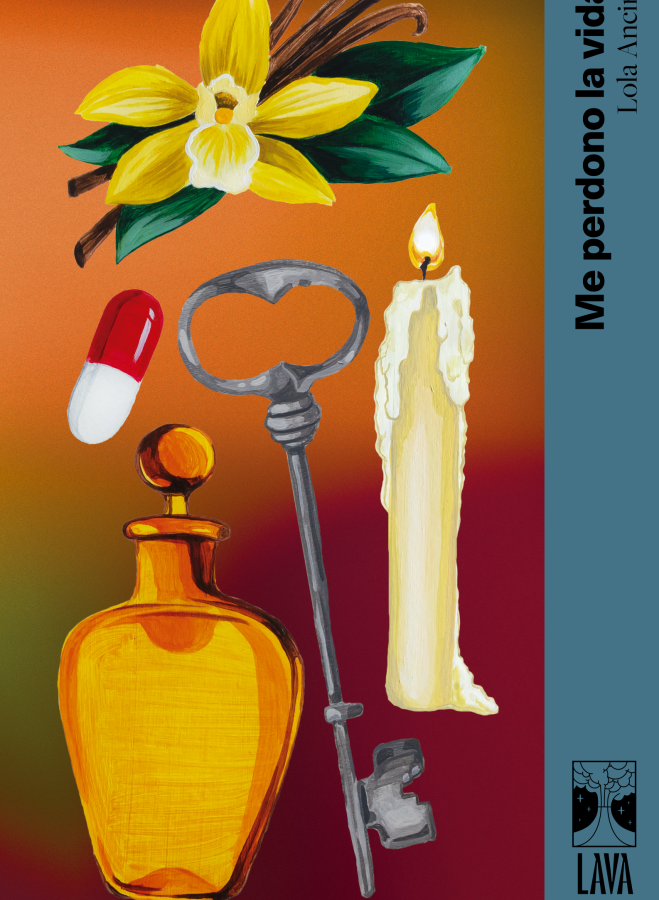
Halfway between ghost stories and psychological horror, this debut is a disturbing exploration of guilt, motherhood, and grief; of the wounds we inherit and the dead who never stop speaking to us when there is no one left listening.
In this making-ofLola Ancira explains how she wroteMe perdono la vida (Lava).
***
The genres of horror, Gothic, and the fantastic, especially in short fiction, have shaped my way of inhabiting the world since my early youth, both in reading and in writing.
I have published five books of short stories and
Me perdono la vida is my first foray into long-form narrative. The seed of this novel emerged at the end of 2017, alongside a project of a historical-fiction short story collection that I later published under the title
Tristes sombras. At that time, with the support of a grant from the Fundación para las Letras Mexicanas, in Mexico City, I conceived the main idea of the novel: the conflicts of the mother of a small child affected by Münchausen syndrome by proxy, and I began writing the first chapters. When it turned out to be a secondary project that required much more time than I could devote to it, I had to leave it.
I resumed writing the novel and left it again for brief periods until, in 2023, I received support from the Programa de Estímulo a la Creación y al Desarrollo Artístico (PECDA) Querétaro 2023 to develop this project. I worked intensively for several months on the first version of the manuscript with my tutor, the writer Daniel Escoto. Both the plot and the fragmentary structure and the characters changed considerably in the writing process and subsequently in the revision; the setting and the atmosphere gained much more weight and I decided to hybridize it by adding chapters of short essays around suicide, a topic I needed to write about beyond fiction, because in August of that year I suffered the loss of a very close person for this reason. Consequently, grief became another fundamental element of the story, as well as disorders related to depression and the invisible pains, afflictions that are often misunderstood and stigmatized.
Following the idea of the most classic Gothic novel, I moved some of its essential elements to Mexico City in the late 20th and early 21st centuries, isolating an old mansion completely from the sociocultural context of the time to entrench the protagonists even more in a nearly hermetically closed world, draining them through physical oppression and mental distress; a family in which the main inheritance is, moreover, illness. This novel brings together the stories of four women from different generations, three of them linked by kinship, who inhabit the same large and old house that guards the memory, the voices, and the presences of other grieving lives.
Returning a bit to the writing process, after announcing on social media that I was formally writing my first novel, I learned of the interest from the Barcelona-based publisher LAVA for its publication. Finally, in early 2026, we began more formal discussions. The deal and the editing work by Adrià Rosell has been very careful and dedicated, I am amazed by the result. It is a great fortune, as a Mexican writer, that my first novel sees the light in Spain.
Me perdono la vida is my catharsis and a sad, though also hopeful, song for those of us who have lived on the edge of the abyss and have looked into it, but we choose to cling to the hands that multiply to hold us on this side.
—————————————
Author: Lola Ancira. Title: Me perdono la vida. Publisher: Lava. Sales: Todos tus libros.