
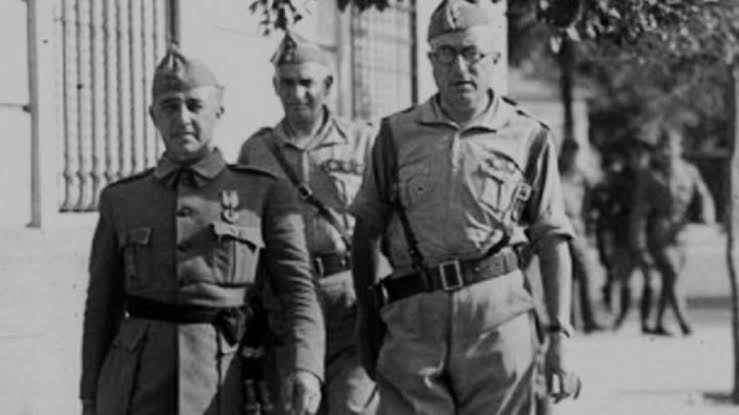
To commemorate the 90th anniversary of the Civil War, José Ángel Mañas recreates in Zenda, day by day in this section, what happened in 1936, perhaps the most pivotal year in all recent Spanish history.
Wednesday, September 23, 1936: The Yagüe Crisis
Are you alright, my lieutenant colonel?
—Perfectly. Start it up, go ahead.
Juan Yagüe, in the back of the Chrysler, was once again feeling the ache in his chest, and when he opened his eyes he found the gaze of his chauffeur in the rearview mirror. The car started. Breathing in hard, Yagüe scanned the sun-scorched fields that arose as they left the town. The yellow of the parched earth reminded him of the daisies of the Llano Amarillo. The color difference mirrored the difference between his mood then and now. After two long months of war, Yagüe had lost ten kilos. The wear showed. And it wasn’t just the crisis of the past weekend, his collapse before his men as he exposed himself to the noonday sun after eating the little he ate. If on the Llano he was still convinced that a strong, well-coordinated military coup could guarantee the rapid seizure of power, now he understood, like everyone, that the war could be prolonged greatly.
From there his eagerness to reach Madrid and his concern upon noticing that Republican resistance was growing. Already Badajoz had been the first serious hurdle on the way, with a virulent street-by-street assault, almost house by house, and numerous casualties. Upon arriving at Talavera, seeing the barbed wire that protected the town and four rows of trenches dug by the Republicans, Yagüe feared something similar.
Fortunately, the militiamen were not military. When their air power began to hover over them, many fled in panic. The rest imitated them after the charge of the Moorish cavalry and the Tercio. Even so, the Republicans returned two days later with more men and more determination, and more soldiers and Civil Guards. “Guards whom they led to the front without weapons, out of distrust of them!” he remembered, smiling to himself. The point is that, if they did not hurry, with the experience the Republicans were gaining, the resistance in Madrid would be fierce. But if they leveraged the moral effect of the victories, the capital could fall to nothing.
—If we go north and descend from El Escorial, Madrid will be ours in two days —he had told Franco—. But if we stray to relieve the Alcázar, then we will reach from the south and encounter the natural barrier of the Manzanares and troops that will have had all the time in the world to prepare.
But Franco turned a deaf ear, and Yagüe suspected that the blowout, which was loud, had not helped his heart to recover, just as the heat and lack of sleep had not.
In short, the exhausting effort and the disappointment of clashing with Franquito were taking their toll. Franquito himself recommended returning to Cáceres and resting. Yagüe protested vehemently: he did not like being relieved of command. In part because he suspected that Franco resented having him as a pesky nuisance.
But in the end he had accepted and provisional ceded command to Asensio Cabanillas. His nature could not endure it any longer. It would only be a few days, he thought, the time to recover. And there he was. His gaze fell once again on the first dehesas along the road, where some bulls were peacefully grazing.
—I told you to stop looking in the rearview mirror. Focus on getting to Cáceres as quickly as possible —he murmured.
Todas las entradas de 1936 día a día
Entrevista con José Ángel Mañas sobre 1936 día a día