
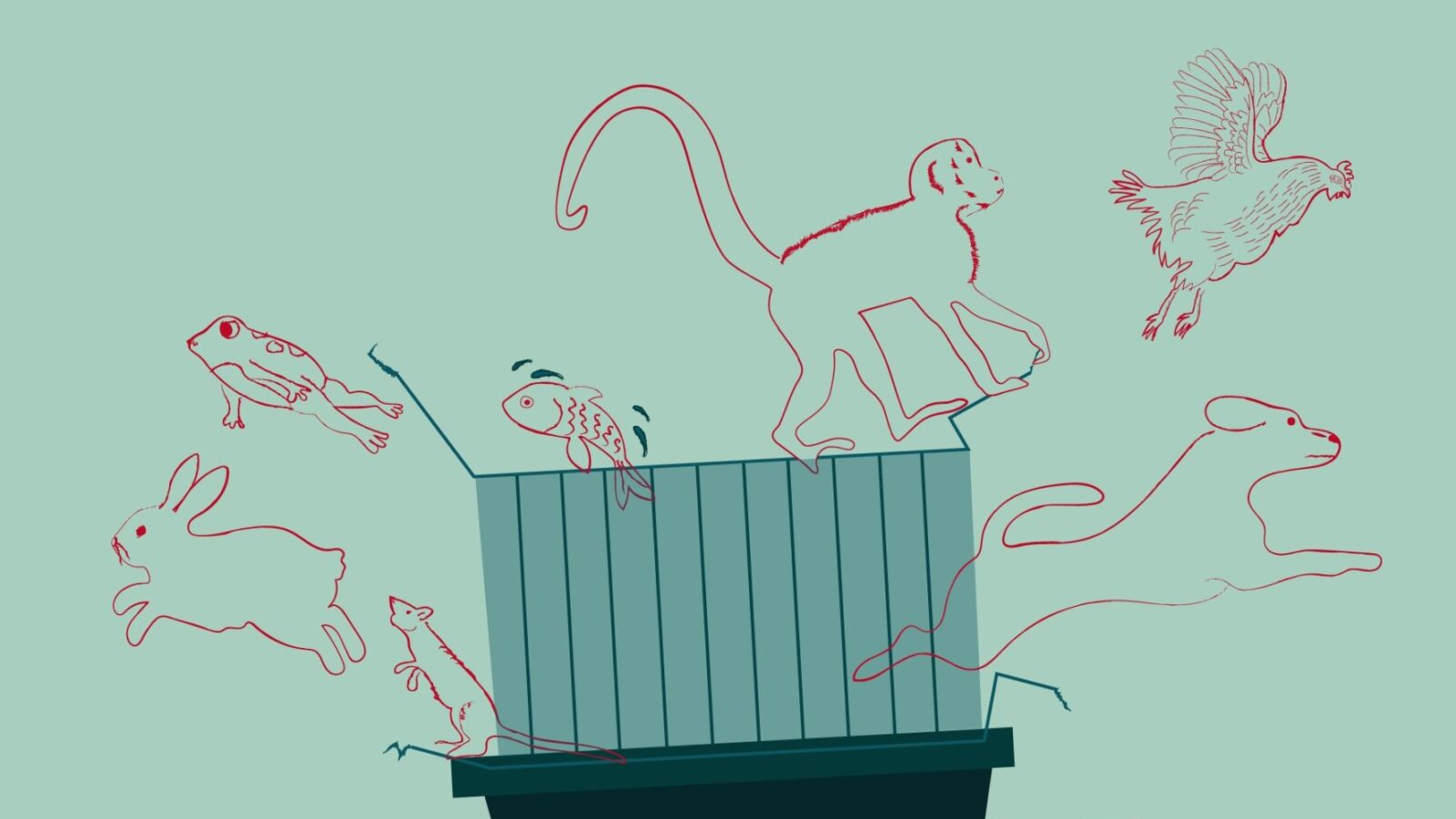
Can ethical justification be given for scientific experimentation on animals? The question is as old as Aristotle’s experiments in the fourth century BCE, although contemporary debate sometimes proceeds without acknowledging its own history. This controversy raises philosophical questions of great depth, for it leads us to ask what the purpose of scientific research is, to what extent ethics should guide science, and why humans consider ourselves more valuable than other animals. It also makes us wonder what health is, what the most ethical and effective ways to obtain it are, and how our health relates to the health of other living beings and the biosphere as a whole.
The writer discusses in Zenda the writing process that culminated in Paradoxes of Animal Experimentation (Plaza y Valdés).
***
For decades I have been troubled by a question, and that concern eventually became the seed of a book. In our society, no one now doubts that dogs feel pain and pleasure, sadness and joy, and possess sophisticated cognitive abilities that allow them to understand humans, communicate with them, and sometimes even play tricks on them. We know they feel affection for other dogs, for humans who treat them well, and for animals of other species. For this reason, in some countries, including Spain, laws have gradually granted them certain protections, though we can lament that progress is slow.
And yet, there is a hole in the legislation that allows torturing and killing dogs in terribly cruel ways. Cats can be tortured legally as well. And in the same way, monkeys, rabbits, hamsters, chickens, salmon, zebrafish… in reality, any animal species can be treated similarly.
For this torture to be legal, it is enough that someone with a certain level of scientific training asserts they have a research project that, in order to progress, needs to cause suffering, and that this project is approved by a so-called ethics committee. In Spain, as in most countries, legislation does not require that the members of such a committee be ethics experts, and typically the majority are experimenters who have never opened a book on ethics in their life. Ethics is an academic discipline studied in Philosophy degrees and requires several years of intensive dedication to train in it, and it is completely exceptional for a scientist to possess that training. Thus, calling them ethics committees is absurd. Well, it is these committees, which receive a name that has nothing to do with what they really are, that grant permission to torture and kill. Often, the experimenters take turns on the committee to authorize each other’s experiments, and that is all.
Some of these experiments aim to cure human diseases, but in many other cases they pursue very different ends: testing the toxicity of products and substances, from insecticides to detergents, checking the efficacy of military weaponry, carrying out repetitive studies with no practical purpose that inflate researchers’ curricula vitae, seeking ways to increase the economic gains of the livestock and fish industries, or satisfying a sadistic curiosity that wants to discover, for example, how animals react when subjected to extreme pain. The animals unfortunate enough to be used are confined for life in artificial spaces, in tiny cages or tanks, and subjected to all kinds of mistreatment that causes them physical, emotional, and mental pain. While I was researching to write the book, I read a multitude of scientific articles describing in detail the barbarities committed against animals that are made to suffer painful diseases, have their skin burned, bones broken, are forced to become addicted to drugs and alcohol, are kept for days without much food, are compelled to remain immobilized while breathing toxic gases, are subjected to electric shocks with the sole aim of seeing whether their cage-mates console them, or have their throats slit in front of their peers to study their reactions.
When scientists are asked why they do these barbarities, the usual response goes like this:
—Actually, we don’t want to do it, we don’t want to experiment on animals. We wish we could avoid it. We do it against our own will.
—And then, why do you do it?
—Because we are obligated.
—Obligated by whom?
—By science.
And there we discover that the laboratories of experimentation are a strange place made of obedience and repression of empathy and reflection, where scientists seem to bow submissively before a cruel science that demands sacrifices, like the bloodthirsty gods of other ages demanded the sacrifice of a goat to cure the gravest disease of the firstborn. All this is even more disconcerting when we see that at the same time many other scientists utterly refuse to use animals and argue that this practice is not only immoral but also ineffective. In recent years, more and more scientists have questioned animal experimentation and defended other, more useful methodologies. In fact, about 90% of drugs intended to cure human diseases that had worked in animals subsequently do not work in humans. Right now, in the scientific community, the debate is very intense.
Critical scientists argue that this inefficient practice persists mainly due to habit, due to pressures within the system, because laboratories are equipped for that and changing them would be expensive, because researchers have learned to work this way and changing requires time, due to anthropocentrism, due to ancestral fears of disease and death that prevent clear thinking, and due to a ritual and sacrificial impulse that resembles religion. In fact, a very well-known experimenter with whom I debated at a conference explained to me with enthusiasm that he was fond of bullfighting, and clearly there are similarities between both practices and both are about a human being trying to impose himself on nature and on the fear of death through ritualized tortures and ceremonies of domination. But experimentation also persists for another reason: because it feeds the lucrative business of companies that breed animals, that produce all the gadgets needed for the experiments (cages, aquariums, surgical equipment, systems to immobilize the animals, specific software…) and that also perform contract experiments for those universities or companies that prefer to outsource these shady and controversial activities outside their premises.
Isn’t all this very strange? Why does our society tolerate these practices, why are they protected by the political class and the academy? Why do the media almost never discuss this in a critical and reflective way? What is at stake?
For years I read about the topic, attended scientific conferences, dialogued with all kinds of experts, and listened to experimenters describe their experiments. What finally convinced me that there was something very dirty there was hearing the scientists who design the experiments talk among themselves (when they thought no one else was listening) about the animals they used: jokes, contempt, tasteless jokes, insults. But also by reading studies showing that a substantial portion of the technicians who handle the animals (not the same people who design the experiments) end up suffering from stress that in turn causes health problems as a result of spending their workday watching the animals suffer. And there you have the contradiction that experiments intended to improve our health in the future are making some of the people carrying them out sick in the present. In 2022 I began writing the book that has ended up titled Paradoxes of Animal Experimentation. Writing it was a journey into an irrational and contradictory world that, surprisingly, is well protected within the rational world of science. I must thank the Plaza y Valdés publisher for embracing this book on a controversial and difficult topic.
Indeed, animal experimentation is a tangle of irrationality, and in it are condensed many of the contradictions of our society, which remains unable to free itself from barbarism. It clearly reflects a society that says it loves animals while exploiting them with cruelty in numerous businesses and traditions. It also reflects a society supposedly deeply concerned with human health, which claims that to protect our health it is legitimate to torture millions of animals each year, yet at the same time it cannot take seriously the greatest threat to our health ever: climate chaos and ecological crisis.
To write my book I read many fascinating volumes, but above all I discovered something that astonished me: in addition to centuries of scientists and philosophers who have argued against animal experimentation, there is also a very long literary tradition of novels and short stories that have been able to lucidly explain the barbarity of this practice. I learned and greatly enjoyed reading Jonathan Swift, Mary Shelley, Robert Louis Stevenson, Wilkie Collins, H. G. Wells, Mark Twain, C. S. Lewis, William Kotzwinkle, Karen Joy Fowler, and Joseph Andras. And there I was convinced, once again, that good literature can reveal truth in a deeply profound way.
If we truly believe that the human species is the most intelligent and that our society is already far removed from the priests who sacrificed goats in the temple so that the gods would cure the sick, we should take on as an urgent task to end this barbarity.
—————————————
Author: [redacted]. Title: Paradoxes of Animal Experimentation. Publisher: Plaza y Valdés. Seller: All Your Books.