
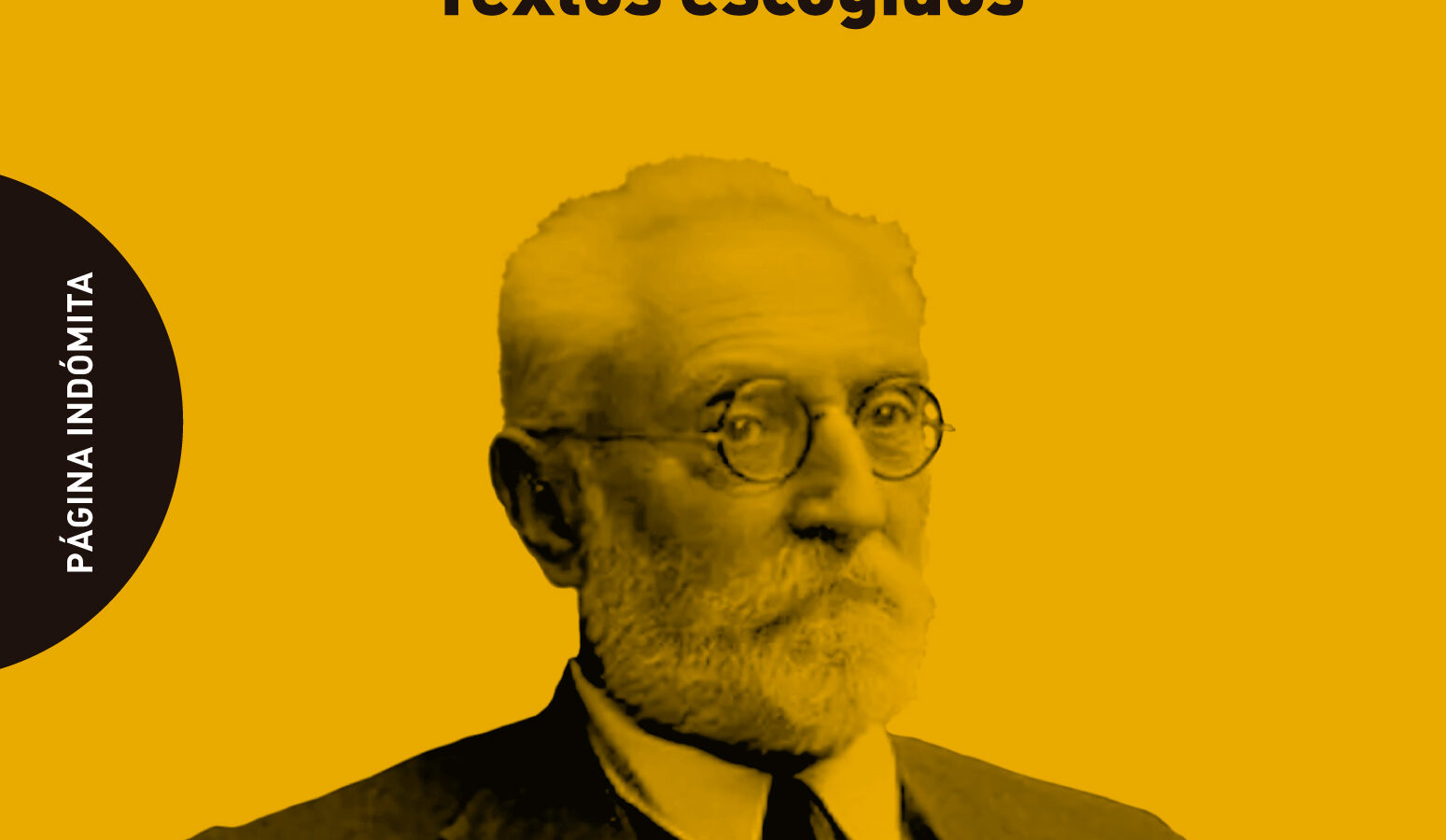
In recent years an expression has been used more and more, a term that decades ago was predominantly employed by the most ardent Unamuanists. I refer to “civil war,” in the obvious reference to the one that broke out in Spain on July 18, 1936. That phrase, with such potent significance, points unmistakably to its advocate, Miguel de Unamuno, and hence it is coherent that the publisher Página Indómita has used it in the title of the selection of texts by the writer, teacher, and Basque politician published in Barcelona in 2026, marking the ninety-year anniversary of that ideological and military confrontation that continues to fuel varied and opposing approaches and dialectics.
The book gathers various texts related above all to the singular and akhirnya (self-critically) reflective stance of Miguel de Unamuno in the face of such a fateful historical event
. They are dated from the beginning of the collection and extend up to nearly the death of that great figure who insisted on being flesh and bone, which occurred at his home in Salamanca on the afternoon of the last day of December 1936. The cause of his death is not devoid of speculation, the writer himself having fed the suspicion that he could have been murdered in his own house, a hypothesis he proposed on 7 December of that year in a letter to the New York novelist Henry Miller, four days later in another addressed to the journalist Juan Carretero Luca de Tena, director of the
ABC
of Seville, and yet a couple of dates after in the one addressed to Quintín de Torre.
In 1936, the Civil War: Selected Texts several letters from the restless intellectual and prolific man of letters addressed to different recipients have been grouped, though not all reached their destination. The letters are dated; the first on August 10, 1936, addressed “to a socialist of good faith,” and published in the Venezuelan newspaper La Esfera on January 3, 1937. The last was to Quintín de Torre, on December 13, 1936. Between them are reproduced those sent to María Garelli, Lorenzo Giusso, Esteban Madruga, Francisco de Cossío, Henry Miller, and the aforementioned Juan Carretero Luca de Tena. The book also collects Unamuno’s annotations, including passages from a work he was working on in his final months, The Tragic Resentment of Life: Notes on the Revolution and Spanish Civil War, whose manuscript would see the light more than half a century later. It also includes the volume of Miguel de Unamuno’s responses to interviewers from various international and Spanish media, namely: the French Le Petit Parisien, Le Matin, Candide, L’Humanité, the Dutch De Tijd, the transatlantic magazine Repertorio Americano, the Greek newsmagazine I Kathimeriní, the Polish Kurjer Warszawski, and the Salamanca-based dailies El Adelanto and La Gaceta Regional.
In some of these texts, it is not only Unamuno’s philosophical and political interpretation of the conflict that prevails, but equally the consequences that it brought to the writer’s private and family life in his turbulent final stretch take on unusually significant importance: he no longer had Concha Lizárraga, his domestic anchor and customary emotional support, who died in May 1934; he had to assist his children, and three of them had not been heard from for months; his third Rectorate had been revoked following remarks of his that he later called “innocent” (59), in which he reaffirmed them. He had made those remarks at the University of Salamanca, in a Paraninfo crowded with Falangists, acting as rector with Franco’s representation. Those remarks apparently provoked an unpremeditated dialectical clash with General Millán-Astray, on October 12, 1936, in a commemorative session then called Fiesta de la Raza in memory of the Spanish discovery of America. He even found himself almost in financial need as his income had drastically declined. He was confined and under surveillance in his own home, in a situation he understood and experienced as if he were in a hidden prison.
Amidst these personal ordeals, he redefined the meaning his works acquired in that context, among them the “poematic” Paz en la guerra and the novel he described as “mystical,” San Manuel Bueno, mártir. About the former I reproduce a paragraph that is very apt, in which he recalled that he had sung in its pages about “Bilbao of our other civil war. That one was civil. And even domestic. This one is uncivil. And worse than uncivil” (91).
Starts and ends the book with the reproduction of the contents of two drafts that show two antithetical positions of Miguel de Unamuno and illustrate a reframing of his view of the war and its consequences. The first is a speech delivered as a councilor in the City Hall of Salamanca on July 25, 1936. In that text he inclined to serve Spain by supporting what remains healthy in it, the “regularly armed” people, offering to “come to save Western civilization, the Christian civilization, which is in danger” (21). The second draft has no precise December date, being inscribed on the back of a letter of recommendation. Those lines expressed a striking change of perspective on the war and its subsequent drift, as evidenced by the following passage: “I fear that under Franco’s dictatorship what will be allowed the least is frankness. What will prevail will be the grinding” (123).
The aforementioned forecast was formulated by Miguel de Unamuno using a dual linguistic and cognitive scheme with playful overtones that bore his unmistakable signature, for the content was nonetheless severe and forceful. In this case he anticipated that in the Francoist state there would be an end to the freedom to think and to express political views while repression would roam freely, as already exemplified by one of the insurgent side’s generals, Emilio Mola, who addressed him with phrases such as “venomous and rancorous beast” (100) and “monster of perversity” (104).
Similar linguistic and analytical phrasing characterized other Unamunian expressions from that era, though without the same onomastic play described above. I refer to a couple of well-known phrases, one attributed to the nascent Franco regime, that of “to win is not to convince, nor to conquer is to convert” (63, 90, 95 and 116), a phrase that appears in this book with variants, for example “to win is not to convince, and to possess is not to preserve” (70), and “They will win, but they will not convince; they will conquer, but they will not convert” (105). There is another phrase referring to both sides in the conflict, those referred to as “the Huns” and the “Others,” with the initial H and the two words in italics. Miguel de Unamuno repeatedly returned to that formula, as the examples cited in the reviewed book show: “Outside Spain there are Spanish intellectuals who cannot return because they would be shot by the Huns or the Others” (75); “The Huns are as savage as the Others, in this war without quarter, without mercy, without humanity and without justice” (80); “And if the so-called Reds and Marxists, the Huns, carry on that war with brutal savagery, the Others, the national or savior side, establish their regime of white terror with refined perversity” (94); “No matter how many atrocities the so-called Reds, the Huns, committed, those of the Whites, the Others, are greater” (99); “Between the Huns—Reds— and the Others—Whites (the color of pus)— they are bleeding, ruining, poisoning and—what I consider worse—stultifying Spain” (100); “What the Others call Anti-Spain, the liberal, is as Spanish as the Spain fought by the Huns” (114).
The pathetically playful aspect of pathos vanishes entirely in distinct forms of expression and analysis where, despite their opposing ideologies, both sides are accorded similar destructive responsibilities, such that when Miguel de Unamuno notes that two social plagues, two epidemics, two insanities, two collective moral suicides, two kinds of terror developed in this context, “the white terror, as fierce as the red” (87); “a terror a hundred times worse than the one they tell us exists among the Reds” (108). And not one form of opio, but two: the one breathed by Bolshevik religion, and the other by those who called themselves Christian believers but lacked the authenticity that is presumed to be truly Christian. Not hate, but two, represented here by atheism on one side and by those who claimed that there was an intellectuality betraying Spain on the other.
As a unique kind of human being who chose to be and was, Miguel de Unamuno did not often tie himself to anyone’s thinking or even to his own, due to the constant inner struggle between heart and mind. He set an almost unattainable benchmark for self-criticism, and not least for rejecting militant sectarianism of any stripe. It occurs to me that if he ever clung to any premise—and not always, because it was enough for it to be a fairly settled premise to feel compelled to violate it—it would be the one contained in the Latin phrase attributed to Aristotle: Amicus Plato, sed magis amica veritas.
That uncompromising attitude was part of his very identity and can be reconciled with what he said and published in El Adelanto of Salamanca, on August 18, 1936, with a pair of days’ delay reproduced in the Charro newspaper La Gaceta Regional: “When everything passes, I am sure that I, as always, will face the victors” (37). And there was no need to wait for everything to pass, because the forewarned confrontation would soon take place. In addition to that assertion, there were the statements made to the Greek writer Nikos Kazantzakis, which appeared on December 14, 1936 in the Greek publication I Kathimeriní, and which would prove prophetic, because in order to say in any forum what he thought he did not hesitate to face any harm of any kind: “I have not betrayed the cause of freedom. but, for the moment, it was absolutely necessary to impose order. Once restored, I will soon rise up and fight again for freedom, absolutely alone” (56).
—————————————
Author: Miguel de Unamuno. Title: 1936, the Civil War: Selected Texts.Publisher: Página Indómita. Sale: Todos tus libros.