
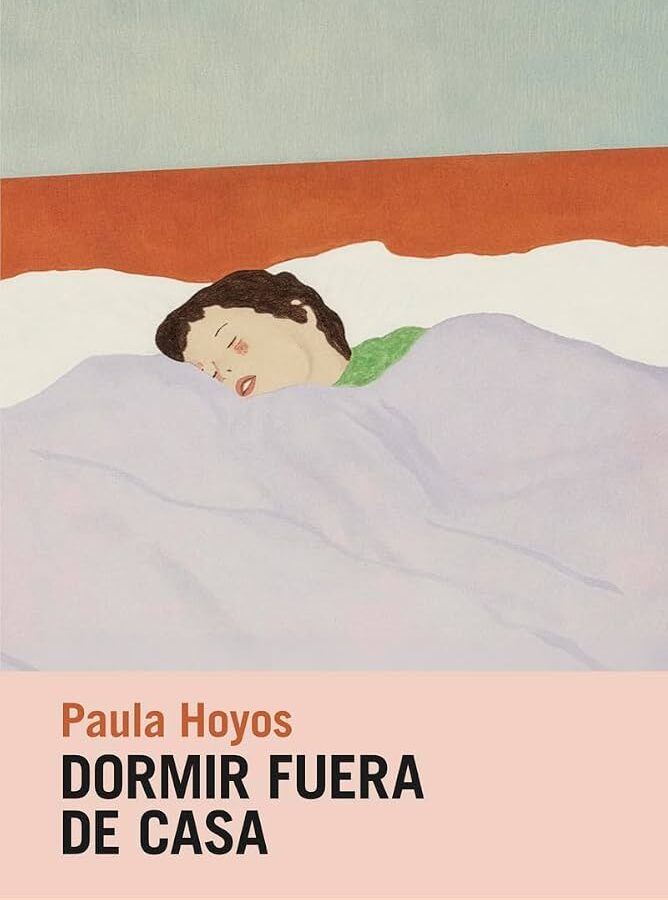
A breakdown forces the evacuation of a plane and delays the Rome-Barcelona flight by a day. While waiting for news of their new boarding, four passengers from two generations meet and spend those strange suspended hours together.
In this making-of Paula Hoyos explains how she wrote Sleeping Away from Home (Candaya).
***
On two occasions I had tried to write a novel and both times I had failed. I threw myself into writing with a vague idea in my head and believed that later, through writing, I would find the story. But things don’t work that way, at least not in my case.
I was twenty-nine. The first thing was the idea, the question: why are they sitting on this plane? What decisions and events have led them here? Are they alone? How do they relate to one another? I went down to the stationery shop and bought a small ring-bound notebook. I wrote in black the questions that over the following weeks I would answer in blue: structure, narrator, settings, characters, etc. Only when I completed the “exercise notebook” did I begin to write.
I began with enthusiasm. Guillem and Julio, my first two characters, emerged quickly. Lalia and Inés resisted more; there were several versions of them that still didn’t work. The problem was that I couldn’t find the right distance. Everyone could have a bit of me, but none should be me. Sleeping Away from Home is an ensemble novel, and one of the goals was that the text feel balanced: no one should be the protagonist, everyone should function as a group of people, as a unit.
Ianire Doistua posed the right questions to me during the process, which made me realize some mistakes. I advanced slowly with the writing. I shared fragments with my workshop peers. Some days I thought the text was brilliant; other days, that it was rubbish. I enjoyed writing, even though many days I didn’t write much. The most interesting moments were when the text “got away from me” and topics I hadn’t anticipated writing about emerged. I read aloud. If I hit a block, I wrote by hand.
On one hand, there was hard work: the hours I spent typing on my laptop, sitting in bed, in the Montserrat Abelló Library and in a quiet café near my home, but which no longer exists. On the other hand, there was soft work: all the times I convinced myself that I should go fetch the details. I remember a spring afternoon in Sant Felip Neri, watching the orange petals in the center of the square; the quiet of the passatge Sant Felip; the Gracia pastry shop where I ate a Neapolitan sfogliatella; the scent of Santa Maria del Pi church. All the details I “had to go check” in order to write the novel. And, of course, the books I had read and the films I had seen convincing me (or deceiving me) that they were indispensable to define the character of one or another character. “I’ll only be able to write this chapter if I read that novel.” “I’ll only be able to progress if I rewatch that film.” “This play will serve me for this idea.”
When I had the first draft, I let the novel rest and entertained myself by writing short stories for months. The Umbilical Cord won the María de Maeztu in Estella. My friend Paula drove me to pick up the prize and, for the first time, I felt a little bit like a writer. It gave me a boost. This pattern repeated: I revised, rewrote, deleted everything superfluous and then left the draft again to distance myself from the text.
Between the summer and autumn of 2024 I read The Grey Notebook, by Josep Pla, I underlined some passages, and I was particularly interested in reflections about style: “It has a flaw, of course: it’s a bit laden with literature. The adjectives are contrived, the sentence feels unnatural, the concern for originality is too visible. But what can you do? It’s the defect of age. The best style is that of family letters, but without the excess of informality those letters usually have […]”
Afterwards I did the final revision: I erased the paragraphs where I showed off, those where I tried to shine or impress. I tried to be honest and set myself a rule: only the phrases I believed in could remain; even if it was fiction, I had to feel, when reading them, that they spoke the truth. I revised the manuscript and felt that I had reached the end. I was sure I could spend years correcting the novel, but I would no longer be able to improve it.
I sent it to two short novel contests. I forgot about the matter. I dedicated myself to reading. From time to time I jotted down ideas on my phone for a (perhaps) future novel and later transferred them to a laptop document called Notes.
The afternoon of August 28, 2025, Getxo’s library director called me to say I had won the Ramiro Pinilla Prize. I answered the phone seriously and quite restrained. When I hung up, I lay on the sofa and thought: “What a thing just happened!” I was thirty-three, and the time that had passed had resolved some questions that had troubled me in the past. The next day, with the news absorbed, I walked the entire length of Consell de Cent street, headphones on, quite happy and still incredulous: a group of strangers had connected, in some way, with those characters I had invented and loaded with the details I had gathered for years; characters who met and comforted one another in a game of mirrors where some held the answers to others’ questions.
—————————————
Author: Paula Hoyos. Title: Sleeping Away from Home. Publisher: Candaya. Availability: Todos tus libros.