
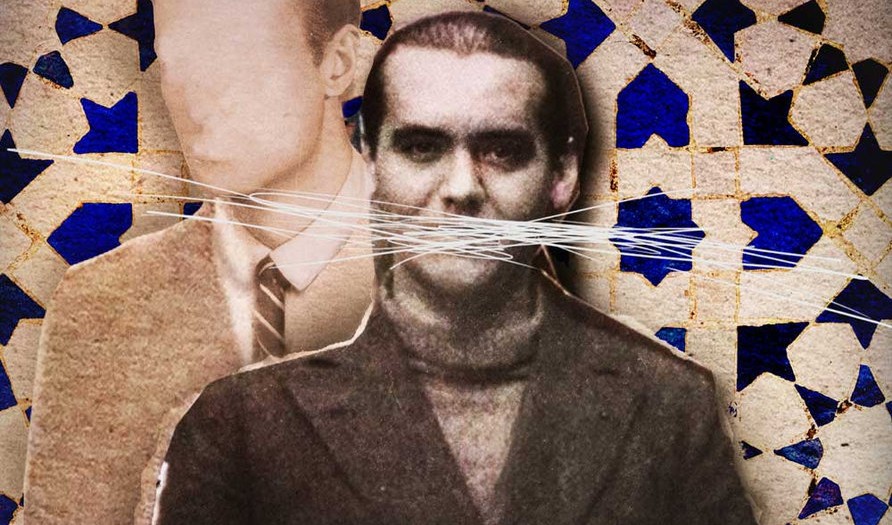
Last week I shared, as will happen with many, perhaps with the whole world, the hardest tribute, the most beautiful, the most human that Federico García Lorca has received since he is no longer in the world, although he remains, as a poet, as a human being, everywhere. It is a film by filmmaker Manuel Menchón, who is also the author of, for example, a essential, beautiful remembrance of the history and the death of Miguel de Unamuno.
What Menchón has now offered to contemporary cinema is The Broken Voice, more than an hour of film in which Lorca, his love, his music, the terrible heartbeat of his murder, and the many friends who, with him, were helping to forge a Spain that was different, republican, joyful, and possible, come together.
He was killed by those who rose up against the Spanish Republic. A murder that today returns to the history of Spain as a monumental reminder of the greatest symbol of the terrible events that led to Franco’s dictatorship.
Facing this film, I felt a sensation tied to the present moment, in Spain, in Europe, in the Americas, in every corner of the world. For today, everywhere, one can find the terrible roots of what happened in those wars, and also in the wars that are being fought in countries that, like the one I write from, feel that the time has come to become worse.
It’s a strange world, this one, which perhaps can only be understood if we look back, study, and repudiate what happened to Lorca and what happened after Lorca, for example in Hitler’s Germany, which, by the way, is now appearing again in various disguises everywhere, as if that villain had been a benefactor rather than a killer.
Ninety years have passed since Lorca’s murder. I attended the first screening of Menchón’s film. Later I asked him questions that appear here. They concern Lorca’s love, Juan Ramírez de Lucas, with whom the poet wished to travel abroad when that Spain seemed about to break apart. That great love of Lorca (who would later become a great journalist) kept its secrets, which now surface (in writing) in Menchón’s film. It is, says the author, “the unknown chapter of Lorca’s great love… The intimate story of a love interrupted in the context of a country shattered by tragedy.” As a line from the unforgettable verse by the poet José Hierro says, “I have not told anyone that I was about to cry.”
Before the interview, this is what the director pointed out to me to warn of what inspired him and what this document now is: “Lorca’s murder, exactly 90 years ago, turned him into a myth. In the summer of 1936, Federico García Lorca and the young Juan Ramírez de Lucas planned to leave Spain and begin a new life far from a society that forced them to conceal their relationship. That trip never happened. Weeks later, Lorca was killed in Granada, at the outset of the Civil War. Ninety years later, The Broken Voice recovers that interrupted story and delves into a deeply intimate and loving dimension of Lorca tied to his last months of life, until now barely accessible from direct sources.”
During the interview, the filmmaker expresses this shiver: “The past is more alive than ever. In these more than four years of work I have recognized in the present the mechanisms of the horror that the film recounts: pointing at the other, normalizing lies and hatred. It is easy to pay homage to Lorca; the hard task is to combat the hatred that led to his death. Juan Ramírez de Lucas embodies another consequence: surviving, forced to hide his love and silence his life. Yes, but not from solemnity, rather from restitution. The film is an embrace of Federico, of course, but also of Juan: the one who survived, the one who had to hide his love, his memories, and a fundamental part of his life. I was interested in looking not only at the murdered genius, but also at the man who stood on the other side of the tragedy, condemned to keep living in silence.”
In Lorca, life and creation are inseparable. His universal dimension arises from expressing, from the most intimate and local conflicts that anyone recognizes: desire, repression, the fear of living as one is. Lorca keeps speaking to us because those conflicts remain open.
“I did not want to repeat either themes or genres. My previous film had already been about the Spanish Civil War. But several events occurred. The first pages of Juan’s diary reached me, where he wrote: ‘I want these memories to see the light after my death.’ I was deeply moved that a man had to hide his memories for an entire life. A few days later, in my close circle, a friend was beaten for walking hand in hand with his boyfriend. It was Christmas Eve. That shook me. Then I understood Juan’s silence in a new way. And I also understood that Lorca’s murder was not something so distant. The past is more alive than ever. It stems from the need to understand the country and the world in which I live. In those lives I find very current questions: who can speak, who has to hide, what story is told, how a society can permit the persecution of a group. I make films about that past because its consequences continue to shape our present.”
“I envy the determination with which Argentina has fought for truth and justice. In Spain there are still many victims in graves and ditches, families who have not been able to recover their own as in Argentina. Ninety years have passed since the start of the Civil War and we still do not know for certain how many remain to be found. That terrifies me, that we have learned to live with that absence.”
—Now this is a film that narrates the encounter with Juan and with Federico. To what extent is it not also an explanation of how the world was then?
—The film speaks of an intimate encounter, but also of a world that turned intimacy into danger.
—————————