
To commemorate the 90th anniversary of the Civil War, José Ángel Mañas recreates on Zenda, day by day in this section, what happened in 1936, perhaps the most pivotal year in all of Spain’s recent history.
October 1, 1936: The Last Republican Cortes
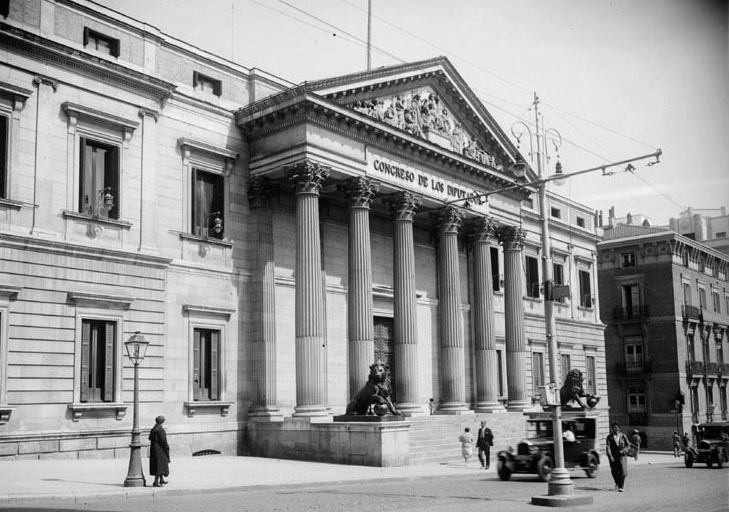
The Congress Palace opened to the public at ten in the morning. It was the first time that Rosenberg attended a session of the Cortes. Installed in an ambassador’s box with his full delegation — and at his side, Mijaíl Koltsov — the plenipotentiary representative of the USSR, in the dais of honor, observed the parliamentary session with a certain sense of disappointment.
The first thing that surprised, compared with the Soviet Duma, was how small the chamber on the Carrera de San Jerónimo seemed. Almost five hundred seats, half of them empty — between deputies shot by the fascists or the authorities, and others on the right in exile or in Burgos — formed a crescent of rows in tiered seating facing the presidential table.
On one side of the speakers’ tribune lay the blue Government bench from which Largo Caballero now turned toward the Soviet dais. In a well-lit table at the foot of the tribune were the stenographers. Above them, figures from historical paintings, allegories of political virtues, watched, but there were also journalists occupying the press gallery, small and with an ante-room, and visitors who followed the session from the public benches, both of which were now crowded.
Curiously, that same day in Burgos a gala day was inaugurated with draperies on the balconies to greet the rebel generals who, arriving by car at the Palacio de la Capitanía General, were cheered with enthusiasm by Burgalese crowds with the same faith in victory as the extraordinary audience strolling through Madrid along the corridors of the Congress and under the great vault of the Hall of the Lost Steps: militiamen and militiamen women, officers who had never before visited Parliament.
Some deputies came in uniform and attended the morning session, before returning to the front. As for the press cronists, none took their eyes off the ambassador Rosenberg, who remained stern, with his small mustache and his unmistakable white jacket, in the dais of honor.
At last, below, before a scant hundred deputies, Largo Caballero took the floor. Once the usher had offered him the usual orange soda, the president explained that his Government was as legitimate as any of the previous ones and that he deemed — to the Russians’ surprise — the entry of the CNT into it vital.
—If the Confederation controls the ministerial work, the victory will be for Spain as a whole. Afterwards, the proletariat will have as a reward a new political and social structure that will turn the first article of the Constitution into a reality: Spain will be a republic of workers of all classes.
There was a certain defiant tone in his voice, and the speech was greeted with a chants of “Long live Russia” and applause for the ambassador. Many heads turned toward Rosenberg, whose smile did not hide his concern about what such a challenge signified for the communists. But even more significant was the intervention of José Antonio Aguirre, the head of the PNV, the only right-wing party present.
—What was Christ born for in this world, gentlemen? —exclaimed Aguirre— Did He come to help the powerful or to lift up the humble? We have it clear. We are with the humble, with the people, because we come from them. We were born for the people and we fight for them. Until we defeat fascism, Basque nationalism will remain steadfast in its position!
There were ovations and Aguirre grew emotional. Today at last the Autonomy Statute of Euskadi was voted, the first official recognition of their nation.
—Long live Basque autonomy!
Shouted Dolores Ibárruri when Diego Martínez Barrio, as president, closed the historic session by recalling that the Republican Cortes would reconvene in early December.
All the entries of 1936 Day by Day
Interview with José Ángel Mañas about 1936 Day by Day