
“When you name me, I disappear.” In a manner akin to the old Castilian riddle, if I want to talk about him, I have to break him. How curious this verb is! Why do we say break the silence instead of any softer expression, such as cut, stop, interrupt…? That verb, break, suggests a certain violence and presupposes, whether we like it or not, an act of force, as if we were destroying something. Complementarily, we tend to refer to silence as a burden, a barrier, or something endowed with gravity. It might seem at first glance that silence, like emptiness, is something light, perhaps tenuous, but our language betrays us and we talk about the weight of silence as if describing oppression. Perhaps that is why we use the term break.
But, are we really breaking the silence right now, me with my writing and you, reader, with the reading of this text? Yes and no, at the same time. No, because I am not speaking, I am not producing sound and you, reader, are following the course of my argument without moving your lips. But yes in the sense that I am not staying silent and, therefore, I do not meet the strict requirement of absolute silence. The word breaks the silence. Even if it is a written word and not spoken. We take this for granted in everyday life: for example, we say quite naturally that a prisoner has broken his silence when he makes a written confession or when simply signing a declaration.
It might seem that I linger on futile digressions, but anyone who has given a moment’s thought to silence knows that one of its fundamental traits, perhaps the first that leaps to our consideration, is its paradoxical nature. Beginning, of course, because it is impossible to speak of it without violating it (as language betrays us!). One cannot talk about silence without betraying it. All of us who write about silence and, of course, those who ponder it the most, are its greatest or most persistent traitors, even if we do not shout, even if we do not make noise. Strictly speaking, silence would only admit silence and perhaps even that could not be expressed.
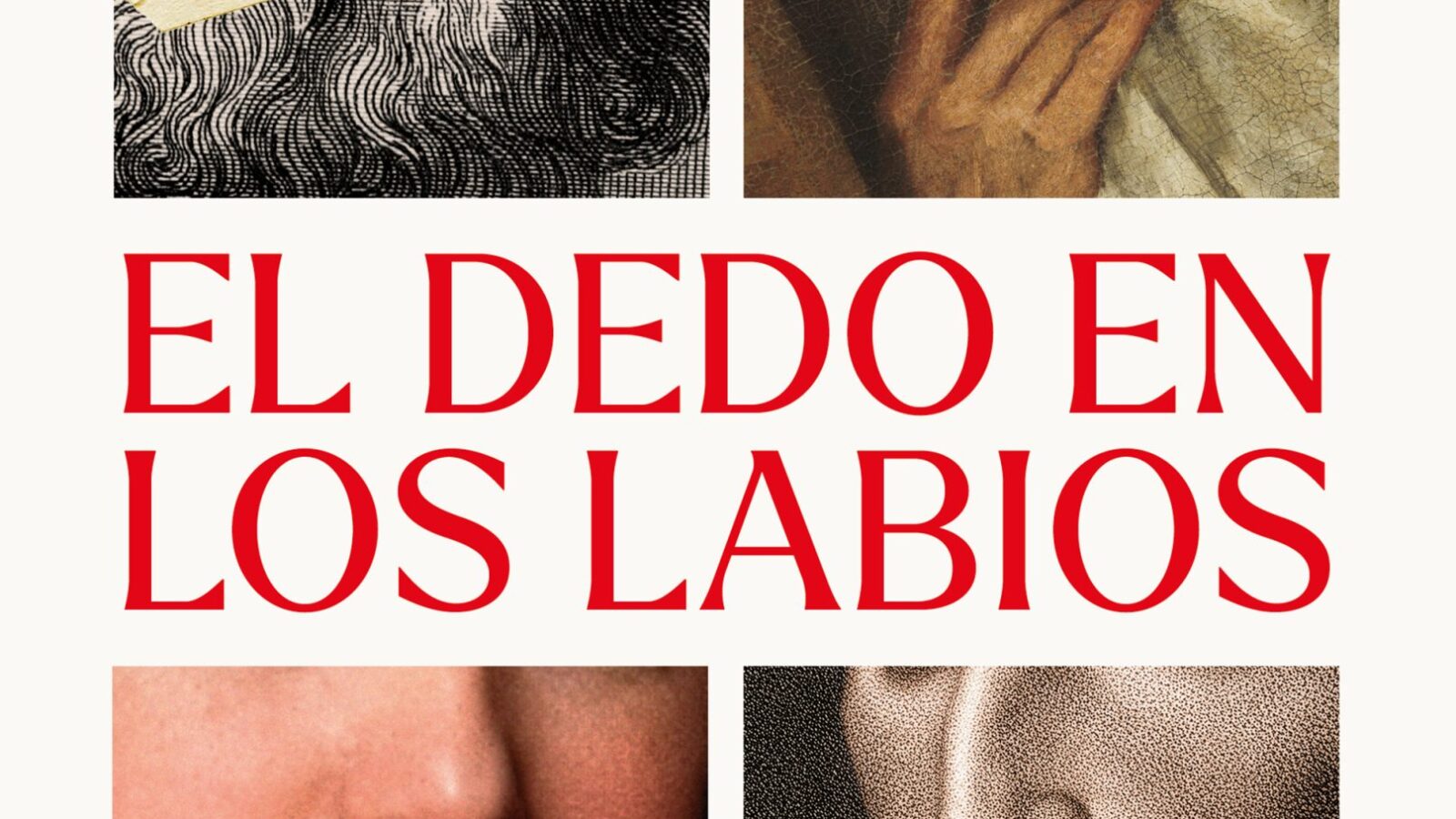
As with any other student of silence, Lola Pons has had no choice but to accept these contradictions as a starting point. Her book is titled The Finger on the Lips and, therefore, to fulfill the purpose most clearly revealed by the subtitle, The Silence in the History of the Spanish Language, she has decisively chosen, with all its consequences, to take as reference and cognitive frame the opposite situation in order to analyze the subject at hand. The same cover illustrations make this clear: silence is better understood as refraining from speaking —to be silent— and there is no better symbol for approaching this reality than sealed lips, whichever the case may be. And if not, a decisive command: shhh, chhh, chisss, chitón. Or a gesture: the index finger placed transversely and imperatively beside the closed lips.
And immediately, a realization, which remains another paradox: much has been written about silence, much has been said about silence, to the point that it is difficult to bring something original or different to everything that concerns it. Lola Pons, a writer of recognized prestige, professor at the University of Seville, a researcher and communicator with a fruitful intellectual career and a long bibliographic output, knows this well. Treating silence in an accessible tone within a volume of a little over two hundred pages (not counting the annotated bibliography) is no easy task. For now, it is unavoidable to strictly delimit the topic so as not to drift into its religious, philosophical, anthropological, or artistic implications. And that is what the author has done.
From the very opening pages it is clear that her attractive essay is the work of a specialist in Spanish culture, or more precisely, in Hispanic literature. It could go further, and it would not be a trivial matter, noting that her main interest lies in language, its uses, etymologies, loans and derivatives, or in the varying meanings of words depending on context. In that flow, silence enters as negation but also as a continuity that develops through other means. Because sometimes silence is more eloquent than words themselves. It says more by saying nothing. For that reason it says a lot. But, that said, one must know how to use it. And there are masters of silence, as there are masters of proverbs or of popular speech.
We often speak of wordplay, as if words themselves played. The reality is that we become mental prisoners of a game we do not control. When silence is introduced as a wildcard in our discourse and in our life, we think we master it, but more often it gives the impression that it masters us, or at least enjoys an autonomy that escapes us. This is so because silence possesses a gravity or density or transcendence that often imposes itself on us with a force greater than any discourse. Not for nothing do the most solemn and elevated ceremonies demand silence. Absolute silence. Who dares to break it then?
I fall silent, then. Others fall silent too. We all fall silent. We keep quiet. Another happy expression! Do we keep quiet? Where do we keep it? And if only the valuable things are kept, then perhaps, deep down, we all agree that since man is by definition a talkative animal, in the end our true treasure is silence. Indeed, a large part of the human actions we deem most valuable require silence: introspection, concentration, relaxation, contemplation… The vast majority of human creative activities can only be done in silence: imagining, inventing, writing, composing, meditating…
But let us not delude ourselves by embellishing or sweetening silence. For silence also has a less accommodating side. As we have said: silence imposes. Let us take another step: silence is frightening. Children of a very young age know this well. There is nothing that terrifies them more than a silent presence or situation. And not only children feel that reverential fear of silence. The powerful also know how to manage their silence to instill reverential fear around them. Ultimately, let us acknowledge it: silence is also the breath of death. Death arrives in silence. And even when initially it is not so, it spreads like a mantle: the deathly silence, we often say.
These light reflections have been sparked by the pleasant reading of Lola Pons’s text. Some of them, or similar ones, can be found by the reader in the book itself. Thus, both the author and I, who have continued with her up to this point, have preferred to exchange our reservoir of silence, our treasure, for this nuanced assessment that can only be made with its antithesis, namely words. But at least I—though I suppose the same holds for her—take comfort in thinking that, at heart, the contradiction, or incongruity if you like, was worth it. In human terms there can be no absolutes: to love silence is also to betray it. If it could speak, surely it would forgive me (us).
—————————————
Author: Lola Pons. Title: The Finger on the Lips. The Silence in the History of the Spanish Language. Publisher: Taurus. Sales: All Your Books.