
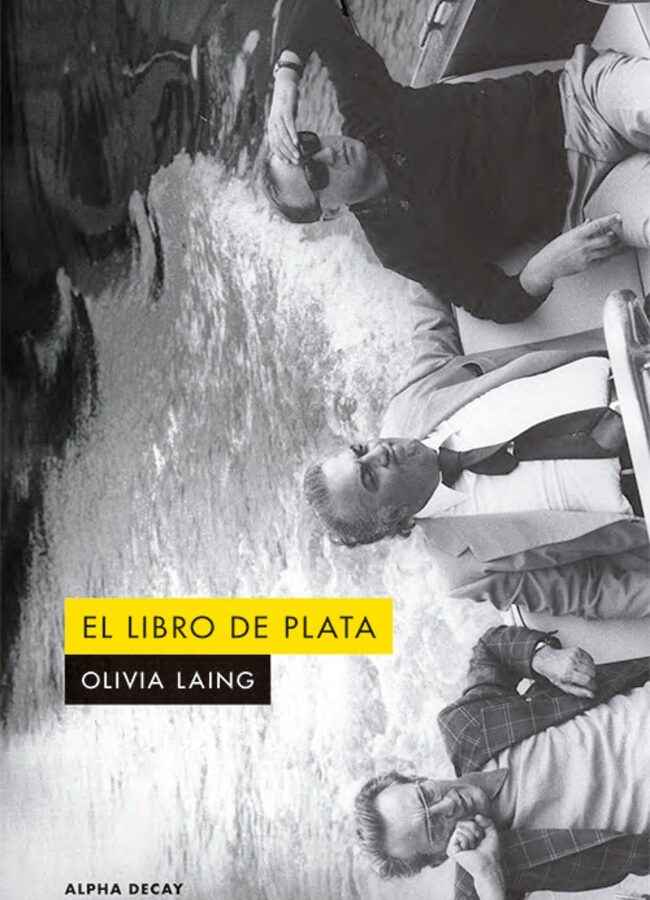
September 1974. A young Londoner meets in Venice Danilo Donati, the legendary costume designer and production designer who brought to life the visions of Federico Fellini and Pier Paolo Pasolini. Together they move to the mythical Cinecittà studios.
On Zenda we offer the opening pages of The Book of Silver (Alpha Decay), by Olivia Laing.
***
It’s true that there are ten thousand people here. He doesn’t part from Dani, but from the moment they pass under the Cinecittà sign, Danilo becomes a shared possession. And his owner, of course, is the studio. He seems to know everyone by name and obviously everyone knows him. People keep approaching him, taking his hand or hugging him, murmuring puzzling remarks that could be compliments or expressions of understanding. Of course he’s a popular figure; of course everyone adores him. It’s not as though he imagined he had discovered him. But Nicholas can’t help feeling small, diminished, a dog with its tail between its legs.
Nor does it help that he doesn’t really understand what is happening here. Dani has started to fill him in on the tram, the latest in a string of frustrated attempts, and has grown exasperated seeing that it was a task impossible to accomplish. Cinecittà is a whole universe. It is a world the same way Rome is a world. You’ll do well here, Nico. You learn fast.
The film studios make him think of Hollywood. Marilyn Monroe and two clowns on roller skates, or a bear on a motorcycle. The farce. There are clowns, astronauts, nuns here as well, but everyone presents as serious, professional, straightforward. That doesn’t mean there aren’t pratfalls, but they’re the same you would find in a building under construction or in a school. Okay, he says to him, elbowing him in the ribs. Are you still awake? Do you want to see mine?
At this stage of production, he explains, they still don’t have actors. The nuns were taken from another shoot. Federico has been to London for casting. Deciding may take months of increasingly frenetic doubts. He has an almost pathological need to see every face on earth before choosing one in particular. He sits at his desk, surrounded by photographs, and may God save the soul of anyone who shows up there with the idea that they will audition. The best the applicant can do is come in and tell him about the problems they’ve had on the train. Or with the wife! Anyway, don’t worry about that. As for me, I am two people. The other Danilo is running his sewing workshop in Rome. We won’t be meeting him today. Today is Dani the one who builds shooting sets. Today is the big day. Today we will begin turning those drawings of ours into things. As long as they please him. Let’s go see Federico.
He hadn’t expected that he would get to meet Fellini, and certainly not today. He had pictured him as someone inaccessible, a master of ceremonies who doesn’t show himself before the show. But now they are climbing Studio 5’s stairs, someone knocks, they enter. The man seated at the desk wears the same elegance as Danilo, white shirt and black tie. He could be the director of a funeral-pomp company. He has a gigantic, leonine head, and it’s clear his hair has been raked by claws. Blessed eyes, you’re back, aren’t you? Back to this movie corpse of mine. He springs to his feet, embraces Danilo, crushes him against him, pushes him aside to appraise him from head to toe, and plants a kiss on each cheek. The prodigal son, he says. And he has acquired a friend, how charming. An English Botticelli. Nicholas is pushed forward, introduced. He can’t quite believe what is happening. He opens his mouth, but the river of words has already surged past, so fast, so expressive, that he can’t keep up with what’s being said. Danilo’s head is bowed and his shoulders are squared. He looks like a bull. He leaves the drawing folder on the table.
For Nicholas, the favorite moment in cinema’s entire history is when Marcello Mastroianni goes down to the beach at the end of La Dolce Vita, in a white suit and a black shirt, almost like the demon, and finds the carcass of a monstrous fish that the waves have mysteriously left on the sand. He has masturbated more than once to the memory of that dissolving face. The scene transcends the story, the realism. It is pure image, suspended, on the verge of falling.
He understands that he is expected to blend in, so he sits up very straight and lets his gaze wander discreetly around the office. It is almost empty, a white cube perched atop the vast Studio 5. This is the machine where Fellini focuses the lens, his device for reviewing faces. There are portraits scattered on the desk, also pinned to a felt board behind his head. What unites those faces that attract him is that they are, in a way, faces unaware of themselves, that do not feel the presence of any outside gaze. There are no actor’s faces here. They are faces from the street, from the countryside, faces that radiate mischief or malice. Innocent faces, sinister faces, teethy faces, or faces pocked by acne. Tacked among those faces are dreadful marker-drawn caricatures of women with giant bosoms and men inexorably crushed by the weight of penises as large as palm trees. It is almost unbelievable that the great director is this teenager who bounces in his chair, pointing with his finger at something that has escaped Danilo. He realizes that Nicholas is watching him and then he winks at him.
They stay there for an hour, always standing. Dani accompanies him for every drawing, and although there are many objections, it doesn’t seem that he rejects anything outright. It is past one o’clock when they go out. Feed your boy, says Fellini. He is wafer-thin. For a moment he feels as if he is being swallowed by the arco voltaico of Fellini’s attention. I like your drawings, kid, he tells him in English. Then he reaches out, gives him a smack on the butt. Nicholas notices with horror that his face has flushed. He looks up, meeting a pair of smiling dark eyes, and he hears the door slam behind him. The sensation reminds him a little of having an X-ray. You didn’t say he was gay, he whispers. He isn’t. Well, it’s a long story. In short, he is determined that people will love him. Yes, even you. He has an obsession with seduction. Oh, God, Nico. I’m tired. Still, it’s good that he liked the drawings. Do you want a coffee? We can have it in the studio.
[…]
—————————————
Author: Olivia Laing. Title: The Book of Silver. Translation: Albert Fuentes. Publisher: Alpha Decay. Available at: All Your Books.